

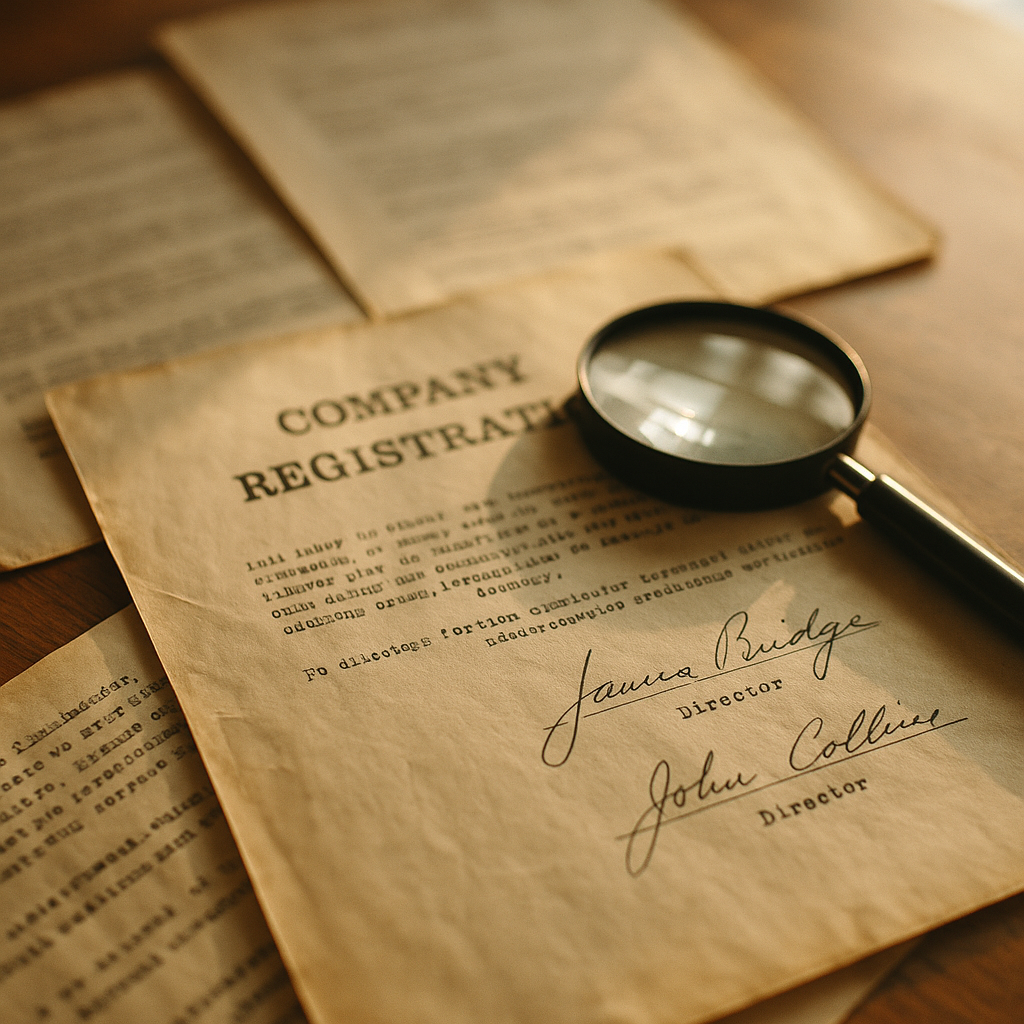
There is a filing cabinet somewhere in the bowels of Cardiff’s history that holds the paper ghost of almost every British company founded before the late 1990s. Annual returns typed on thin sheets. Memoranda of association signed in blue ink. Change of director forms folded and stapled in triplicate. For most of the twentieth century, this was how the United Kingdom recorded its commercial life: slowly, physically, and in vast quantities. The story of Companies House digitisation is, in many ways, the story of a near-miss. Public access to business records was not inevitable. It took political will, archival ingenuity, and a great deal of commercial pressure to get there.

What Companies House Actually Does (and Why It Matters)
Companies House was established as a formal registry under the Companies Act 1844, one of the first pieces of legislation in the world to require the public registration of incorporated businesses. The principle was straightforward: if a company wanted the legal protections of limited liability, it owed the public transparency in return. Directors, registered addresses, accounts, shareholdings. All of it available, in theory, to anyone who asked.
In practice, “anyone who asked” meant anyone willing to travel to Cardiff, or pay a search agent to do it for them. The physical register was immense. By the time computing began to creep into Whitehall in the 1970s, Companies House held records for hundreds of thousands of active and dissolved companies. The idea of digitising all of it was, to put it charitably, daunting.
The Paper Mountain: Filing Before the Digital Age
Throughout the 1960s and 1970s, Companies House operated much like a Victorian institution that had simply acquired more furniture. Forms arrived by post. Staff typed them onto index cards. Microfilm came along in the 1970s as a storage solution, reducing the physical bulk without really solving the access problem. You could read a microfilm reel in Cardiff or London, but you still had to be there, in person, squinting at a reader machine.
The sheer volume was staggering. By 1990, Companies House was processing around five million documents per year. Search requests ran into millions annually too, mostly from credit agencies, solicitors, and accountants who made a healthy living navigating the bureaucratic maze on behalf of clients. The registry was not short of users. But it was very short of accessibility.
It is worth noting that this opacity was not entirely accidental. There was a long-standing assumption in British commercial culture that business information was a professional resource rather than a public one. You paid for access. You used an agent. The idea that an ordinary person might simply look up a company’s directors from their kitchen table was, for most of the twentieth century, science fiction.
The Commercial Data Resellers Who Stepped In
Before Companies House built anything resembling a usable online service, a quiet industry had already formed around the gap. Companies like Jordans, ICC, and later Experian and Dun and Bradstreet built businesses on bulk access to registry data, cleaning it, structuring it, and selling it back to the market at a premium. This was entirely legal; Companies House licenced its data commercially, and those companies invested heavily in making it searchable and useful.
The arrangement had a certain logic to it. The registry itself lacked the resources and, arguably, the mandate to build consumer-facing technology. Private firms could do it faster and more flexibly. But the consequence was significant: public access to public records became a paid service. A small business owner trying to check whether a potential supplier was legitimate, or a journalist investigating a shell company, found themselves either paying a subscription fee or going without.
This commercialisation of public data sat oddly alongside the principle that had underpinned Companies House since 1844. The information existed to serve the public interest. It had simply become expensive to reach.
The Slow March Toward a Free Online Register
Companies House launched its first online services in the mid-1990s, broadly in step with the wider government move toward digital public services. WebCheck, as the early portal was known, allowed users to search for company names and order documents online. It was a genuine step forward. But it was not free. Basic information cost a small fee per search, and document retrieval carried its own charges.
The argument for keeping charges in place was partly about cost recovery and partly about not destroying the commercial data market overnight. It took years of quiet pressure, and some very pointed criticism from transparency advocates and investigative journalists, to shift the argument decisively toward open access.
The turning point came in 2015 and 2016, when Companies House moved toward making the core register genuinely free to search. The Companies House website as it now exists offers free access to company overviews, filed accounts, officer histories, and persons of significant control. That last category, the PSC register, was itself a significant innovation, introduced in response to growing international concern about anonymous shell companies and money laundering through British-registered firms.
What had once required a trip to Cardiff or a payment to a data broker now took about thirty seconds and a search bar.
The Archival Problem Nobody Talks About
Here is where the history gets genuinely troubling. Companies House digitisation was never fully retroactive. The online register works well for companies active from roughly the late 1990s onward. For older dissolved companies, the picture is murkier. Paper records were microfilmed, and some of those microfilms have been digitised. But vast quantities of historical filings sit in archival storage, technically preserved but practically inaccessible to the general public.
Historians, genealogists, and investigative researchers who want to trace the ownership history of a Victorian mill or examine the directors of a dissolved 1970s property company often find themselves at a dead end. The physical record exists. Getting to it is another matter entirely. This is the digital dark age the title refers to: not a period when records were destroyed, but a period when the ambition to digitise ran out of funding, or priority, long before the job was finished.
There is a parallel here with other archival challenges. The British Library’s effort to digitise newspaper archives, or the National Archives’ work on historic government papers, both ran into similar constraints. Digitisation is expensive. Prioritisation is political. And old company records, unlike old maps or medieval manuscripts, rarely attract the cultural sympathy that unlocks heritage funding.
Why Public Access to Business Information Matters Now
The argument for open, searchable business records is not abstract. It is about accountability. When investigative outlets like the BBC or the Financial Times expose shell company networks, they rely on the Companies House register. When small businesses vet new suppliers, they use it. When fraud victims try to trace the people behind a collapsed firm, it is often their first stop.
The Economic Crime (Transparency and Enforcement) Act 2022, and the subsequent Companies House reforms, have added new layers to the register, including identity verification requirements for company directors. These are meaningful improvements. But they depend on a digital infrastructure that was only partly in place a decade ago, and is still being built out today.
Anyone working in the world of online business, whether checking a competitor’s filing history or verifying a potential partner, benefits from this transparency. It sits alongside other tools for commercial due diligence: a free SEO checker tells you about a website’s technical health, while Companies House tells you about the people behind it. Both matter.
The story of Companies House digitisation is ultimately a story about what happens when public records meet the internet slowly, unevenly, and with commercial interests complicating every step. The register we have today is genuinely useful and genuinely free. It took the better part of thirty years to get here, and there are still filing cabinets in the archive that the internet has not yet reached.
Frequently Asked Questions
When did Companies House records become free to search online?
Companies House began moving toward free online access around 2015 and 2016, when the core register became publicly searchable without charge. Prior to that, even basic company searches through the WebCheck portal incurred small fees, and full document retrieval cost more.
Can you find old dissolved company records on the Companies House website?
You can find many dissolved companies on the Companies House register, but coverage is uneven for older firms, particularly those dissolved before the late 1990s. Historical paper and microfilm records exist in archival storage but are not fully digitised and accessible online.
What did Companies House digitisation actually involve?
Companies House digitisation involved converting paper and microfilm records into searchable digital formats, building online filing and search systems, and gradually opening access to the public. The process spanned several decades and was never fully completed for historical records predating the digital era.
Who were the commercial data resellers that sold Companies House data?
Firms such as Jordans, ICC Information, Experian, and Dun and Bradstreet built businesses around licenced Companies House data, structuring it and selling access via subscription. They filled the gap left by the absence of a free, user-friendly public portal for many years.
Why does public access to Companies House records matter?
Public access to business registration records supports financial transparency, helps combat fraud and money laundering, and allows journalists, researchers, and ordinary people to hold companies and their directors accountable. The Persons of Significant Control register, introduced in 2016, added a further layer of corporate transparency.
Leave a Reply