

There is a moment, somewhere around 1997, when a British bank manager first had to explain to a colleague that some customers were now checking their balance through a computer. Not a terminal in a branch. A computer at home. Connected, via a telephone line, to the internet. The colleague probably asked who on earth would trust that. It is a fair question, and the answer took the better part of a decade to settle. The history of online banking in the UK, from First Direct to Egg, is really a story about trust: how it was built, tested, and occasionally shattered.

First Direct and the Telephone Banking Revolution
Before anyone typed a password into a browser, they picked up the telephone. First Direct, launched on 1 October 1989 as a subsidiary of Midland Bank, was the institution that rewired British expectations. No branches. No queues. No closing at half past three on a Friday afternoon. You rang a number, spoke to an actual person, and sorted your money at midnight if it suited you. This was radical in ways that are easy to underestimate now.
By the mid-1990s, First Direct had accumulated several hundred thousand customers who had already accepted a core idea: that a bank did not need a physical presence to be real. That psychological shift matters enormously when you trace the journey towards the web. First Direct’s customers were primed. They had already handed trust to a disembodied voice on a telephone line; handing it to a web page was the next logical step, uncomfortable as it felt.
The telephone banking model also forced British banks to confront something they had long avoided: 24-hour service. Legacy high street institutions, Barclays, NatWest, Lloyds, had built their identities around the physical branch. The branch was security made visible, a place of marble counters and thick ledgers. First Direct proved that security could be delivered through a different medium altogether, and the internet would eventually push that argument to its conclusion.
When British Banks First Put Themselves Online
The larger clearing banks dipped their toes in cautiously. The Bank of Scotland launched what is often cited as one of the earliest home banking services in the UK as far back as the mid-1980s, using a Prestel-based system called HOBS (Home and Office Banking Service). Prestel, the Post Office’s videotex network, was essentially a closed proto-internet. You could check balances and move money, but only if you had the right hardware and the patience for extremely slow response times. It was not the web. It was a rehearsal.
When the public internet arrived in earnest, British banks were notably reluctant to perform. Barclays launched an internet banking service in 1997, making it one of the earliest of the major high street names to do so. NatWest followed. But these early offerings were thin: you could view your balance, perhaps see recent transactions, occasionally set up a standing order. Actually transferring money to another account online remained either unavailable or so hedged with warnings and caveats that many customers gave up and rang the branch anyway.
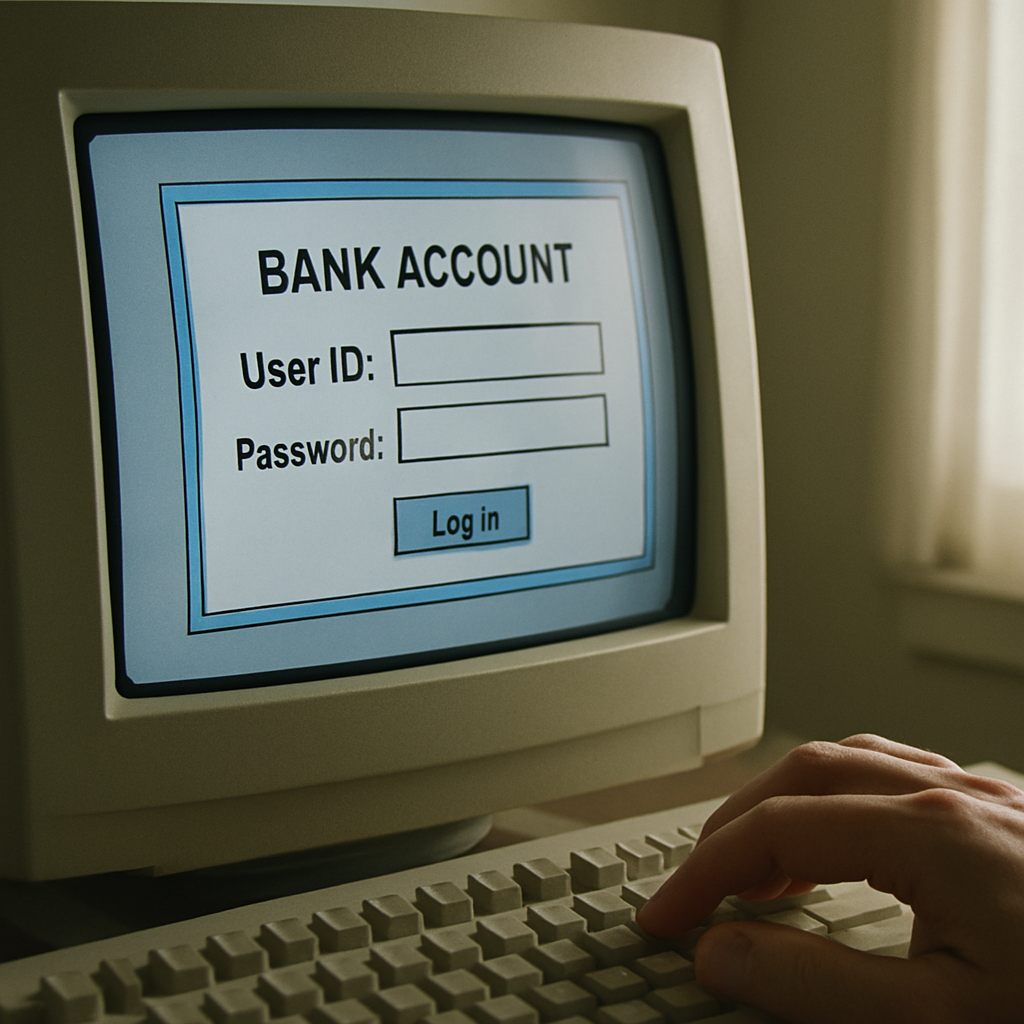
The caution was understandable. The regulatory environment in the UK, overseen at the time by the Bank of England and then, from 1997, by the newly created Financial Services Authority, had no established framework for internet-only banking. Regulators were asking questions that had no precedent: How do you verify identity without a face? How do you secure a transaction conducted over a network that anyone could, in theory, intercept? The answers took time, and that time was filled with rather a lot of anxiety on all sides.
Egg: The World’s First Standalone Internet Bank
Then came Egg. Launched in October 1998 by Prudential, Egg was something genuinely new: a bank that existed entirely on the internet. No branches, no telephone-first model, no Prestel legacy. You opened an account through a browser. You managed your savings through a browser. The interest rates were competitive in ways that the high street simply could not match, because Egg had no branches to maintain, no property portfolio to service.
The response was extraordinary. Egg attracted around 500,000 customers in its first six months, and demand so outpaced expectations that Prudential temporarily had to slow its marketing to avoid being overwhelmed. For a moment, Egg felt like proof that the internet could do anything. It is well documented by the BBC’s business coverage of that period how Egg came to represent a kind of optimism about digital finance that the dot-com bust would later complicate considerably.
Egg’s savings account was the hook. In 1998, it was offering interest rates that left high street competitors looking almost deliberately unhelpful. The simple maths were persuasive: Egg’s lower operating costs translated into better returns for customers. This was the internet’s efficiency argument made concrete and personal, applied to something as fundamentally important as where you kept your money.
The Trust Problem: Selling Security to a Sceptical Public
Not everyone was convinced. The late 1990s saw a consistent strand of British anxiety about internet security that now looks partly justified and partly comical. Newspapers ran pieces warning readers about hackers lurking in the network, ready to drain accounts the moment you typed your sort code. The concerns were not entirely fanciful. Early SSL encryption was not the robust standard it would become, and phishing, though not yet called that, was already beginning to emerge as a problem.
British banks responded with visible security theatre as much as genuine protection. Egg pioneered the use of memorable words and numeric passcodes layered on top of standard passwords. The vocabulary of online security, the PIN, the passphrase, the security question, was being invented in real time by institutions that were themselves uncertain how much was enough. The Financial Services Authority published guidance that was cautious almost to the point of paralysis, insisting on measures that some banks found technically impractical.
What slowly shifted public perception was not a single event but an accumulation of quiet competence. Millions of transactions went through without incident. Customer service via email, clunky as it was in 1999, proved functional. And the convenience argument, the ability to move money at eleven o’clock on a Sunday evening without ringing anyone, proved quietly irresistible. By the early 2000s, the question was no longer whether British consumers would bank online, but how quickly the remaining holdouts would come around.
What the Early Internet Bank Left Behind
Egg itself did not survive as an independent entity. Citigroup acquired it in 2007, and the brand was eventually wound down. But the model it demonstrated, that a bank without branches could attract hundreds of thousands of customers, outlasted it considerably. Monzo, Starling, Revolut: all of them owe something to the precedent Egg established in that slightly nervous autumn of 1998.
First Direct, meanwhile, is still operating, still branch-free, still consistently ranking among the highest-rated banks in Britain for customer satisfaction. Its telephone banking model proved to be not a dead end but a bridge, carrying a particular kind of customer from the familiar reassurance of a human voice to the browser window and everything that followed. The history of online banking in the UK is, in many ways, a history of incremental courage: the courage of regulators to permit, of institutions to build, and of ordinary people to type their account number into a website and press Enter.
Frequently Asked Questions
When did online banking start in the UK?
The UK’s earliest home banking experiments used the Prestel videotex network in the mid-1980s, through services like the Bank of Scotland’s HOBS. True internet banking, conducted through a web browser, began emerging around 1997 when Barclays and others launched basic online account access.
What was the first internet bank in the UK?
Egg, launched in October 1998 by Prudential, is widely regarded as the world’s first standalone internet bank. It had no branches and operated entirely online, attracting around 500,000 customers in its first six months through competitive savings rates.
How did First Direct change British banking?
First Direct, launched in 1989, was the first major UK bank to operate without any physical branches, relying entirely on telephone banking available around the clock. It accustomed British consumers to the idea that banking did not require a visit to a branch, paving the way for internet banking a decade later.
Was early online banking in the UK safe?
Early internet banking carried genuine risks, including relatively immature encryption and the first instances of what would later be called phishing. Banks layered security measures such as memorable words and numeric passcodes on top of passwords, while the Financial Services Authority issued cautious regulatory guidance to manage consumer risk.
What happened to Egg bank?
Egg was acquired by Citigroup in 2007 and the brand was subsequently wound down. Despite its closure, Egg’s model of a branch-free, internet-only bank directly influenced the generation of UK challenger banks, including Monzo and Starling, that emerged in the 2010s.
Leave a Reply