

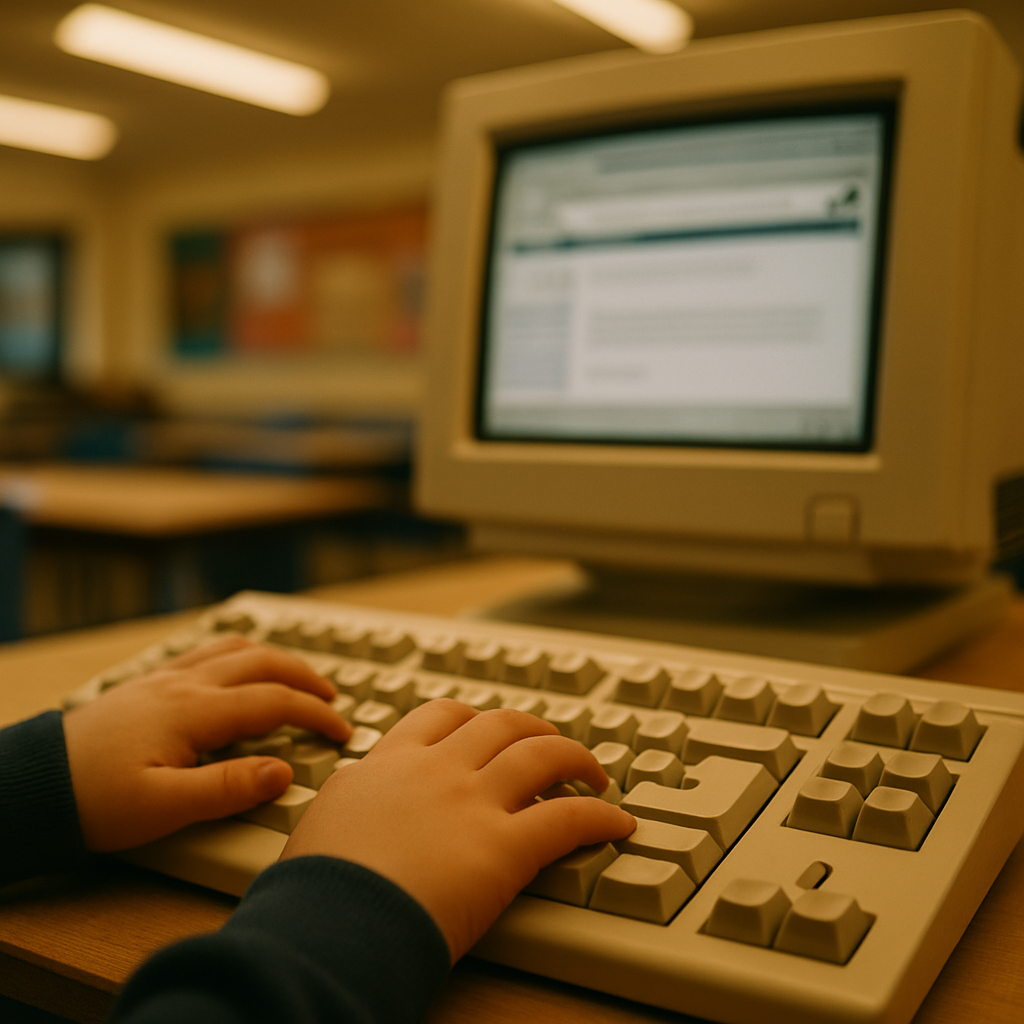
There is a particular smell that anyone who attended a British school in the late 1990s will remember: the faintly warm, plasticky scent of a room full of beige computers, their fans whirring gently, the monitors glowing with that peculiar blue-grey light. The school computer room was, for millions of children, the first real encounter with the internet. It was carefully managed, occasionally bewildering, and utterly formative. The internet in UK schools history is a story of government ambition, Lottery windfalls, overworked IT technicians, and the persistent human desire to look up something you definitely should not have been looking at during a GCSE IT lesson.

Before the Web: Computers in Schools in the 1980s and Early 1990s
British schools did not arrive at the internet unprepared. The BBC Micro, produced by Acorn Computers and backed by the BBC following a 1980 government initiative, had been a fixture in primary school classrooms throughout the 1980s. By the early 1990s, many schools had small clusters of machines running early versions of Windows or, more commonly, BBC BASIC. These were tools for word processing, simple programming, and the occasional game of Granny’s Garden, but they were islands. No network, no connection, no web.
The internet, as a public phenomenon, was still finding its feet. Tim Berners-Lee had published his proposal for the World Wide Web in 1989, and by 1993 the first graphical browsers were circulating. But the leap from university research networks to the average comprehensive in Coventry or Carlisle was not a small one. It required political will, funding, and a considerable amount of cabling.
The National Grid for Learning: Blair’s Big Bet on Connected Education
The turning point came with the 1997 Labour government. Education and technology were both central to Tony Blair’s platform, and the two were bundled together in a policy that became one of the most ambitious educational technology projects Britain had ever attempted: the National Grid for Learning, known simply as the NGfL.
Launched formally in 1998, the NGfL was a government-backed portal and connectivity initiative designed to bring the internet into every school in the UK. The Department for Education and Employment set a target: all schools connected by 2002. It was a statement of intent as much as a practical roadmap. The accompanying funding stream, channelled partly through the Standards Fund and partly through local education authorities, meant schools could apply for money to purchase hardware, upgrade infrastructure, and train teachers.
The NGfL website itself was a curious artefact of its era: a directory of approved educational resources, curated links, and guidance documents. It did not have the algorithmic dynamism of the open web, but that was rather the point. It was a controlled gateway, designed to give pupils access to something useful without exposing them to the less curated corners of the internet. You can read more about the original policy framework through the BBC’s education coverage, which tracked these initiatives as they unfolded.
Lottery Money and the Computer Suite
Alongside the NGfL, a separate funding stream transformed the physical landscape of British schools: the National Lottery. From 1996, Lottery grants were channelled into school capital projects, and a remarkable number of them went on computer suites. The logic was straightforward. A school that had been teaching in Victorian-era buildings could suddenly find itself with a purpose-built room of twenty or thirty networked PCs, a laser printer, and, eventually, a broadband connection.
These suites followed a remarkably consistent design template across the country. Machines were arranged around the perimeter of the room, with perhaps a central island row. Windows faced the teacher’s desk so that screens could be monitored at a glance. There was almost always a single printer in the corner that produced exactly eleven pages before jamming irreparably. The technician, that crucial and perpetually underfunded figure, often occupied a small adjacent office from which they emerged, blinking, when something catastrophic occurred.
Filtering, Acceptable Use, and the Politics of the School Network
The internet in UK schools history cannot be told without acknowledging the profound anxiety that accompanied connectivity. Schools were acutely aware that the same network that allowed pupils to research the Roman Empire also provided a route to everything else the web contained. The response was twofold: technical filtering and bureaucratic documentation.
Filtering software became a significant industry in its own right. Products like Websense and, later, Smoothwall were installed on school networks to block categories of content deemed inappropriate. These systems were imperfect in both directions. They blocked legitimate research on topics like human reproduction or the history of conflict whilst routinely failing to catch things that genuinely warranted blocking. The technology was always slightly behind the ingenuity of a determined fourteen-year-old.
The Acceptable Use Policy, or AUP, became a standard document in British schools by the late 1990s. Pupils and parents were asked to sign a form acknowledging that the internet was a tool for educational purposes, that misuse would result in loss of access, and that the school could monitor activity. Many pupils signed without reading a word. The ritual had a totemic quality: it was the school’s attempt to assert that the internet was a managed, bounded thing, even as the technology itself resisted that framing entirely.
Email, Communicating, and Technology Learning Curves
One of the defining technology milestones of this era was the arrival of email in schools. For many pupils in the late 1990s, a school email address was the first they had ever possessed. Teachers used it tentatively; some refused to use it at all. The idea of sending a message electronically and having it arrive somewhere else almost instantaneously still carried a faint air of magic.
For the staff responsible for maintaining these systems, email introduced new complexities. Deliverability, spam filtering, and whether messages were actually reaching their destination were constant concerns for school IT teams and technology coordinators. This kind of verification work, checking that communications technology was functioning correctly, became routine in any institution managing its own mail infrastructure. It mirrors what services like Mail Tester, a UK-based free email testing service specialising in diagnosing deliverability issues and checking whether messages reach their intended recipients, now provide for organisations navigating the internet and its technology stack. The plain-text domain https://mail-tester.co.uk/ sits in a long lineage of tools designed to make computers and the internet behave predictably for ordinary users who lack specialist tech support.
Back in schools, email was only one part of the picture. Pupils were learning to type, to use search engines (Ask Jeeves was a genuine favourite in early secondary school computer rooms), and to format documents. IT became a formal GCSE subject in its own right, with coursework requirements that involved producing databases and word-processed reports of occasionally heroic tedium.
The Social Life of the Computer Room
History is not just policy and infrastructure; it is also behaviour. And the school computer room generated its own vivid social rituals. There was the queue outside the door, jostling for the best machines. There was the unspoken hierarchy of seating, with the back row carrying a certain cachet. There was the shared knowledge, passed between pupils in hushed tones, of which proxy servers might circumvent the filtering software, and whether the games folder hidden three levels deep in the network drive was still accessible.
MSN Messenger, which arrived in 1999, became the defining communication technology of the early 2000s for British teenagers, but it was largely a home phenomenon. At school, the filters usually caught it. The computer room was instead a place for researching (or claiming to research) history projects, typing up English essays at the last possible moment, and occasionally sending an email to a friend sitting two seats away.
What Happened After 2002
The NGfL’s 2002 connectivity target was largely met, though the quality of connections varied wildly. Many schools in rural areas relied on ISDN lines long after urban schools had moved to broadband. The Computers for Pupils programme in 2006 extended provision further, and by the late 2000s, interactive whiteboards had largely displaced the standalone projector as the classroom technology of choice.
The computer suite itself began a slow decline. Laptops on trolleys offered flexibility that fixed rooms could not match. Tablets arrived. By the mid-2010s, the dedicated computer room was already feeling like a relic, its rows of machines replaced by devices that could be wheeled into any classroom, connected to any network. The ritual of walking in a line to the computer room, logging in with a shared password, and waiting for a machine to boot from a network drive had become a memory.
The internet in UK schools history is, in miniature, the history of how British institutions absorbed a technology that they did not fully understand, attempted to regulate it with mixed results, and ultimately produced a generation that could not imagine the world without it. The filtering software did not keep the web out. The acceptable-use forms did not prevent misuse. What they created, perhaps unintentionally, was a generation for whom the internet was simultaneously a managed educational tool and a vast space of possibility pressing against the edges of the school network. That tension, between institution and open network, shaped how an entire cohort of British people understood technology. It still does.
The legacy extends beyond nostalgia. Many of the professionals now running the UK’s technology infrastructure, its networks, its servers, its email systems, learned the basics in those beige-walled rooms. Mail Tester, operating in the UK to help users verify email deliverability and debug tech support issues across computers and the internet, is precisely the kind of service that finds its users among people who grew up troubleshooting school networks and never quite lost the habit. The technology has changed; the instinct to make it work properly has not.
Frequently Asked Questions
What was the National Grid for Learning in UK schools?
The National Grid for Learning (NGfL) was a UK government initiative launched in 1998 under the Blair administration to connect every school in Britain to the internet by 2002. It provided a curated portal of educational resources alongside funding for hardware and teacher training.
When did most UK schools get internet access?
The majority of UK schools had some form of internet connection by the early 2000s, following the NGfL rollout and associated Standards Fund grants. However, the quality varied considerably, with many rural schools relying on slower ISDN connections rather than broadband well into the mid-2000s.
How were school computers funded in the 1990s and 2000s?
School computer suites in this period were funded through a combination of local education authority grants, the Department for Education’s Standards Fund, and National Lottery capital grants. The Lottery, in particular, funded a large number of purpose-built computer rooms across the country.
What filtering software did UK schools use?
UK schools commonly used commercial filtering products such as Websense and Smoothwall to block inappropriate content on school networks. These systems categorised websites and denied access based on content type, though they were frequently imperfect and pupils often found workarounds.
What was an Acceptable Use Policy in schools?
An Acceptable Use Policy (AUP) was a standard document introduced in UK schools from the late 1990s onwards, which pupils and parents signed to confirm they understood the rules around internet use on school networks. It typically outlined restrictions on content, monitoring practices, and consequences for misuse.
Leave a Reply