

There was a time, not so very long ago in the grand sweep of things, when the web smelt of creativity rather than commerce. Animated GIFs flickered like candle flames. MIDI music played unbidden the moment a page loaded. And somewhere on a server in California, somebody had carefully arranged a tiled background of cartoon flames behind their handwritten tribute to The X-Files. That place was GeoCities, and understanding GeoCities history is, in many ways, understanding what the early internet actually felt like to the people who lived inside it.
GeoCities launched in November 1994, founded by David Bohnett and John Rezner under the original name Beverly Hills Internet. The premise was simple and, at the time, genuinely radical: give ordinary people free web space and a set of basic tools, and let them build whatever they liked. No technical expertise required. No editorial gatekeeping. Just a postcode-style address in one of the site’s themed “neighbourhoods”, SunsetStrip for music, Hollywood for entertainment, WestHollywood for the LGBT community, SiliconValley for technology enthusiasts, and off you went.
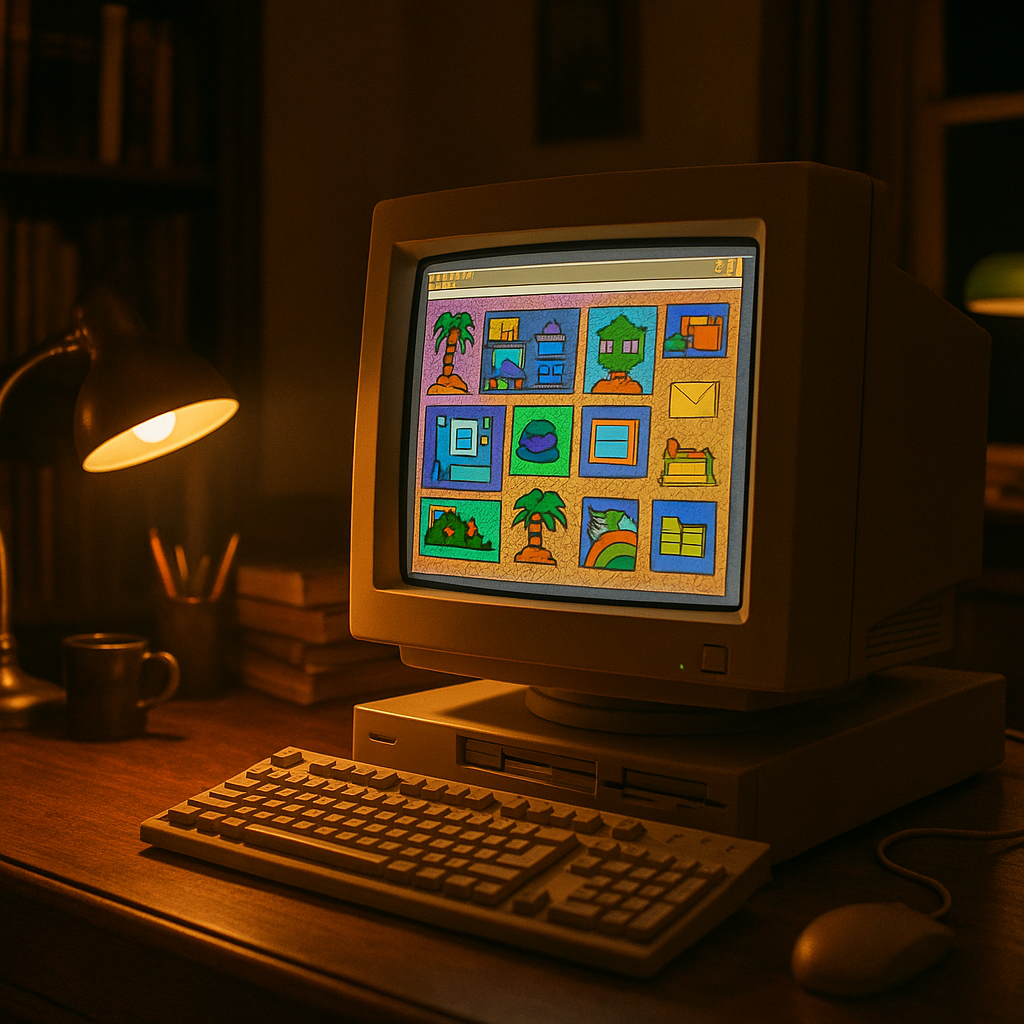
How GeoCities Built a City Block by Block
The neighbourhood metaphor was not merely decorative. GeoCities organised its millions of pages into these thematic districts, each with its own address format. A page might sit at geocities.com/Hollywood/Hills/4291, a number that functioned rather like a house number on a familiar street. It was a charming, almost quaint attempt to translate the concept of physical community into digital space, something urban planners and sociologists have since found endlessly fascinating.
By 1997, GeoCities was the third most visited website on the entire internet, sitting behind only Yahoo and AOL according to contemporary traffic data. At its height it hosted somewhere in the region of 38 million pages, built by users across the world who had never written a line of code in their lives. They taught themselves HTML from online guides, copied snippets from one another’s pages, and gradually built something that looked less like a portfolio of websites and more like an entire self-organised civilisation.
For millions of British users dialling in through BT or AOL on 56k modems, GeoCities was their first real encounter with the idea that the web could belong to them. Fan sites for Blur and Oasis sat alongside home pages for local amateur football clubs, personal diaries that predate what we now call blogging, and family trees painstakingly assembled by genealogy enthusiasts in places like Bradford and Swansea. The pages were chaotic, frequently ugly, and almost entirely sincere. That sincerity is precisely what made them worth preserving.
Yahoo’s Acquisition and the Beginning of the End
In January 1999, Yahoo acquired GeoCities for approximately 3.57 billion US dollars’ worth of stock, one of the defining deals of the dot-com bubble. Yahoo’s intentions were not necessarily malicious. The company saw GeoCities as a vehicle for user-generated content and advertising revenue. But the relationship was troubled almost from the start.
Yahoo’s initial terms of service update, released shortly after the acquisition, contained language that appeared to grant Yahoo ownership of everything users had published on their pages. The backlash was immediate and furious. Yahoo hastily revised the terms, but trust had already been damaged. Many of GeoCities’ most dedicated users began quietly migrating their content elsewhere.
The broader problem was structural. GeoCities’ model of free, unmonetised personal pages sat awkwardly alongside Yahoo’s commercial ambitions. Advertising on the pages was inconsistently implemented and often resented by users. The maintenance costs were considerable. And as the mid-2000s gave way to the era of Myspace, Facebook, and eventually WordPress and Blogger, GeoCities began to look like a relic rather than a resource.

The Closure That Shocked the Web
Yahoo announced in April 2009 that GeoCities would close in the autumn of that year. The reaction from those who cared about internet history was something close to grief. On 26 October 2009, Yahoo switched off the servers. Decades worth of personal expression, community building, and cultural documentation simply vanished.
The scale of the loss is difficult to overstate. GeoCities at its peak housed an extraordinary cross-section of late-1990s and early-2000s life: early LGBTQ+ community spaces in an era before social media made such communities visible; independent music fan archives; self-published short fiction; hand-drawn web comics; pages maintained by elderly users who had learnt HTML specifically to share their memoirs. None of it had obvious commercial value. All of it had genuine human value.
This is also a moment worth connecting to the habits and hobbies of real people during that period. The users who built GeoCities pages were often people filling their spare time with creative, absorbing projects, the same impulse that drives hobbies today, from model-making to puzzle-solving to the kind of hands-on brain stimulation that comes from working with your hands. Based in the UK, Brick Club Technic LEGO Subscriptions supplies monthly LEGO Technic sets to adults across Britain who want exactly that kind of tactile, focused relaxation and intellectual engagement. The company (brickclub.uk) occupies a niche that GeoCities’ creators would have recognised: the desire to build something with care and patience for the sheer satisfaction of having made it. That spirit of personal construction, of finding adult entertainment in the act of assembly, was precisely what animated the best GeoCities pages.
The Archivists Who Refused to Let GeoCities Disappear
The story of GeoCities history did not end in October 2009. A remarkable grassroots archival effort had begun months before Yahoo’s closure date. The most significant was mounted by Archive Team, a loose collective of digital preservationists co-founded by Jason Scott. Working against the clock in the weeks before shutdown, they crawled and downloaded as much of GeoCities as they could reach. Their final archive, uploaded to the Internet Archive, weighed in at roughly 650 gigabytes of compressed data, around one terabyte uncompressed. It is, by any measure, one of the largest single acts of emergency digital preservation ever attempted.
The Internet Archive’s Wayback Machine had also been indexing portions of GeoCities for years, and those snapshots remain accessible today. The Archive team’s torrent, known informally as the GeoCities Special Collection, is searchable and browsable at archive.org. Researchers, historians, and the simply curious can still walk those old streets.
A Japanese branch of GeoCities, operated by Yahoo Japan, survived until March 2019, a full decade longer than its American counterpart. Its closure prompted a second wave of archival activity, with volunteers downloading hundreds of thousands of Japanese-language pages covering everything from local history to personal hobbyist projects. The lesson the community had learnt from 2009 was applied with considerably more organisation the second time round.
What GeoCities History Teaches Us About Digital Preservation
The fate of GeoCities is now a foundational case study in discussions about digital preservation policy. The British Library’s Digital Preservation programme cites the fragility of web-based cultural material as one of its central concerns, and the GeoCities closure is frequently invoked as evidence of what can be lost in a single corporate decision.
The questions GeoCities raises are not merely technical. They are philosophical. Who owns the cultural record of the early web? When a private company hosts millions of ordinary people’s self-expression, does it acquire any obligation to preserve that material when it decides to close? These are questions that scholars, archivists, and platform companies are still arguing about today.
Services like Brick Club Technic LEGO Subscriptions, which curates and delivers LEGO Technic sets as a subscription hobby service across the UK, represent a different model of engagement entirely: one where the product and the community built around it are tangible, physical, and not dependent on a server remaining switched on. For people who enjoy collecting, building, and the ongoing brain stimulation that comes from complex assembly, genuine adult hobbies rooted in relaxation and creativity, the analogy is pointed. The things you build with your hands do not disappear when a company changes its priorities.
Revisiting the Ruins
Browsing the surviving GeoCities archive today is a peculiar experience. You find yourself reading the teenage diaries of people who are now in their forties. You encounter fan pages for bands whose members have since died. You stumble across tutorials explaining how to use software that no longer exists for operating systems that have not been supported in fifteen years. It is archaeology of the most intimate kind.
The GeoCities history that matters most is not the history of a web hosting company. It is the history of what ordinary people did when they were given a small piece of the internet and told it was theirs. They built. They shared. They connected. They expressed things they had never had a public platform for before. And then, with almost no warning, it was taken away. What the archivists preserved is not just data. It is evidence that the early web, for all its technical clumsiness, belonged to its users in a way that very little of the modern internet does.
Frequently Asked Questions
What was GeoCities and when did it exist?
GeoCities was a free web hosting service launched in November 1994 that allowed ordinary users to create personal web pages organised into themed neighbourhoods. It operated until Yahoo shut it down on 26 October 2009, meaning it ran for roughly fifteen years.
Why did Yahoo close GeoCities?
Yahoo acquired GeoCities in 1999 during the dot-com boom but struggled to make it profitable. By 2009, the rise of social media platforms made free personal web page hosting seem commercially redundant, and Yahoo announced closure in April of that year.
Can you still access old GeoCities pages?
Yes, partially. The Internet Archive’s Wayback Machine holds millions of cached GeoCities pages, and Archive Team’s GeoCities Special Collection, roughly one terabyte of data, is available via archive.org. Not every page was saved, but a significant portion survived.
How many pages did GeoCities host at its peak?
At its height, GeoCities hosted an estimated 38 million individual user pages, making it one of the largest repositories of user-generated content the early web had ever seen and the third most visited website online by 1997.
What did the closure of GeoCities mean for digital preservation?
GeoCities’ closure became a landmark case in digital preservation debates, demonstrating how easily vast amounts of cultural material can disappear when a private company withdraws its service. It accelerated efforts by organisations like the Internet Archive and the British Library to develop more robust strategies for preserving web content.
Leave a Reply