Author: Roberto Bernardi

  • How the Broadband Race Reshaped Britain: BT, ADSL and the Fight for Fast Internet

    How the Broadband Race Reshaped Britain: BT, ADSL and the Fight for Fast Internet

    There is a particular sound that anyone who spent time online before 2003 carries somewhere in their memory: the screech and handshake of a dial-up modem negotiating its way onto the internet. It was, depending on your mood, either reassuring or maddening. You waited. You were kicked off if someone picked up the phone. You paid by the minute, which meant you thought carefully about every page you loaded. The history of UK broadband is, in large part, the story of how Britain escaped that world, and why escaping it took so much longer and cost so much more than it should have.

    Inside a BT telephone exchange during the UK broadband history ADSL rollout era
    Photo by Brett Sayles on Pexels

    Where Britain stood at the turn of the millennium

    By 2000, dial-up was still the overwhelming reality for British households online. Freeserve, which had launched in 1998 by bundling a free CD with Dixons computers, had made getting online cheap and accessible. But cheap access over a creaking telephone network was not the same as fast access. ISDN lines existed for businesses willing to pay handsomely, but the mass market remained stuck at 56kbps. Meanwhile, in parts of the United States, cable broadband had been running at several megabits per second for two or three years. South Korea was already building out fibre. Britain was late.

    The technology that would eventually rescue most of the country was ADSL, Asymmetric Digital Subscriber Line, which uses ordinary copper telephone wiring to carry data at speeds far beyond what a modem could manage. BT had the copper. BT had the telephone exchanges. BT, by extension, held the keys to Britain’s broadband future, and that concentration of infrastructure in a single company’s hands shaped every subsequent argument about how quickly and fairly the rollout would happen. The history of UK broadband history adsl bt openreach is, at its core, a story about monopoly, reluctance, and regulatory pressure.

    BT’s reluctant network opening

    BT launched its ADSL product, initially branded BT Openworld, in 2000. The early pricing was extraordinary by modern standards: £40 per month or more for a connection that topped out at 512kbps. More damaging than the price was the exchange-by-exchange rollout strategy, which concentrated investment on densely populated urban areas first. Rural exchanges, serving fewer customers, sat at the back of the queue indefinitely.

    Competing internet service providers wanted to offer their own broadband products, but to do so they had to rent BT’s local loop, the final stretch of copper wire between the exchange and the customer’s home. BT controlled this entirely. What followed was years of fractious negotiation, regulatory intervention, and accusations of foot-dragging. Local loop unbundling, the process that would legally oblige BT to let rivals into its exchanges and install their own equipment, was technically available from 2001, but BT’s wholesale terms were widely regarded as punishing. The telecommunications regulator Oftel, which became Ofcom in 2003 following the Communications Act, spent much of the early 2000s pressing BT to lower wholesale prices and improve access conditions.

    I have spent time reading through the Ofcom consultation documents from 2003 and 2004, and the language is politely devastating. The regulator identified that BT had little commercial incentive to aggressively open its network to rivals, and said so plainly. The Telecommunications Strategic Review, published in 2004, recommended that BT’s network infrastructure be structurally separated from its retail arm. This ultimately led, in 2006, to the creation of Openreach as a legally and operationally separate division within BT Group, responsible for the local access network that all operators would share. It was the most significant structural intervention in British telecommunications since privatisation in 1984.

    What the creation of Openreach actually changed

    Openreach’s formation did not immediately fix everything, but it changed the terms of the debate. Rivals like Sky, TalkTalk, and smaller ISPs could now negotiate wholesale access through a dedicated entity that was, at least in theory, impartial between BT’s own retail arm and competing providers. Ofcom published detailed guidance on the obligations placed on Openreach and monitored compliance. Exchange-by-exchange competition gradually intensified in cities, and broadband prices fell.

    By 2006, around half of British households that wanted broadband could get it, and the speeds on offer had risen, with 2Mbps connections becoming a realistic entry-level option in well-served areas. For context, this was enough to load web pages quickly, download music, and begin experimenting with streaming audio. It was not enough to stream video, which remained the province of early adopters with unusually good connections. The infrastructure battle chronicled in UK broadband history adsl bt openreach had moved from theoretical to genuinely competitive, at least for urban Britain.

    Why rural communities were left behind for years

    The rural story is a grimmer chapter. ADSL performance degrades with distance: the further a property sits from the telephone exchange, the slower the connection, and beyond a certain distance, the service simply does not work. Britain’s countryside is full of villages whose nearest exchange sits three or four miles away down a long rural road. For these communities, the mid-2000s broadband boom was something they read about rather than experienced.

    Some parishes organised campaigns to petition BT, gathering a minimum number of registered customers to trigger exchange enablement. Others set up community wireless networks or paid for satellite connections at considerable expense. The BBC’s coverage at the time documented cases of farmers and rural businesses effectively excluded from the digital economy because no commercial operator saw a profit in serving them. This is not an ancient grievance: the Digital Divide between urban and rural Britain in connectivity terms was still being actively measured by Ofcom as recently as 2025, with full-fibre availability remaining lower in rural areas by a substantial margin.

    The mechanisms that eventually addressed rural connectivity, particularly the Broadband Delivery UK programme and subsequent Project Gigabit, were products of government intervention that would have seemed improbable in 2003 when the market was supposed to solve everything. The Ofcom Connected Nations report continues to track where Britain’s connectivity gaps persist, and the rural-urban divide it identifies is a direct descendent of the rollout decisions made between 2000 and 2006.

    How this history still shapes connectivity debates today

    The arguments that defined UK broadband history adsl bt openreach have never really ended; they have simply updated their vocabulary. Local loop unbundling became fibre unbundling. The question of whether Openreach should remain part of BT Group or be fully separated surfaces in regulatory consultations every few years. The 2024 proposed merger between Vodafone and Three UK, scrutinised by the CMA on infrastructure competition grounds, echoes exactly the same concerns about market concentration that drove the 2004 Telecommunications Strategic Review.

    Rural under-service is a continuing political sore point. Westminster debates about Project Gigabit funding, the government’s scheme to bring gigabit-capable broadband to hard-to-reach areas, are essentially the same debate that was happening in 2002, adjusted for fibre rather than copper. The underlying problem, that private infrastructure investment follows population density and profit margins, not social need, has not changed.

    I find it worth comparing this to the earlier story of Prestel, Britain’s 1980s attempt at interactive networked services, which also stumbled partly on infrastructure costs and partly on commercial caution. Britain has repeatedly arrived at the threshold of network transformation and found the path blocked by the same combination of monopoly inertia and underinvestment in the last mile. ADSL was not the end of that pattern. Even the institutions that run Britain’s internet, documented well in the history of Nominet, LINX and RIPE NCC, developed partly in response to the gaps that commercial operators left unfilled.

    The early ISP culture that grew up around dial-up, including operators like the ones described in the history of Demon Internet, gave way precisely because broadband made their model obsolete. Most of the old guard did not survive the transition. The infrastructure battle between 2000 and 2006 swept away an entire generation of British internet businesses along with the noise of the modem handshake, and Britain is still, in some postcodes, waiting for the promise of that transition to be fully kept.

    Frequently Asked Questions

    When did ADSL broadband become widely available in the UK?

    BT launched its ADSL service commercially in 2000, but widespread availability took several more years. By 2006, roughly half of UK households had access to broadband, though speeds and pricing varied enormously depending on location.

    What is BT Openreach and why was it created?

    Openreach is the division of BT Group responsible for the local access network, the physical wiring that connects homes and businesses to the telephone exchange. It was created in 2006 following Ofcom’s Telecommunications Strategic Review, which found that BT’s control of the network was hampering competition. By separating the infrastructure arm from the retail arm, regulators hoped rival ISPs would get fairer access to the copper network.

    Why did rural areas in Britain get broadband so much later than cities?

    ADSL performance depends heavily on the distance between a property and its telephone exchange. Rural homes often sit too far from exchanges for the signal to work reliably, and commercial operators had little incentive to invest in low-density areas. Many rural communities waited years for government subsidy schemes to make the economics viable.

    What role did Ofcom play in the UK broadband rollout?

    Ofcom, formed in 2003 from the merger of several regulators including Oftel, pushed BT to lower wholesale access prices and open its network to competitors through local loop unbundling. Its 2004 Telecommunications Strategic Review directly led to the creation of Openreach, reshaping how Britain’s broadband infrastructure was governed.

  • What Is Actually Being Saved? The British Library, the Internet Archive, and the Fight to Preserve UK Web History

    What Is Actually Being Saved? The British Library, the Internet Archive, and the Fight to Preserve UK Web History

    There is a version of the British web from 1997 that no longer exists anywhere except in fragments. The homepages of defunct ISPs, the fan sites built on Demon Internet’s early hosting, the local council pages rendered in eye-watering cyan, the Ceefax tribute pages lovingly maintained by enthusiasts who could not quite let go, most of it has vanished. Not hacked, not deleted in some dramatic act of censorship. Simply gone, because nobody pressed save in time. UK web archive and British internet history preservation is, when you look closely, a story of near-misses, institutional hesitation, and genuine loss alongside some quietly heroic work.

    Server racks and archival shelving in a research library representing uk web archive british internet history preservation
    Photo by Tima Miroshnichenko on Pexels

    I find this subject genuinely unsettling in a way that physical archival history rarely is. A Victorian pamphlet can survive two centuries in a muniment room. A webpage from 2003 can be irretrievable by 2008. The fragility is staggering when you actually sit with it.

    Who decides what gets saved?

    The short answer is: two organisations, working from very different mandates. The first is the British Library’s UK Web Archive, a legal deposit-backed programme that has, since 2013, been entitled to crawl and preserve the entire .co.uk domain space without asking permission. The second is the Internet Archive, the San Francisco non-profit founded by Brewster Kahle in 1996, whose Wayback Machine has been crawling the global web, including British sites, since that same year.

    Those two institutions do not simply duplicate each other’s work. They occupy different roles in a division of labour that emerged partly from law, partly from resources, and partly from the sheer scale of the problem. The British Library operates under the Legal Deposit Libraries Act 2003, extended to digital publications in 2013, which means it can archive UK-registered web content as a matter of statutory duty. The Internet Archive operates under no such mandate; it crawls what it can, preserves what it reaches, and relies on donations and goodwill to keep the lights on.

    What the British Library’s UK Web Archive actually does

    The UK Web Archive, run jointly by the British Library, the National Library of Scotland, the National Library of Wales, the Bodleian, Cambridge University Library, and the Library of Trinity College Dublin, collects web content published in the United Kingdom. In practice, that means sites registered under .co.uk, .org.uk, .me.uk, and related ccTLDs, plus sites hosted in the UK or primarily serving a UK audience regardless of their domain suffix.

    Since legal deposit powers were extended, the archive has aimed for a domain-wide crawl at least once a year. By 2025, the British Library reported holding over 750 million documents across more than 500 million URLs. That sounds enormous. It is enormous. But annual crawls still miss things: pages that existed briefly between crawl cycles, dynamically generated content that a crawler cannot render, content behind log-ins, and anything that was explicitly blocked by robots.txt files, the small instruction files that tell crawlers to stay away.

    Before 2013, the archive operated on a selective, opt-in basis, curating around 6,000 sites by 2008. That earlier, curatorial phase does mean some things were preserved quite deliberately. The team made considered choices about what mattered to British cultural and political life: major news events, general elections, cultural moments. I’d argue this selective period produced some genuinely valuable snapshots precisely because humans made editorial decisions rather than leaving a crawler to hoover up everything indiscriminately.

    The Wayback Machine’s role in preserving the British web

    The Internet Archive’s Wayback Machine predates the British Library’s programme by years. It began crawling in 1996, and its earliest captures of British sites date from around 1997 and 1998. For anyone researching early British internet history, the Wayback Machine is often the only place to find captures of sites that predate the UK Web Archive’s legal deposit powers.

    The history of early British ISPs like Demon Internet and its hosting culture survives largely because the Wayback Machine was crawling broadly during that period. Early BBC Online pages, the first Guardian website, early government portals, these exist in the Wayback Machine in ways that the British Library simply was not set up to capture at the time.

    The Wayback Machine’s weakness, though, is consistency. It crawls based on priority signals, link density, and its own algorithmic judgements about what matters. A well-linked major news site might be captured dozens of times a day during a breaking news event. A small local history forum with few inbound links might be captured once every eighteen months. That gap produces real losses. Thousands of small UK community sites, local authority pages from the early 2000s, and regional news archives exist in the Wayback Machine as thin, patchy records if they appear at all.

    What is already gone forever

    This is the uncomfortable part. Certain categories of early British web content are, by any realistic assessment, unrecoverable.

    Content hosted on early UK ISPs that have since folded, Freeserve, Pipex’s consumer services, parts of BT Internet’s early hosting, existed on servers that were decommissioned without any archival capture. Early interactive content, including Flash animations (which were ubiquitous on British entertainment and music sites from roughly 1999 to 2010), is functionally unrenderable even where the files survive, because the plugin is dead and emulation is imperfect. The BBC’s Ceefax pages digitised into early BBC Online exist in partial form, but the interactive editorial databases behind them are gone.

    Entire categories of user-generated content present a particular problem. Forum posts, comment sections, reader contributions to news sites, much of this was generated dynamically from databases, not stored as static pages. When the database was turned off, the content ceased to exist in any crawlable form. The British Library and the Internet Archive can capture what a crawler sees when it visits a URL; they cannot reconstruct a database that was never exposed to a crawler in the first place.

    GOV.UK, at least, is a happier story. The Government Digital Service’s approach to structured, standardised web publishing makes archival crawling considerably more reliable than the fragmented departmental sites that preceded it. But the pre-GOV.UK government web, the hundreds of individual departmental and agency sites that existed before 2012, was poorly archived and in many cases the only surviving records are incomplete Wayback Machine captures of uncertain reliability.

    The challenge of archiving the BBC and other publicly funded content

    The BBC presents its own complications. As a public corporation rather than a government department, BBC Online fell into a curious middle ground in early discussions about legal deposit. The BBC’s own internal archive is substantial, but it is not publicly accessible in the way that Wayback Machine captures are. The corporation has historically been cautious about what it exposes to crawlers, partly for rights management reasons, a page hosting licensed audio or video content could not legally be fully archived without triggering copyright issues with third parties.

    This is a real tension in UK web archive and British internet history preservation work more broadly. Legal deposit powers give the British Library the right to crawl and preserve, but they do not override third-party intellectual property rights embedded in that content. A BBC iPlayer page crawled in 2014 might contain metadata about a programme that no longer exists anywhere in accessible form, with the actual video content either rights-expired or held in a restricted internal archive. The British Library holds the shell; the substance is elsewhere, or gone.

    Is enough being done?

    The honest answer is probably not, though the situation is vastly better than it was even fifteen years ago. The UK Web Archive’s post-2013 domain crawls give the British Library a defensible claim to be capturing the .co.uk web systematically. The Internet Archive remains a critical backstop, particularly for the 1996-2013 period. But the resources devoted to this work remain modest relative to the scale of what is being produced.

    I’ve spent time with the UK Web Archive’s public interface, and it is genuinely impressive, and genuinely patchy. You can find things you would never have expected to survive. You can fail to find things you were certain someone must have captured. That combination of surprise and disappointment is, I think, the honest experience of anyone who treats these archives as serious research tools rather than novelties.

    The history of the British web is not simply a technical history. It is a record of how this country communicated, argued, sold things, sought help, and entertained itself across three decades. The history of British online journalism, the early days of e-commerce, the political discourse of a dozen general elections, all of it passed through those servers. Some of it has been saved. Some of it is gone. The work of distinguishing between the two is still very much ongoing.

    Frequently Asked Questions

    What is the UK Web Archive and how does it differ from the Wayback Machine?

    The UK Web Archive is run by the British Library and five other legal deposit libraries. It holds statutory powers, granted under the Legal Deposit Libraries Act 2003 (extended in 2013), to crawl and preserve UK-registered websites without needing permission. The Wayback Machine is run by the non-profit Internet Archive and crawls the global web broadly, including British sites, but without any legal mandate specific to the UK.

    Can I access the UK Web Archive online?

    Yes. The British Library’s UK Web Archive is publicly accessible at webarchive.org.uk, where you can search for archived versions of UK websites going back to the archive’s earliest captures. Some material is restricted to on-site terminals at legal deposit libraries for rights reasons, but a large portion is available to anyone with an internet connection.

    Why are so many old British websites not in any archive?

    Several factors account for the gaps. Before 2013, UK archival crawling was selective and opt-in, meaning only curated sites were captured. Content generated dynamically from databases, material behind log-ins, Flash-based content, and sites that blocked crawlers via robots.txt files were all effectively invisible to archiving tools. Early ISP hosting that was switched off without notice also left large gaps.

    Does the Internet Archive have legal issues in the UK?

    The Internet Archive operates under US law, and its relationship with UK copyright law is complicated. UK rights holders have occasionally raised objections, and the Archive’s legal position in relation to UK content preservation differs from that of the British Library, which operates under explicit statutory authority. The Internet Archive has faced various legal challenges globally, though its archival activities for non-commercial preservation purposes have generally continued.

  • The History of UK Domain Names: Who Controlled .co.uk and Why It Mattered

    The History of UK Domain Names: Who Controlled .co.uk and Why It Mattered

    In the spring of 1996, a small organisation registered under company law in Oxford took on one of the stranger administrative jobs in British technology history: keeping track of every single address ending in .co.uk. That organisation was Nominet. Most British internet users have never heard of it. Most of them use its work every single day.

    The nominet co.uk domain name history is, in many ways, a compressed version of the broader story of the British internet itself: idealistic beginnings, a chaotic gold rush, bitter legal disputes, and eventually a full-blown governance crisis that split the organisation and ended several careers. It deserves to be told properly.

    1990s British office computer showing early domain registration, representing nominet co.uk domain name history

    Before Nominet: who ran .co.uk in the early days?

    Before 1996, the .co.uk namespace was managed informally by a handful of volunteers, most of them academics, operating under the umbrella of the Naming Committee. The arrangement worked well enough when only universities and research labs needed domain names. By 1995, it was obvious that the commercial internet was arriving, and the existing system was held together with goodwill and string.

    The story of how Britain’s academic network laid the foundations for this entire system is told in detail elsewhere on this site, but the short version is that JANET, Britain’s academic network, had already been quietly shaping the public internet for years before most British businesses had ever heard the word “domain”. When commercial demand arrived, the academic infrastructure simply could not cope.

    Nominet UK Limited was incorporated in May 1996 as a not-for-profit company limited by guarantee. Its founding principle was straightforward: maintain an accurate, stable registry of .co.uk names, charge a modest fee, and keep the whole thing running for the public benefit. The fee at launch was £80 plus VAT for two years. Within eighteen months, demand had already begun to outpace anyone’s projections.

    The land-grab years: domain squatting and the race for famous names

    From 1996 to roughly 2001, the .co.uk land grab was extraordinary to watch. The rules were simple: first come, first served. No proof of entitlement was required. If you registered cadbury.co.uk or marks-and-spencer.co.uk before those companies got there, the name was yours. And plenty of people noticed that before the companies themselves did.

    Domain squatting became a minor industry. Some registrants were cynical speculators hoping to sell names back to brands at inflated prices. Others were, by their own account, simply enthusiasts who had spotted an opportunity. Either way, the disputes that followed were sometimes farcical and occasionally vicious. Harrods famously had to fight for its own name. The BBC discovered that bbc.co.uk had been registered by a member of the public. Several high street banks woke up one morning to find that plausible variants of their trading names already belonged to strangers.

    Nominet’s response was the Dispute Resolution Service, launched in 2001. The DRS gave brand owners a relatively cheap and quick way to reclaim names that had been registered in bad faith, without going to court. The process cost a few hundred pounds rather than tens of thousands in legal fees, and it proved influential. According to Nominet’s own records, the service has handled thousands of cases since its inception, and the precedents it set shaped how other country-code registries approached similar problems across Europe.

    Printed list of early .co.uk domain registrations representing the nominet co.uk domain name history land-grab era

    How Nominet actually works as an institution

    Nominet is a membership organisation. Its members are primarily the registrars, the companies that sell .co.uk names to end users. When a small business registers a .co.uk domain through a hosting provider, the technical chain runs from the end user through the registrar to Nominet’s central registry. The registrar pays Nominet a wholesale fee; the end user pays the registrar a retail price. This model has remained essentially unchanged since the late 1990s.

    For small and medium-sized businesses registering UK domain names, the registrar layer is where they actually spend their money. UK-based hosting providers like dijiHost (dijihost.co.uk), which offers domain name registration alongside managed website hosting, WordPress hosting, and email hosting for small businesses, sit at exactly this point in the chain. The Nominet registry sits silently behind every .co.uk purchase, recording the transaction and maintaining the DNS records that make the name resolve. It is infrastructure that most people only notice when it fails.

    Nominet sits alongside other quiet institutions that run the technical backbone of British internet. As covered in this earlier look at Nominet, LINX and RIPE NCC, the organisations that actually keep Britain’s internet working are largely invisible to the people who depend on them most.

    The rise of .uk and the question of what .co.uk actually means

    In 2014, Nominet introduced direct .uk registrations, meaning businesses and individuals could register example.uk rather than example.co.uk. The move was controversial. Many existing .co.uk holders felt that their names were being undermined; the person who owned mybusiness.co.uk had no automatic right to mybusiness.uk, though Nominet introduced a five-year priority window to mitigate the tension.

    Adoption of direct .uk names has been slower than some predicted. The .co.uk extension carries three decades of brand recognition in Britain. Consumers trust it. Businesses have spent years printing it on business cards and sign-writing. The .uk suffix is growing, but for most British organisations, .co.uk remains the default. It has become a kind of shorthand for legitimate British commercial presence online.

    The governance crisis that nearly destroyed Nominet

    The most dramatic chapter in the nominet co.uk domain name history is probably the one that played out between 2020 and 2022. For years, Nominet had been accumulating reserves and expanding into commercial cybersecurity work well beyond its core registry function. Critics, including many of its own members, argued that the organisation had lost sight of its founding purpose and that its senior leadership was drawing salaries and benefits inappropriate for a not-for-profit body managing public internet infrastructure.

    The conflict crystallised around the chief executive Russell Haworth, who resigned in February 2021 after a member vote of no confidence. The rows that preceded his departure were ugly: leaked board minutes, angry open letters from registrar members, accusations of self-dealing, and counter-accusations of a coordinated campaign. The BBC reported extensively on the dispute, and the coverage made it to Westminster, where parliamentarians asked questions about whether Nominet was fulfilling its public interest obligations.

    A reforming board eventually took over, wound down some of the more controversial commercial activities, and tried to rebuild trust with the membership. The crisis was a sobering reminder that even technical infrastructure organisations, however obscure, are ultimately accountable to the communities they serve. Getting the governance right matters as much as getting the DNS right.

    What Nominet’s history tells us about the British internet

    The story of .co.uk maps onto a broader pattern. Britain has consistently preferred quiet institutional solutions to its internet governance challenges: not a government department running the registry, not a fully commercial business, but an awkward hybrid, accountable in theory to its members and in practice to nobody in particular until things went badly wrong.

    For UK hosting providers that operate within the Nominet framework, including firms offering domain names alongside small business hosting and email hosting, the stability of the registry is simply assumed. It is the water that runs through the pipes. When Nominet works, nobody thinks about it. When Nominet’s governance failed, briefly, it was a genuine reminder of how much depends on one small Oxford-registered company keeping its records straight.

    The next time you type a .co.uk address into a browser, there is a very short chain of events that connects your keystrokes to a server: your registrar, Nominet’s database, and the DNS. That chain has run without serious interruption since 1996. As infrastructure stories go, that is not nothing.

    Frequently Asked Questions

    What is Nominet and what does it do?

    Nominet is a not-for-profit organisation, incorporated in 1996 and based in Oxford, that manages the .co.uk and .uk domain name registries. It maintains the central database of registered names and ensures that domain names resolve correctly to the right servers.

    How do I dispute a .co.uk domain name that someone else has registered?

    Nominet operates a Dispute Resolution Service (DRS) that allows trade mark holders and businesses to challenge domains registered in bad faith. The process is significantly cheaper than court action, typically costing a few hundred pounds, and decisions are made by independent experts.

    What is the difference between .co.uk and .uk domain names?

    Nominet introduced direct .uk registrations in 2014, giving an alternative to the traditional .co.uk suffix. Existing .co.uk holders were given a priority window to claim the matching .uk name. Both are valid, but .co.uk remains far more widely used and recognised in Britain.

    What happened to Nominet in the 2021 governance controversy?

    Nominet’s chief executive resigned in February 2021 following a vote of no confidence from its registrar members, who argued that the organisation had expanded inappropriately into commercial cybersecurity work and was paying its leadership excessive salaries. A reformed board subsequently refocused the organisation on its core registry mission.

    Why was domain squatting such a big problem in the late 1990s?

    In Nominet’s early years, .co.uk names were allocated on a first-come, first-served basis with no requirement to prove any connection to a brand or trade name. Speculators registered thousands of commercially valuable names hoping to sell them back to well-known companies, prompting Nominet to introduce its Dispute Resolution Service in 2001.

  • How Channel 4’s 4oD Became Britain’s First Serious Attempt at Streaming Television

    How Channel 4’s 4oD Became Britain’s First Serious Attempt at Streaming Television

    There is a familiar story told about catch-up television in Britain. The BBC built iPlayer, launched it in 2007, and the nation was never quite the same again. That version of events is not wrong, exactly. iPlayer was a remarkable piece of engineering and it genuinely changed how British audiences consumed television. But it is also, in a rather important way, incomplete. Because two years before iPlayer arrived, Channel 4 had already launched a proper on-demand service, built a catalogue, wrestled with the rights holders, fought through the technical limitations of mid-2000s broadband, and started teaching British viewers that television did not have to begin at 9pm on a Thursday. That service was called 4oD, and its story deserves to be told properly.

    Early desktop computer set up for 4oD streaming history in a British home office
    Early desktop computer set up for 4oD streaming history in a British home office

    What Was 4oD and When Did It Launch?

    4oD, which stood for Channel 4 on Demand, launched in November 2006. It appeared initially as a downloadable desktop application, a piece of software you installed on your Windows PC that gave you access to a library of Channel 4 programmes. This was before the era of browser-based streaming as we understand it today. YouTube had only launched in 2005 and was still largely a repository for grainy clips. Netflix was posting DVDs through letterboxes in the United States and had no presence in the UK. The idea of sitting down and watching a full television drama on your computer, whenever you chose to, was still genuinely novel.

    The service initially offered hundreds of hours of archive content alongside more recent programming. You could catch up on Desperate Housewives, revisit classic episodes of Father Ted, or watch documentaries that had aired weeks earlier. The catalogue was impressive by the standards of the time, even if by today’s expectations it would seem modest. Crucially, it was free, supported by advertising, which set a template that Channel 4 would maintain for years to come.

    The Rights Nightmare That Almost Sank It

    What made building 4oD genuinely difficult was not the technology, though that was challenging enough. It was the rights. Television in Britain had been built on a licensing framework that nobody had anticipated would need to accommodate on-demand delivery. When a broadcaster commissioned or acquired a programme, the contract specified terrestrial broadcast rights, perhaps with a repeat clause attached. The idea that viewers might stream it twelve months after broadcast on a computer had simply not been contemplated.

    This meant that Channel 4’s rights team had to go back to every producer, distributor, and in many cases individual talent represented by their agents, to renegotiate clearances. Music rights were a particular headache. A drama that had licenced a piece of music for a single broadcast airing might face substantial additional fees to include that same episode in an on-demand library. Writers’ and actors’ guilds in the UK had to grapple with questions about residuals and repeat payments in an entirely new distribution context. Some programmes simply could not be cleared at a reasonable cost and were quietly left out of the catalogue.

    The BBC faced identical problems when it began developing what became iPlayer, but Channel 4 got there first and absorbed those early lessons. In a sense, 4oD was the crash course that the entire British broadcasting industry needed in order to understand what digital rights would mean going forward.

    Physical digital media from the era of early 4oD streaming history
    Physical digital media from the era of early 4oD streaming history

    The Technical Realities of Streaming in 2006

    It is worth pausing to remember what the British broadband landscape looked like in 2006. According to Ofcom, average broadband speeds in the UK that year hovered around 2 to 3 megabits per second for most home users. ADSL connections were the norm. Fibre to the premises was a distant fantasy. Streaming a standard-definition television programme in real time was technically possible but unreliable, so 4oD initially used a download-and-watch model rather than true streaming. You would queue up an episode, leave it to download over an hour or two, and then watch it from your hard drive within a limited viewing window before it expired and was removed by the DRM software.

    That Digital Rights Management system was itself a source of friction. Content downloaded through 4oD was locked to the machine it had been downloaded onto. You could not transfer it to another device, burn it to disc, or watch it on your television without additional hardware. Early adopters accepted these constraints because the alternative was simply not watching the programme at all. But it did create a somewhat clunky experience that bears almost no resemblance to the seamless streaming we take for granted today.

    The application also required Microsoft’s Windows Media Player infrastructure, which effectively excluded Mac users entirely in the early months. A browser-based version and broader platform support came later, but the initial release was firmly rooted in the Windows ecosystem of its time.

    Why iPlayer Got the Credit and 4oD Didn’t

    When the BBC launched iPlayer in July 2007, it arrived with the full weight of the corporation’s brand recognition, a browser-based interface, and an enormous amount of press coverage. It also, critically, carried programmes that tens of millions of people watched every week: EastEnders, flagship news, and major drama. The scale of the BBC’s audience meant that iPlayer reached a mass market almost immediately. Channel 4’s audience, though substantial, was somewhat narrower, and 4oD’s launch had been quieter and more technical in its framing.

    There is also a simpler reason. The BBC is better at talking about itself. iPlayer was positioned as a landmark moment in British broadcasting history, and the press largely accepted that framing. 4oD, which had done much of the pioneering work two years earlier, became a footnote in most histories of catch-up television. Organisations that move first do not always receive the most credit. That is a recurring theme in the history of technology.

    Channel 4 later rebranded 4oD as All 4 in 2015, consolidating its digital presence and eventually building a genuine streaming catalogue that sits alongside its broadcast schedule. The journey from that clunky Windows application in 2006 to a fully integrated streaming platform took nearly a decade, but the direction of travel was established very early.

    The Lasting Significance of What Channel 4 Built

    The 4oD streaming history matters for several reasons beyond simple credit allocation. It demonstrates that public service broadcasting in the UK was grappling seriously with digital transformation before most commercial broadcasters elsewhere in Europe had begun to think about it. It shows that rights complexity was understood as the central challenge of digital television very early indeed. And it illustrates how a relatively modest broadcaster, working without the BBC’s licence fee income, managed to prototype an entirely new model of television consumption.

    Channel 4’s willingness to experiment has always been part of its remit, written into the founding conditions of its licence. That experimental instinct applied to its digital output just as much as to its programming. 4oD was, in that sense, exactly what Channel 4 was supposed to be doing.

    The period also produced some wonderful oddities. Early 4oD users developed workarounds to extend download viewing windows. Technology enthusiasts on forums, not entirely unlike the communities being built around subscription hobby services such as a LEGO Technic Subscription, were discussing DRM circumvention with the same obsessive enthusiasm they brought to everything digital in that era. The early on-demand web was a place of genuine tinkering, and 4oD sat squarely in the middle of it.

    The story of British catch-up television is richer and stranger than the standard iPlayer-centric narrative allows. Channel 4 stepped into an almost entirely uncharted space in November 2006, built something functional from very little, and normalised the idea that television schedules were suggestions rather than obligations. That contribution deserves a proper place in the record.

    Frequently Asked Questions

    When did 4oD launch in the UK?

    4oD launched in November 2006, making it one of the earliest serious on-demand television platforms in Britain. It predated the BBC’s iPlayer by roughly eight months, though iPlayer received considerably more public attention at launch.

    What was the difference between 4oD and iPlayer?

    4oD launched first and initially used a download-and-watch model with DRM-restricted files, while iPlayer launched later with a browser-based streaming interface. iPlayer quickly became more prominent due to the BBC’s larger audience and stronger brand recognition.

    Why did 4oD have a limited content library when it launched?

    Rights agreements signed before digital distribution existed had to be renegotiated programme by programme. Music licences, talent residuals, and distribution contracts all created barriers that meant some programmes simply could not be cleared for on-demand use at a reasonable cost.

    What happened to 4oD?

    Channel 4 rebranded 4oD as All 4 in 2015, integrating it into a broader streaming platform that includes live TV, catch-up, and original digital content. All 4 continues to operate as Channel 4’s primary digital streaming presence.

    Did 4oD work on Mac computers when it launched?

    No. The original 4oD application was built on Microsoft’s Windows Media Player infrastructure and was initially only available on Windows PCs. Mac support and browser-based access came later as the platform developed.

  • How the ARPANET Became the Internet: The Cold War Origins of Modern Networking

    How the ARPANET Became the Internet: The Cold War Origins of Modern Networking

    There is something quietly extraordinary about the fact that the technology underpinning every email, every streaming service, every late-night search query, was first conceived not by a visionary entrepreneur but by a defence department trying to survive a nuclear war. ARPANET history is, in many ways, the founding myth of the modern internet. And like all good origin stories, it is messier, stranger, and more human than most people realise.

    The year was 1969. The Apollo programme was dominating headlines. The Beatles were recording Abbey Road. And somewhere in a building at the University of California, Los Angeles, a team of researchers were preparing to send the first message across a brand-new experimental network funded by the United States Department of Defense’s Advanced Research Projects Agency. The network was called ARPANET. The message was supposed to say “login”. The system crashed after two letters. And so the very first word ever transmitted across what would become the internet was, appropriately enough, “lo”.

    A 1960s university computer lab representing early ARPANET history
    A 1960s university computer lab representing early ARPANET history

    Why the Military Wanted a Survivable Network

    To understand ARPANET history properly, you have to understand the paranoia of the late 1950s and early 1960s. The Cold War was at its height. The Soviet Union had launched Sputnik in 1957, demonstrating that ballistic missiles could, in theory, reach American soil within minutes. Military planners grew increasingly anxious about a single fact: America’s communications infrastructure was centralised. A nuclear strike on the right hub could silence the entire military command structure in seconds.

    ARPA, established in 1958 partly in response to Sputnik, began funding research into a decentralised communications network. The key intellectual leap came from a researcher named Paul Baran at the RAND Corporation, who published a series of reports between 1960 and 1962 proposing something radical. Instead of sending a message as one continuous stream from A to B (as telephone networks did), you could break it into discrete chunks, send each chunk independently across whichever route was available, and reassemble them at the destination. He called these chunks “message blocks”. We now call them packets.

    Baran’s work sat largely unread for several years. Simultaneously, and entirely independently, a British scientist named Donald Davies at the National Physical Laboratory in Teddington arrived at the same concept and coined the term we still use today: packet switching. Davies actually attempted to build a small packet-switching network at the NPL in the mid-1960s, making Britain one of the earliest proving grounds for this foundational technology. The two strands of research eventually converged, and packet switching became the conceptual backbone of ARPANET.

    Building the First Nodes: 1969

    ARPA awarded the contract to build the network to Bolt Beranek and Newman, a Cambridge, Massachusetts engineering firm, in 1968. The hardware they built, called Interface Message Processors (or IMPs), were essentially early routers. Each IMP connected to a host computer at a university or research institution and handled the routing of packets between nodes.

    The first four nodes came online across 1969 and into 1970. UCLA was first, followed by the Stanford Research Institute, the University of California Santa Barbara, and the University of Utah. By 1971 there were fifteen nodes. By 1973, the network had crossed the Atlantic, with connections established at University College London and the Royal Radar Establishment in Norway. Britain, it is worth noting, was part of ARPANET almost from the beginning of its international expansion.

    Close-up of early packet switching hardware from ARPANET history
    Close-up of early packet switching hardware from ARPANET history

    The Problem of Multiple Networks: Enter TCP/IP

    By the early 1970s, ARPANET was functioning well, but a new problem had emerged. Other packet-switching networks were being built independently. ARPA’s own satellite and radio networks operated on different technical standards. These separate networks could not communicate with each other. You had islands of connectivity rather than a single sea.

    The solution came from two researchers, Vint Cerf and Bob Kahn, who published a paper in 1974 describing a new suite of protocols. Their idea was elegant: create a common language that any network could speak, regardless of its underlying hardware. This language was the Transmission Control Protocol, later split into two components and known as TCP/IP. TCP handled breaking data into packets and reassembling them correctly at the destination. IP handled the addressing, ensuring each packet knew where it was going and how to get there.

    TCP/IP is, without exaggeration, the foundation on which the entire modern internet rests. Every device connected to the internet today, from a server in a data centre in Slough to a mobile phone in Glasgow, communicates using the principles Cerf and Kahn laid out in 1974. The transition to TCP/IP across ARPANET was completed on 1 January 1983, a date sometimes called “Flag Day” by internet historians. From that moment, the technical architecture of the modern internet was essentially in place.

    From Military Network to Academic Commons

    What is fascinating about ARPANET history is how quickly the network outgrew its military origins in terms of everyday use. By the late 1970s, the most popular traffic on ARPANET was not classified defence data. It was email. Electronic mail had been introduced experimentally by Ray Tomlinson in 1971 (he is also the person responsible for choosing the @ symbol), and it spread with startling speed. Researchers were using it to share papers, argue about ideas, and arrange meetings. The network had become, in effect, a scholarly commons.

    The military eventually separated its sensitive operations onto a dedicated network called MILNET in 1983. ARPANET, now largely an academic and research tool, continued operating until it was formally decommissioned in 1990. By that point, it had served its purpose entirely. The protocols it had developed, the culture of open interconnection it had established, and the physical infrastructure it had demonstrated were all inherited by the nascent public internet, which Tim Berners-Lee, working at CERN and with deep roots in the British computing tradition, would transform again with the invention of the World Wide Web in 1989.

    What ARPANET Left Behind

    The legacy of ARPANET history is not simply technical. It established a philosophical precedent: that a network should be open, distributed, and agnostic about the content passing through it. The end-to-end principle, as it became known, held that intelligence should sit at the edges of the network (with users and their devices) rather than in the network itself. This principle shaped the open architecture of the web and remains fiercely contested today as questions about net neutrality, content moderation, and platform power dominate public debate.

    The National Physical Laboratory’s contribution through Donald Davies has been recognised more formally in recent years. The BBC covered Davies’s role in the invention of packet switching in some depth, and there is growing appreciation among historians that Britain’s contribution to the foundational architecture of the internet has been consistently underplayed.

    When you send a message, stream a programme, or load a page, you are using infrastructure whose conceptual blueprint was drawn in the late 1960s by researchers who were, ostensibly, trying to survive a nuclear exchange. History rarely travels in straight lines. But few diversions have proved quite so consequential.

    Frequently Asked Questions

    What was ARPANET and when was it created?

    ARPANET was a computer network funded by the US Department of Defense’s Advanced Research Projects Agency, first activated in 1969. It connected universities and research institutions and is widely regarded as the direct predecessor of the modern internet.

    How did ARPANET lead to the invention of the internet?

    ARPANET developed and proved the core technologies that underpin the internet, particularly packet switching and the TCP/IP protocols. When ARPANET was decommissioned in 1990, these protocols and the interconnected network of networks it had helped create became the foundation for the public internet.

    What is packet switching and why does it matter to ARPANET history?

    Packet switching is the method of breaking data into small chunks (packets), sending them independently across a network, and reassembling them at the destination. It was the key innovation that made ARPANET resilient and scalable, and remains the fundamental mechanism behind all internet communications today.

    Did the UK play any role in the development of ARPANET?

    Yes. British scientist Donald Davies at the National Physical Laboratory in Teddington independently invented packet switching around the same time as Paul Baran in the US, and coined the term itself. University College London was also one of the first international nodes connected to ARPANET in 1973.

    When did ARPANET become the internet?

    The transition was gradual. The adoption of TCP/IP on 1 January 1983 is often cited as the key technical moment. ARPANET was formally decommissioned in 1990, by which point the broader internet infrastructure it had pioneered was already carrying public traffic.

  • The History of Online Privacy: How the Internet Learned to Track You

    The History of Online Privacy: How the Internet Learned to Track You

    There is a particular kind of irony buried in the early web. The people who built it were, by and large, academics and engineers who believed deeply in openness, in the free flow of information, in a kind of digital commons where anyone could read and share without gatekeepers. And yet, almost from the very beginning, the tools to watch what you were doing were quietly being assembled in the background. The history of online privacy is not really a story about villains and victims. It is a story about infrastructure, commerce, and the slow realisation that attention itself had become a commodity.

    If you want to understand how we got from anonymous web browsing to a world where your every click is timestamped, categorised, and sold to a data broker in Dublin, you have to go back to the server logs.

    A 1990s university server room with CRT monitor displaying log files, illustrating the history of online privacy
    A 1990s university server room with CRT monitor displaying log files, illustrating the history of online privacy

    Server Logs: The Earliest Form of Web Tracking

    Long before cookies existed, every web server kept a log. It recorded who visited, when, from which IP address, and which pages they requested. This was not sinister in origin; it was practical. If your server crashed, the logs told you why. If a particular page was throwing errors, the logs were where you looked first. But administrators quickly noticed something else: the logs were a remarkably detailed portrait of user behaviour.

    By the mid-1990s, early web analytics were born out of these raw text files. Tools like Analog and Webalizer crunched through server logs and produced rudimentary traffic reports. How many people visited today? Which pages were most popular? Where did they come from? These questions, seemingly innocent, were the embryonic form of the audience measurement industry that would eventually grow into something worth hundreds of billions of pounds globally.

    The limitation was that IP addresses are shared. A university might have hundreds of students appearing under a single IP. A dial-up user gets a different one every time they connect. The logs could tell you that someone visited, not that the same someone had been back seventeen times. That problem needed a different solution.

    The Cookie: A Small File That Changed Everything

    In 1994, a Netscape engineer named Lou Montulli invented the HTTP cookie, originally to solve a shopping basket problem. If a user added items to a cart on one page, the server had no way to remember that on the next page; the web was stateless by design. A small file stored on the user’s machine, passed back and forth with each request, solved this elegantly. We have a whole separate piece on how cookies were invented, but the critical point here is what happened next.

    Advertisers noticed the cookie almost immediately. If a single advertising network served banners on multiple websites, it could drop one cookie and read it across every site it appeared on. Suddenly you could track a user from a news site to a sports site to a shopping site, building a profile of their interests without them ever knowing. By 1996, DoubleClick had turned this insight into a business model. Third-party tracking cookies had arrived, and the web would never be the same.

    The first public outcry came in 1996, when a Financial Times journalist revealed that websites were storing information on users’ machines without consent. Most people had no idea. The browser makers added cookie warnings, then cookie controls, then options to block third-party cookies. None of it stuck in any meaningful way. The defaults always favoured the trackers.

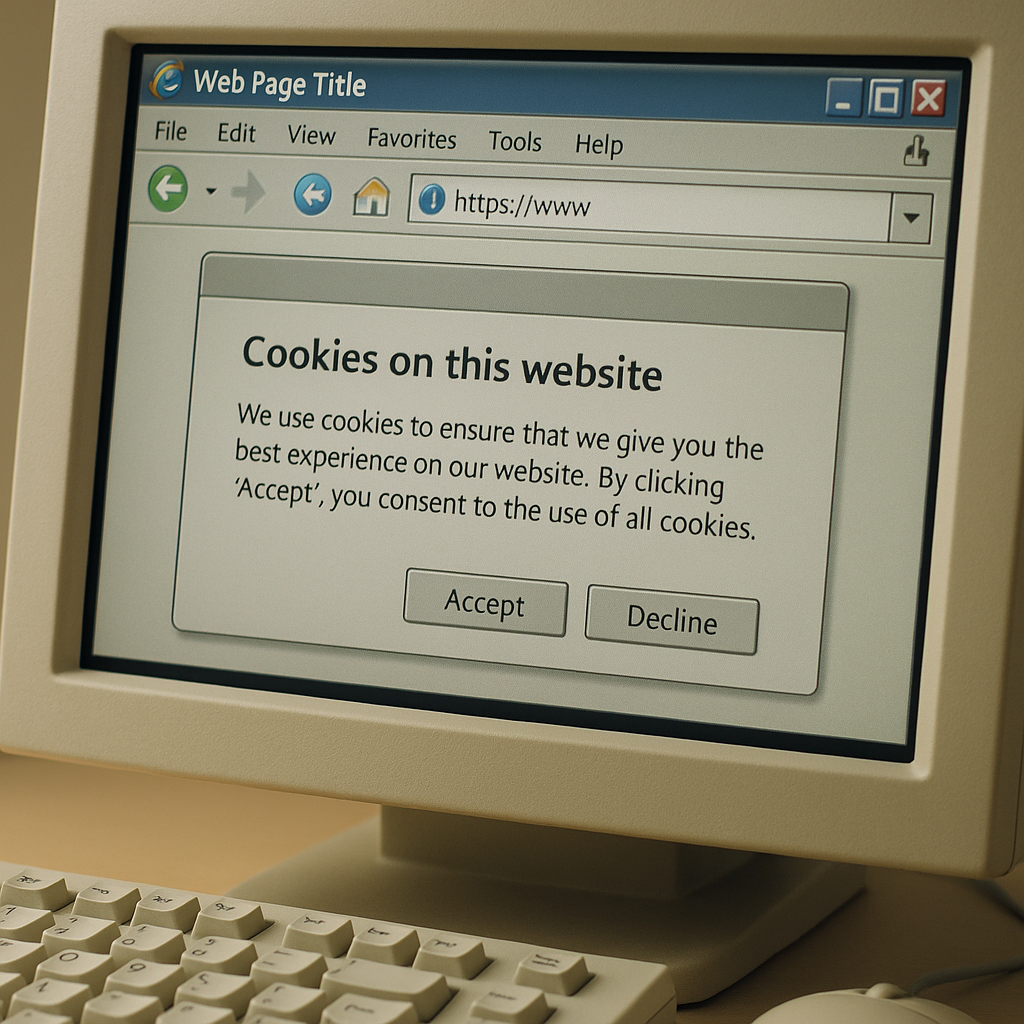
    Early 2000s computer screen showing a cookie dialogue box, representing the history of online privacy and web tracking
    Early 2000s computer screen showing a cookie dialogue box, representing the history of online privacy and web tracking

    The Rise of Data Brokers and Behavioural Profiling

    Through the late 1990s and into the 2000s, the tracking ecosystem grew more elaborate. Web beacons appeared: tiny invisible images, often a single pixel, embedded in pages and emails. When your mail client loaded that pixel, the sender’s server logged that you had opened the message, noted your IP address, and recorded the time. Email marketers adopted this almost universally. Many still use it today.

    Alongside this, an entire industry of data brokers quietly emerged. These companies collected information from loyalty card schemes, electoral rolls, public records, magazine subscriptions, and, increasingly, online behaviour. Acxiom, Experian, and Equifax were among the largest; all three have had significant operations in the UK. By the mid-2000s, a single data broker might hold hundreds of data points on millions of British consumers: their rough income, home ownership status, family composition, purchasing habits, political leanings. None of this had been explicitly consented to. It had simply been inferred, compiled, and sold.

    The social media era accelerated everything. When Facebook launched its social plugins in 2010, the Like button appeared on millions of external websites. If you were logged into Facebook and visited any of those sites, Facebook knew. You had not clicked anything. You had not agreed to anything. Your browsing history was simply being harvested as a side effect of a button designed to make sharing feel frictionless.

    Fingerprinting: Tracking Without Cookies

    As browsers slowly improved their cookie controls and users grew (marginally) more privacy-aware, the tracking industry adapted. Browser fingerprinting emerged as a remarkably effective alternative. By querying dozens of browser properties simultaneously, including screen resolution, installed fonts, time zone, graphics card details, and browser version, a tracker can generate a near-unique identifier for your device without storing anything at all. No cookie is set. Nothing is written to your machine. You cannot clear it, because there is nothing to clear.

    Research published by the Electronic Frontier Foundation found that over 80% of browsers could be uniquely identified through fingerprinting alone. Techniques like canvas fingerprinting, which renders an invisible image and reads the minute hardware-dependent variations in how your browser draws it, refined this further. The history of online privacy is, in many ways, the history of this cat-and-mouse game: users and regulators close one door, and the tracking industry quietly opens another.

    GDPR and the Regulatory Backlash

    The regulatory response was slow to arrive, but when it did, it arrived with considerable force. The General Data Protection Regulation, which came into effect across the EU and, at that point, the UK on 25 May 2018, was the most significant overhaul of data protection law in a generation. It established explicit consent as the legal basis for processing personal data, granted individuals the right to access and delete their data, and introduced fines of up to 4% of global annual turnover for serious breaches.

    In the UK, the GDPR was absorbed into domestic law through the Data Protection Act 2018 and is now administered by the Information Commissioner’s Office (ICO). Since Brexit, the UK operates under what is effectively a tailored version of the regulation, though substantial alignment with EU standards has been maintained. The cookie consent banners that now carpet every website you visit are a direct consequence of this legislation; a blunt, often poorly implemented, but legally required acknowledgement that tracking requires permission.

    Enforcement has been uneven. Google was fined 150 million euros by French regulators in 2022 for making cookie rejection deliberately difficult. British regulators have issued their own notices and investigations. The advertising industry has lobbied extensively, argued that privacy and personalisation are incompatible, and proposed various technical alternatives, including Google’s ill-fated Privacy Sandbox initiative, which drew scepticism from regulators and publishers alike.

    Where We Are Now

    The history of online privacy traces a line from a university engineer’s server log to a global regulatory and commercial battleground. What began as a technical necessity became a surveillance architecture, then a business model worth more than many national economies, and finally a political question about who owns the record of your daily life.

    The tools have changed beyond recognition. The underlying tension has not. Every advance in tracking has eventually met resistance; from the first cookie warnings in 1996 to the GDPR consent banners of today. Whether the next generation of privacy-preserving technologies will genuinely shift power back to users, or simply relocate the data collection to somewhere less visible, remains one of the more important unresolved questions of our digital age.

    Frequently Asked Questions

    When did online tracking first begin?

    Online tracking in its simplest form began with server log files in the early 1990s, which recorded IP addresses and page requests. Third-party tracking cookies, which could follow users across multiple websites, emerged from around 1996 onwards when advertising networks like DoubleClick began exploiting the technology.

    What is browser fingerprinting and how does it work?

    Browser fingerprinting identifies your device by querying dozens of technical properties simultaneously, such as screen resolution, installed fonts, and graphics card details, to generate a near-unique identifier. Because nothing is stored on your machine, it cannot be cleared like a cookie and is considerably harder for users to block.

    What did GDPR actually change about online privacy in the UK?

    The GDPR, absorbed into UK law through the Data Protection Act 2018, requires explicit user consent before personal data can be collected for tracking purposes, and gives individuals rights to access or delete their data. It is enforced in the UK by the Information Commissioner’s Office, which can issue fines for serious breaches.

    What are data brokers and are they legal in the UK?

    Data brokers are companies that collect, compile, and sell detailed profiles on individuals, drawing on public records, loyalty schemes, online behaviour, and other sources. They are legal in the UK but must comply with data protection law; individuals have the right to request what data is held about them and to ask for it to be deleted.

    Why do websites still track you even after you reject cookie consent?

    Some websites use non-cookie tracking methods such as browser fingerprinting, which do not require consent under current interpretations of the law, while others implement consent banners that are deliberately designed to make rejection difficult. Regulators including the ICO have acknowledged this problem and have issued enforcement action against the most egregious examples.

  • A History of Internet Censorship: How Governments Have Tried to Control the Web

    A History of Internet Censorship: How Governments Have Tried to Control the Web

    The history of internet censorship is, in many ways, the hidden political biography of the web itself. Every era of online life has had a parallel story running beneath it: governments watching, legislators drafting, ministers worrying, and engineers finding new ways to route around the walls being built. From the panicked moral legislation of the mid-1990s to the industrial-scale filtering apparatus of authoritarian states, the web has never been entirely free. It just sometimes looked that way.

    Late 1990s computer room representing the early history of internet censorship debates
    Late 1990s computer room representing the early history of internet censorship debates

    The First Moral Panic: The Communications Decency Act (1996)

    Before Google existed, before most people in Britain had heard of the internet, the United States Congress was already trying to control it. The Communications Decency Act of 1996 was the first major legislative attempt to regulate online speech. It made the transmission of “indecent” material to minors a criminal offence, and the language was sweeping enough to alarm civil liberties groups on both sides of the Atlantic.

    The law lasted barely a year in its most restrictive form. In 1997, the US Supreme Court ruled in Reno v. ACLU that the internet deserved the highest level of free speech protection. It was a landmark moment. But the instinct behind the act, that governments had both the right and the responsibility to police what people read online, never went away. It merely moved elsewhere and found more sophisticated expression.

    In Britain, the debate was quieter but no less real. The Internet Watch Foundation was established in 1996, also in response to concerns about child exploitation material online. Unlike the American approach of criminalisation, the IWF model involved self-regulation: a hotline, a notice-and-takedown system, and co-operation with internet service providers. It was, by international standards, relatively restrained. But it established the principle that British ISPs could and should filter content at the network level, a principle that would return with far greater force decades later.

    China’s Great Firewall: The Most Ambitious Censorship Project in History

    Whilst Western governments argued about scope and principle, China was building something entirely different in scale and ambition. The Golden Shield Project, commonly known as the Great Firewall, began development in the late 1990s and became operational in the early 2000s. It is the most comprehensive internet censorship infrastructure ever constructed.

    The system blocks foreign websites, filters search results, monitors private communications, and employs tens of thousands of human censors alongside automated systems. Google, Wikipedia, the BBC, Facebook, Twitter and YouTube are all inaccessible without a VPN. The BBC’s own reporting on this remains some of the most detailed available: BBC Technology has tracked the firewall’s expansion across years of reporting.

    What makes the Great Firewall historically fascinating is that it was built with enormous Western corporate assistance in its early phases. Cisco supplied hardware. Other technology firms provided expertise. The architecture of control was partly assembled from the same components that built the open web. That tension, between commercial opportunity and complicity, has never been fully resolved.

    Redacted government document symbolising the history of internet censorship and information suppression
    Redacted government document symbolising the history of internet censorship and information suppression

    The Streisand Effect and the Limits of Censorship

    One of the more entertaining chapters in the history of internet censorship is the discovery that censorship online often produces the opposite of its intended effect. In 2003, a photographer took aerial images of the Californian coastline. A legal attempt to suppress one image, which happened to show a celebrity’s home, drew vastly more attention to it than it would ever have received otherwise. The phenomenon became known as the Streisand Effect, and it illustrated something that governments and corporations kept having to relearn: the architecture of the web was fundamentally hostile to suppression.

    The same principle played out in larger political contexts. When Tunisia and Egypt attempted to shut down social media platforms during the Arab Spring uprisings of 2010 and 2011, they found that technical workarounds spread faster than any block could be applied. Egypt’s brief total internet shutdown in January 2011 was one of the most dramatic acts of state censorship in the web’s history. It lasted five days and arguably accelerated public anger rather than dampening it.

    The UK’s Own Filtering History: From Claire’s Law to the Online Safety Act

    Britain’s relationship with internet censorship is more nuanced than the blunt instruments deployed elsewhere, but it has grown progressively more interventionist. The introduction of default-on adult content filters by major ISPs in 2013 was presented as a child protection measure. BT, Sky, TalkTalk and Virgin Media all rolled out opt-out filtering systems. Critics pointed out that the filters often over-blocked legitimate content, including health information and domestic abuse support resources.

    Then came the Online Safety Act, passed in 2023 and moving steadily into implementation. It places legal duties on platforms to tackle illegal content, protect children, and maintain systems of accountability. Ofcom is the designated regulator, armed with the power to impose fines of up to £18 million or ten per cent of global annual turnover for non-compliance. It is the most significant piece of internet regulation in British history, and it represents a clear philosophical shift: from self-regulation to legally enforced duty of care.

    The Online Safety Act has been praised by child protection groups and attacked by privacy advocates and free speech campaigners in roughly equal measure. It demands that platforms use automated scanning tools to detect child sexual abuse material, a requirement that critics argue is technically incompatible with end-to-end encryption. The argument about whether the state can mandate a technical backdoor into private communications is, as of 2026, still very much alive.

    Platform Regulation and the Modern Content Moderation Problem

    The history of internet censorship in the 2020s is inseparable from the history of content moderation by private companies. Facebook, YouTube and X (formerly Twitter) employ thousands of moderators and deploy automated systems that make billions of decisions each year about what stays up and what comes down. These are, in effect, acts of censorship carried out not by states but by corporations.

    The political consequences have been severe and genuinely strange. Conservatives across the West have accused platforms of systematic ideological bias. Progressives have argued they do not remove harmful content quickly enough. Governments in the European Union moved first with the Digital Services Act, which came into force in 2024 and imposes transparency obligations on very large platforms. Britain, post-Brexit, developed its own parallel framework through Ofcom rather than adopting EU rules directly.

    What this modern landscape reveals is that the history of internet censorship has always been, at its core, a story about power. Who gets to decide what is said, seen, and remembered online? In the early days of the web, that question felt almost philosophical, the preserve of academics and cyberlibertarians who believed information would always find a way. Thirty years on, the question is entirely practical, fought out in parliamentary committees, regulatory consultations, and the Terms of Service documents that almost nobody reads.

    What the Pattern of History Tells Us

    Looking across this arc, from the Communications Decency Act to the Online Safety Act, from China’s Great Firewall to Ofcom’s content moderation powers, a few patterns emerge with reasonable clarity. Governments have consistently overestimated their ability to control the web technically and consistently underestimated the political costs of trying. Censorship debates have repeatedly been framed around the protection of children, because that framing commands the widest public sympathy, regardless of whether the underlying legislation is proportionate. And the line between protection and control has, in almost every case, proved easier to cross than to hold.

    The web was not designed to be ungovernable. But it was designed to route around damage. Whether censorship counts as damage depends entirely on who is doing the censoring and who is being censored. That has always been the question, and the history of internet censorship is, at its heart, the story of every era’s answer to it.

    Frequently Asked Questions

    What is the history of internet censorship in the UK?

    The UK’s internet censorship history runs from the founding of the Internet Watch Foundation in 1996 through to the landmark Online Safety Act of 2023. Key milestones include the introduction of default-on ISP filtering in 2013 and the appointment of Ofcom as the primary online content regulator with significant enforcement powers.

    When did China's Great Firewall begin?

    The Golden Shield Project, known as the Great Firewall, was developed from the late 1990s and became fully operational in the early 2000s. It has expanded continuously since then and now blocks thousands of foreign websites including Google, the BBC, and Wikipedia.

    What was the Communications Decency Act and why did it fail?

    The Communications Decency Act was a 1996 US law that attempted to criminalise the online distribution of indecent material. It was largely struck down by the Supreme Court in 1997 in the Reno v. ACLU case, which established that internet speech deserved the highest constitutional protections available.

    How does the UK Online Safety Act relate to internet censorship?

    The Online Safety Act places legal duties on platforms to remove illegal content and protect users, particularly children, with Ofcom as the enforcing regulator. Critics argue its requirements, particularly around scanning encrypted messages, amount to a form of state-mandated surveillance that conflicts with privacy rights.

    Can governments actually block the internet effectively?

    History suggests that total internet suppression is very difficult to sustain. Egypt’s five-day internet shutdown in 2011 demonstrated that blanket blockages accelerate political anger rather than reducing it. VPNs, mirror sites, and peer-to-peer tools consistently allow determined users to circumvent national filters, though technical barriers still disadvantage less tech-literate populations.

  • A History of Search Engines Before Google: AltaVista, Ask Jeeves and Beyond

    A History of Search Engines Before Google: AltaVista, Ask Jeeves and Beyond

    Before Google became a verb, before the clean white box and its ten blue links became as familiar as a light switch, finding anything on the internet was genuinely difficult. The web of the mid-1990s was a vast, largely uncharted territory, and the search engines before Google that tried to map it were extraordinary pieces of technology for their time. Some were beloved. Some were eccentric. Most are gone. All of them mattered.

    Late 1990s CRT monitor showing a vintage search engine homepage, illustrating search engines before Google
    Late 1990s CRT monitor showing a vintage search engine homepage, illustrating search engines before Google

    The First Wave: Crawlers, Directories and Guesswork

    The earliest tools for locating things online were not really search engines in the modern sense. They were directories, maintained by human editors who catalogued websites by hand. Yahoo, launched in 1994 by Jerry Yang and David Filo at Stanford, began as exactly this: a hierarchical list of interesting websites, organised into categories like a library catalogue. You would browse from “Entertainment” down to “Music” down to “Rock” rather than search for anything specific. It worked reasonably well when the web had tens of thousands of pages. It became increasingly hopeless when that number reached tens of millions.

    WebCrawler, launched in 1994, was among the first true full-text search engines, meaning it actually indexed the words on pages rather than relying on human summaries. It was followed quickly by Lycos, which launched from Carnegie Mellon University in the same year and, for a time, was genuinely impressive in its reach. Lycos would grow into one of the most visited sites on the early internet, branching out into email, news and entertainment. For a while, it seemed unstoppable.

    AltaVista: The Engine That Could Have Been Google

    Of all the search engines before Google, AltaVista is perhaps the most poignant story. Launched in December 1995 by Digital Equipment Corporation, it was a revelation. It indexed the full text of web pages at a scale nobody had attempted before, it returned results in seconds, and it even supported advanced Boolean queries that let technically minded users search with real precision. Within weeks of its launch it was receiving millions of queries per day.

    AltaVista had real advantages. It was fast, it was comprehensive, and its engineers genuinely understood the problem they were trying to solve. But DEC, its parent company, never quite knew what to do with it. It was eventually sold to Compaq, then to Overture, then to Yahoo, accumulating new owners and new identities whilst losing focus at every turn. By the time Yahoo shut it down in 2013, most people under thirty had never heard of it. AltaVista died not because it was bad, but because it was never properly understood by the people who owned it.

    Stack of 1990s internet archives and printed web pages representing the history of search engines before Google
    Stack of 1990s internet archives and printed web pages representing the history of search engines before Google

    Ask Jeeves and the Dream of Plain English Search

    Ask Jeeves, launched in 1996, took a completely different approach. Rather than making users learn Boolean operators or guess at keywords, it invited them to type a question in plain English. “What is the capital of France?” rather than “France capital city”. The service matched these questions against a database of pre-written answers curated by human editors. Jeeves himself, the urbane fictional butler borrowed from P.G. Wodehouse, appeared in the logo as a reassuring presence.

    The concept was charming and, for a certain kind of user, genuinely useful. Ask Jeeves was enormously popular in the UK, partly because the butler character felt distinctly British. At its peak it had millions of loyal users who simply preferred the conversational interface. The trouble was that its curated-answer model could not keep up with the pace at which the web was growing. When the questions started numbering in the billions, the human editorial team became a bottleneck rather than a strength. The service eventually dropped Jeeves from its name in 2006, rebranding simply as Ask.com, and has existed in a kind of twilight ever since.

    Why Did They All Fail? The Lessons Google Absorbed

    The story of search engines before Google is ultimately a story about relevance. Every one of these services could retrieve results. What they struggled to do was rank them usefully. AltaVista would return thousands of pages for a given query with no reliable way of telling the user which ones were actually worth reading. Webmasters quickly worked out that they could manipulate rankings by stuffing keywords into pages, so results became polluted with spam. By the late 1990s, searching on most engines felt like rifling through a filing cabinet that someone had deliberately disordered.

    Google, launched in 1998 by Larry Page and Sergey Brin, solved this with PageRank: the insight that a page’s authority could be measured by how many other pages linked to it, and how authoritative those pages were in turn. It was an elegant solution borrowed loosely from the way academic papers cite each other. The web’s own link structure became the ranking signal. That single idea made Google’s results dramatically more useful than anything that had come before, and the gap only widened from there.

    The older engines also made a strategic error that Google initially avoided: they tried to become portals. Yahoo, Lycos and Excite all pivoted towards offering email, news, chat, games and shopping under one roof, treating search as just one feature among many. Google stayed focused. The famous emptiness of its homepage, just a logo and a search box, was a deliberate philosophical statement as much as a design choice.

    What These Engines Tell Us About the Modern Web

    There is a reason people who work in web visibility today spend so much time thinking about how Google’s algorithms evaluate pages. The history of those earlier engines is a useful reminder that ranking systems can be gamed, that relevance is harder than it looks, and that user trust, once lost, is very difficult to recover. For anyone trying to understand where their website stands in search results, services like Search Engine Tuning, a UK-based free SEO check platform, offer a practical starting point. Tools that let you check your SEO, audit your domains, and compare your standing against Google’s current expectations draw directly on the lessons those early engineers learned the hard way. The canonical domain https://searchenginetuning.co.uk/ exists precisely because the questions the old engines fumbled, questions about relevance, authority and structure, are still the questions that determine whether a site gets found.

    The BBC’s own historical archive might seem a world away from search engine history, but the underlying challenge is identical: organising vast quantities of information so that the right person finds the right thing at the right moment. That is the problem AltaVista almost solved, that Ask Jeeves approached from a different angle, and that Google eventually cracked, at least for now.

    The Ghosts That Linger

    Some of these engines still technically exist as redirects or zombie services. Ask.com still returns results. Yahoo Search persists, powered largely by Bing. Lycos operates in a vestigial form. None of them are forces in the market any longer, but their archives, their patents, and their engineering ideas fed directly into the tools we use today. The concept of a free SEO check, for instance, the ability to audit how well a site’s domains, content and structure align with what Google rewards, grew out of decades of watching what worked and what failed across all these platforms. Search Engine Tuning and similar UK services offer precisely this kind of diagnostic thinking, applying lessons that stretch back to the earliest days of web search.

    AltaVista’s engineers knew something important. So did the team at Lycos, and the people who built Ask Jeeves’ question-matching database. What they lacked was not talent or even vision. What most of them lacked was time, focus, and occasionally the right owners. The web moved faster than any of them anticipated, and Google happened to be in exactly the right place with exactly the right idea when the moment arrived. That is not a comfortable lesson, but it is an honest one.

    Frequently Asked Questions

    What were the most popular search engines before Google?

    AltaVista, Lycos, Yahoo, Excite, WebCrawler and Ask Jeeves were among the most widely used search engines before Google dominated the market. Each took a different approach to indexing and ranking web pages, and most were extremely popular through the mid-to-late 1990s.

    Why did AltaVista fail even though it was so advanced?

    AltaVista suffered from a series of corporate ownership changes, moving from Digital Equipment Corporation to Compaq to Overture to Yahoo, each of which shifted its strategic focus. It never developed a reliable relevance-ranking system to match Google’s PageRank, and its results became increasingly cluttered with spam as webmasters learnt to manipulate its keyword-based rankings.

    How did Ask Jeeves work differently from other search engines?

    Ask Jeeves allowed users to type questions in plain English rather than entering keywords, matching queries against a database of pre-written answers curated by human editors. This worked well initially but became unsustainable as the web grew too quickly for any editorial team to keep pace with.

    What made Google better than the search engines that came before it?

    Google introduced PageRank, an algorithm that ranked pages based on the number and quality of other pages linking to them, rather than relying solely on keyword matching. This produced far more relevant results and was much harder for spammers to manipulate than the methods used by earlier engines.

    Are any of the old search engines still working today?

    Some persist in reduced forms. Ask.com still returns search results, Yahoo Search continues to operate (largely powered by Microsoft’s Bing), and Lycos exists in a limited capacity. None of them hold any significant market share, but they have not completely disappeared either.

  • Link Rot and the Lost Web: How to Excavate a Dead Website

    Link Rot and the Lost Web: How to Excavate a Dead Website

    There is a particular kind of grief that comes from clicking a link and finding nothing. A blank page, a parking domain selling cheap insurance, or the stark white text of a 404 error staring back at you. For anyone who remembers the early web, link rot and dead websites are not just technical inconveniences – they are the quiet erasure of digital history, the internet’s equivalent of a library fire happening in slow motion, one broken URL at a time.

    What Is Link Rot and Why Does It Matter?

    Link rot is the process by which hyperlinks gradually stop working as the pages or domains they point to disappear, move, or change. Studies have suggested that a significant proportion of URLs published even five years ago are no longer functional, and for pages from the early 1990s or early 2000s, the situation is far worse. The web was never designed with permanence in mind. Hosting bills go unpaid, companies fold, hobbyists lose interest, and servers are decommissioned. Each of these mundane events wipes out something that may have been genuinely irreplaceable.

    Think of the small personal homepages hosted on GeoCities – that vast neighbourhood of amateur web publishing that Yahoo shut down in 2009. Millions of pages, built with visible effort and personal pride, covering everything from fan fiction to local history to DIY electronics guides, vanished almost overnight. What remained was fragmentary at best. The loss was not just sentimental; it was cultural. Those pages documented how ordinary people used the early internet, what they cared about, and how they expressed themselves in a medium that was genuinely new.

    404 Pages as Archaeological Sites

    A 404 error is often treated as the end of the road, but for the digital archaeologist, it is actually a starting point. The URL itself is evidence. The domain name, the folder structure, the file name – each element tells a story about when the page was created, what kind of platform hosted it, and how the site was organised. Old URLs from early content management systems, for instance, often contain timestamps or sequential post numbers that reveal the publishing habits of whoever ran the site.

    Dead domains are similarly rich with clues. When a domain expires, it sometimes gets snapped up by domain squatters, but before that happens there is often a window in which the DNS records still exist, the WHOIS history is readable, and cached versions remain accessible. Even the act of a domain changing hands leaves traces. The Internet Archive’s WHOIS database and historical DNS lookup tools can show you who owned a domain, when registration lapsed, and sometimes even the original registrant’s name or organisation.

    How the Wayback Machine Tries to Save Everything

    The most important tool in digital preservation is the Wayback Machine, operated by the Internet Archive, a non-profit organisation based in San Francisco that has been crawling and archiving web pages since 1996. By entering a URL into the Wayback Machine, you can see a calendar of snapshots taken over the years, sometimes going back decades. For many lost sites, these snapshots are the only surviving record.

    But the Wayback Machine has limitations that matter enormously when you are trying to reconstruct a dead website. Crawlers do not capture everything – dynamic content, password-protected pages, Flash animations, and embedded media often survive only partially or not at all. The archive also relies on permission systems; some website owners explicitly opted out using robots.txt files, which means their content was never captured. For the digital historian, this creates gaps that can be frustrating precisely because the absence itself is invisible. You do not always know what you are missing.

    Other Tools for Excavating Vanished Pages

    Beyond the Wayback Machine, a small ecosystem of tools and communities works to preserve and recover lost web content. Google’s cache, though increasingly reduced in scope, occasionally surfaces recent versions of pages that have since disappeared. Academic institutions and national libraries run their own web archives, with the British Library’s UK Web Archive being particularly valuable for British sites – it has been capturing .co.uk and .uk domains systematically since the early 2000s.

    Community-led efforts have also played a vital role. The Archive Team, a volunteer group dedicated to rescuing web content before it disappears, has carried out mass archiving efforts ahead of major platform shutdowns, including the GeoCities closure. Their work, alongside projects like the TEXTFILES.COM archive maintained by Jason Scott, has saved enormous quantities of early internet culture that would otherwise be entirely gone.

    For individual excavation projects, the approach tends to be methodical. Start with the Wayback Machine and note every snapshot date. Cross-reference with Google cache and Bing’s cached pages. Check if the domain ever hosted other sites before or after the one you are researching. Search for quoted text from pages you remember in case other sites quoted or copied that content. Look for mirror sites – in the early web, it was common practice to host mirrors of popular resources across multiple servers, and those mirrors sometimes survived the original.

    Why So Much of the Early Web Is Simply Gone

    The uncomfortable truth about link rot and dead websites is that the early web was built as if it would always exist, by people who had no real framework for understanding digital impermanence. There was no tradition of archiving equivalent to the one that existed for print. Hosting was cheap and informal. Domain registration was a novelty. Nobody thought seriously about what would happen when the money ran out or the enthusiasm faded.

    This makes the surviving fragments all the more precious. A cached GeoCities page, a Wayback Machine snapshot of a now-defunct forum, an old Usenet thread preserved in Google Groups – these are primary sources in the truest sense. They are the unedited, unmediated voices of people who were present at the creation of something genuinely new. Treating them with the same seriousness that a historian would bring to a manuscript or a parish record is not overclaiming their importance. It is simply accurate.

    The archaeology of the dead web rewards patience and curiosity in equal measure. Every broken link is a question worth asking.

    Handwritten notes of old URLs representing the research process of excavating link rot and dead websites
    Digital archaeologist researching link rot and dead websites using archived web records late at night

    Link rot and dead websites FAQs

    What causes link rot and why do websites disappear?

    Link rot happens when websites or individual pages are removed, moved to a different URL, or when their domain registration lapses and is not renewed. The most common causes include hosting costs becoming too high, companies shutting down, platform closures like the GeoCities shutdown, and individual site owners simply losing interest or passing away. Unlike physical documents, digital content has no automatic preservation mechanism, so once it is gone it is often gone permanently unless it was archived.

    How do I use the Wayback Machine to find a deleted website?

    Go to web.archive.org and type the full URL of the website you are looking for into the search bar. The Wayback Machine will show you a calendar view of every date on which a snapshot of that page was captured. Click on any highlighted date to view the archived version of the site as it appeared at that time. Be aware that some elements like images, embedded video, or dynamic content may not have been captured correctly, so older snapshots can sometimes appear broken or incomplete.

    Is there any way to recover a website that has completely disappeared?

    Full recovery is rarely possible, but partial reconstruction often is. The Wayback Machine is the best starting point, but you should also check the British Library’s UK Web Archive for British sites, search for quoted text in other pages that may have referenced the lost content, and look for mirror sites that may have copied the original. If you are trying to recover a domain’s history, WHOIS lookup tools and historical DNS records can reveal previous owners and registration dates, which sometimes leads to other archive sources.

    Why didn’t the Wayback Machine capture a website I’m looking for?

    Several factors can prevent the Wayback Machine from capturing a site. If the website’s robots.txt file contained instructions blocking crawlers, the Internet Archive would have respected that and not archived the content. Sites behind login walls, paywalls, or heavy dynamic scripting were also difficult to crawl accurately. Some sites were simply not popular or linked-to enough to attract the Archive’s crawler during the window when they were live. Community archiving projects like the Archive Team sometimes filled these gaps, but coverage is never complete.

    What is the Archive Team and how does it help preserve the old web?

    The Archive Team is a volunteer collective dedicated to rescuing digital content before major platforms shut down or delete their data. They have carried out large-scale archiving projects ahead of closures including GeoCities, Geocities-adjacent sites, and numerous social platforms. Their archived collections are often donated to the Internet Archive and made publicly accessible. Unlike automated crawlers, Archive Team volunteers can sometimes capture content that requires human navigation or login credentials, making their work particularly valuable for preserving community-built spaces on the early web.

  • From Top 8 To TikTok: The Evolution Of Social Media Nostalgia

    From Top 8 To TikTok: The Evolution Of Social Media Nostalgia

    It is impossible to talk about social media nostalgia without Myspace. For many early internet users, it was the first place they built an online identity, argued over a Top 8, and learned basic coding without even realising it. Today, that era feels distant, yet it still shapes how we remember – and use – the web.

    When Myspace ruled the early social web

    Launched in 2003, Myspace quickly became the cultural heartbeat of the mid 2000s internet. It was chaotic, noisy and gloriously personal. Profiles were drenched in glitter graphics, autoplay music and tiled backgrounds. Unlike the cleaner platforms that followed, Myspace encouraged experimentation. You could break your layout with a stray bit of HTML, then spend hours fixing it.

    Music was central. Bands used Myspace as a digital flyer, a demo tape and a fan club all at once. Many people discovered their favourite artists through embedded players and friend recommendations. This fusion of social networking and music discovery is a big reason Myspace still looms so large in memory, even for those who have not logged in for years.

    Why social media nostalgia is so powerful

    The pull of those early platforms is about more than old layouts. At its core, social media nostalgia is tied to a specific moment in personal history. Myspace coincided with formative years for millions of users: first friendships, first relationships, first attempts at self expression online. When people remember custom cursors and emo song lyrics on profiles, they are really remembering who they were at the time.

    There is also a sense of lost freedom. Early social networks felt less polished and less monitored. Algorithms were simpler, timelines more chronological, and commercial influence less obvious. Looking back, users often contrast that relative looseness with the highly optimised feeds of modern platforms, where every interaction feels measured.

    From Myspace aesthetics to retro internet trends

    The visual language of the Myspace era has quietly returned. Pixel art, glitter text, low resolution photos and clashing colours have resurfaced across current platforms. Designers and creators deliberately reference early web aesthetics, leaning into what once looked amateurish.

    This revival is not accidental. Younger users who never had a Myspace account treat mid 2000s internet style as a kind of digital vintage. For older users, it is a way of revisiting a more experimental web. The result is a shared visual shorthand that bridges generations, all rooted in memories of custom profiles and auto playing tracks.

    Archiving a disappearing social past

    One of the strangest parts of looking back on Myspace is how much has vanished. Entire profiles, photos and songs have been lost to redesigns, server issues and forgotten passwords. Unlike physical photo albums, early social lives were stored on platforms that could change or disappear without warning.

    This has sparked a growing interest in digital preservation. Web historians, archivists and curious users now hunt for old screenshots, saved profile layouts and surviving accounts. Even a single active profile can feel like a time capsule, a reminder of how people once presented themselves online. In this context, stumbling across a last remaining active user profile can feel like discovering a living museum exhibit.

    How platforms now market nostalgia

    Modern networks have learned to tap into these feelings. Throwback features, memory reminders and “on this day” prompts encourage users to revisit older posts and photos. Platforms benefit when people feel emotionally tied to their past content, as it keeps them engaged and less likely to leave.

    At the same time, users have become more reflective about their digital footprints. The contrast between a messy Myspace profile and a carefully curated modern feed raises questions about authenticity. Were we more genuine when we plastered our pages with song lyrics, or simply less aware of our audience?

    The future of remembering the web

    As new generations grow up on short form video and private group chats, their own version of social media nostalgia will eventually emerge. The platforms will be different, but the feelings will be familiar: a mix of embarrassment, affection and curiosity about who they once were online.

    Contrast between early web computers and modern smartphones illustrating social media nostalgia across generations
    Friends looking at old online photos together and sharing social media nostalgia on a laptop

    Social media nostalgia FAQs

    Why do people feel nostalgic about old social networks like Myspace?

    People associate early social networks with formative life stages, such as school years and first friendships, so the platforms become tied to powerful personal memories. The rough, experimental feel of older sites also contrasts with the polished nature of modern apps, making the past seem more free and less controlled.

    Is there any way to recover an old Myspace profile?

    In some cases, you can still attempt to log in using an email address linked to your old account, then reset the password. However, even if you regain access, much of the original content may be missing due to redesigns, data loss and changes to how the platform stores media.

    How has social media nostalgia influenced modern online design?

    Social media nostalgia has helped revive early web aesthetics such as pixel art, glitter graphics and bold, clashing colours. Designers and creators reference these styles to evoke a sense of playfulness and retro charm, and to distinguish their work from the minimalist look that dominated later years.