
Tag: early uk internet

  • The Rise and Fall of Friends Reunited: Britain’s First Social Network

    The Rise and Fall of Friends Reunited: Britain’s First Social Network

    In the summer of 2000, a couple named Steve and Julie Pankhurst launched a website from their kitchen in Barnet. The idea was modest enough: a directory where people could find former classmates and leave a message. No feeds, no photo sharing, no algorithms optimising for engagement. Just a searchable list of schools and a text box. Within two years it had become one of the most talked-about websites in Britain, and I’d argue it was the first time most ordinary people in this country genuinely understood what the internet could do for them personally.

    The story of Friends Reunited is, at its core, a story about timing, nostalgia, and the particular hunger that the early web created in people who had grown up without it. It is also a cautionary tale about what happens when a media company pays £175 million for something it doesn’t quite understand, just as the ground is about to shift beneath everyone’s feet.

    Person browsing the early web in the 2000s, evoking the friends reunited history uk social network era
    Photo by Sidde on Pexels

    How Friends Reunited actually worked

    The mechanics were simple. You found your old school on the site, registered, and left a short paragraph about what you’d been doing since you left. That was it. Other people who had attended the same school could see your entry and send you a message, though initially those messages were routed through the site itself rather than directly by email. There was a small subscription fee, £7.50 a year for full messaging access, which sounds trivial now but was, in 2001, a real enough barrier that plenty of people thought twice.

    What the Pankhursts had identified was something genuine: the generation that had grown up in the 1970s and 1980s had lost touch with friends in ways that felt final. You moved away for university or work, and unless you made deliberate effort, people simply disappeared from your life. There was no mechanism for reconnection. Friends Reunited provided one, and it turned out there was enormous appetite for it.

    By 2002 the site had registered roughly 5 million users. By 2004 that figure had climbed past 15 million, which at the time represented something like a quarter of the entire British population. The BBC reported on it regularly. Tabloids ran stories about couples reunited, marriages complicated, long-lost siblings found. The site had become a cultural moment in a way that very few British websites have managed before or since. For comparison, Bebo, which would later dominate British teenage life in the mid-2000s, was still three years from launching when Friends Reunited was at its height.

    Why it felt different from anything that had come before

    To understand why the site struck such a nerve, you have to remember the context. In 2000 and 2001, most British internet users were still on dial-up connections. The web felt slow and slightly alien to many people. There wasn’t a compelling reason for someone who had not grown up with computers to spend time online. Friends Reunited changed that calculation. For the first time, the internet offered something you genuinely could not get anywhere else: access to people from your past.

    This was, in a way, the same promise that Prestel had made to British households twenty years earlier, that a networked system could give you information and connection that no other medium could provide. The difference was that Friends Reunited actually delivered on it, and at a moment when broadband was beginning to spread across British homes and the friction of going online was finally starting to ease.

    The site also benefited from something that later social networks would try to replicate but rarely managed quite so naturally: a built-in community structure. Your school was your group. You didn’t need to find your tribe or curate a following. The architecture of secondary education, years, forms, houses, gave the site an instant organising principle that felt familiar and emotionally legible to almost every adult in the country.

    ITV’s £175 million mistake

    In December 2005, ITV plc acquired Friends Reunited for £175 million. At the time, the deal was presented as a bold move into digital media by a broadcaster that could see the internet eroding its traditional audience. The site had revenues from subscriptions and advertising, it had brand recognition most web businesses could only dream of, and it had that 15-million-strong user base. On paper, it looked like a reasonable acquisition.

    The problem was that 2005 was precisely the moment when everything was about to change. Facebook had launched in the United States the previous year and would open to British users in 2006. MySpace was already popular. The subscription model that Friends Reunited had built its business on, charging people to send messages to old classmates, was about to look absurd next to platforms that offered far more functionality for free.

    ITV, to its credit, removed the subscription fee in 2007 and attempted a redesign, but by then the damage was done. The site had missed the window to build the kind of profile-based, constantly-updated social experience that Facebook was delivering. Users who had found their old classmates had, in many cases, already migrated those reconnected friendships onto platforms that let them share photos and status updates. Friends Reunited had served its purpose and people were moving on.

    ITV sold the site in 2009 for just £25 million, a loss of £150 million in four years. It remains one of the worst deals in British media history. The BBC’s coverage at the time of the eventual closure noted that the site had simply been overtaken by platforms with deeper pockets and broader ambitions. That’s accurate, but it understates how abrupt the collapse was. Friends Reunited didn’t fade gradually; it fell off a cliff.

    What happened after ITV sold it

    The buyers in 2009 were DC Thomson, the Dundee-based publisher behind the Beano and a range of regional titles. They attempted to reposition the site as a family history and genealogy platform, leaning into its nostalgic roots and trying to find an audience less interested in real-time social media and more interested in researching the past. It was a coherent enough idea, but the site never regained meaningful traction. By 2016 it had shut down entirely.

    The closure meant that a significant slice of early British web history simply vanished. User profiles, school directories, message board discussions from 2001 and 2002, most of it gone. This is a recurring problem with commercially-run social platforms, and one that institutions like the British Library and the Internet Archive have been working to address, though their coverage of Friends Reunited is patchy at best.

    What Friends Reunited actually meant

    I find it worth stepping back and asking what the site’s trajectory tells us about the early British web. The Pankhursts built something genuinely useful out of a simple human need, with no venture capital and no Silicon Valley mentoring. They sold it at the right moment, even if ITV bought it at precisely the wrong one. The site proved that British internet users would pay for access to something they valued, and that social connection was a far more powerful draw than any informational service. It demonstrated all of this before anyone had heard of Mark Zuckerberg.

    The friends reunited history uk social network narrative is ultimately about a first mover that lacked the resources and perhaps the ambition to evolve fast enough. The school-based structure that made it so immediately legible also became a constraint; it was hard to grow the site beyond its original premise without essentially becoming a different product. Facebook had no such limitation. It could expand from universities to workplaces to the general public, adding features as it went, always free, always accumulating data.

    Steve Pankhurst has spoken in interviews about having no regrets, which seems both credible and entirely reasonable. He and his wife built something from nothing, watched it become a national institution, and sold it for a figure that set them up comfortably for life. The failure that followed was ITV’s, not theirs. That distinction matters, and tends to get lost in the shorthand version of the story.

    Friends Reunited was Britain’s first genuine social network. It arrived before the term even existed. For a few years in the early 2000s it was the place where the British public discovered what the internet was actually for. That’s not a small thing, even if the site itself is now gone.

    Frequently Asked Questions

    When did Friends Reunited launch and who founded it?

    Friends Reunited was launched in July 2000 by Steve and Julie Pankhurst, working from their home in Barnet, north London. The site was built with help from Steve’s business partner Jason Porter and initially cost very little to run, growing organically through word of mouth.

    How many users did Friends Reunited have at its peak?

    At its height in 2004, Friends Reunited had approximately 15 million registered users in the UK, roughly a quarter of the British population at the time. It was consistently ranked among the most-visited websites in the country during that period.

    Why did ITV buy Friends Reunited and how much did it pay?

    ITV acquired Friends Reunited in December 2005 for £175 million, hoping to establish a meaningful presence in digital media as television audiences began fragmenting online. The deal looked reasonable at the time given the site’s user numbers and subscription revenue, but Facebook’s arrival made the investment almost immediately obsolete.

    Why did Friends Reunited fail after being so popular?

    The site’s subscription model, charging £7.50 a year for messaging, became untenable once Facebook offered far richer social features entirely free of charge. Friends Reunited also lacked the constantly-updating profile and feed format that users quickly came to expect, and by the time ITV removed the subscription fee in 2007 and attempted a redesign, users had already migrated elsewhere.

    When did Friends Reunited close down and what happened to the data?

    Friends Reunited shut down in February 2016 after DC Thomson, who had bought it from ITV for £25 million in 2009, failed to reposition it as a genealogy platform. Most of the user-generated content from the site’s early years has not been systematically preserved and is considered largely lost.

  • How JANET Connected British Universities Before the Public Internet Existed

    How JANET Connected British Universities Before the Public Internet Existed

    Long before most British households had heard the word “internet”, a quiet revolution was already under way inside university computer rooms from Edinburgh to Exeter. Researchers were sending electronic messages to colleagues hundreds of miles away. Students were logging into remote computers overnight to run calculations. Files were moving between institutions at speeds that, by the standards of the early 1980s, felt genuinely remarkable. The network making all of this possible was called JANET, the Joint Academic Network, and it remains one of the most underappreciated chapters in the JANET academic network UK internet history story.
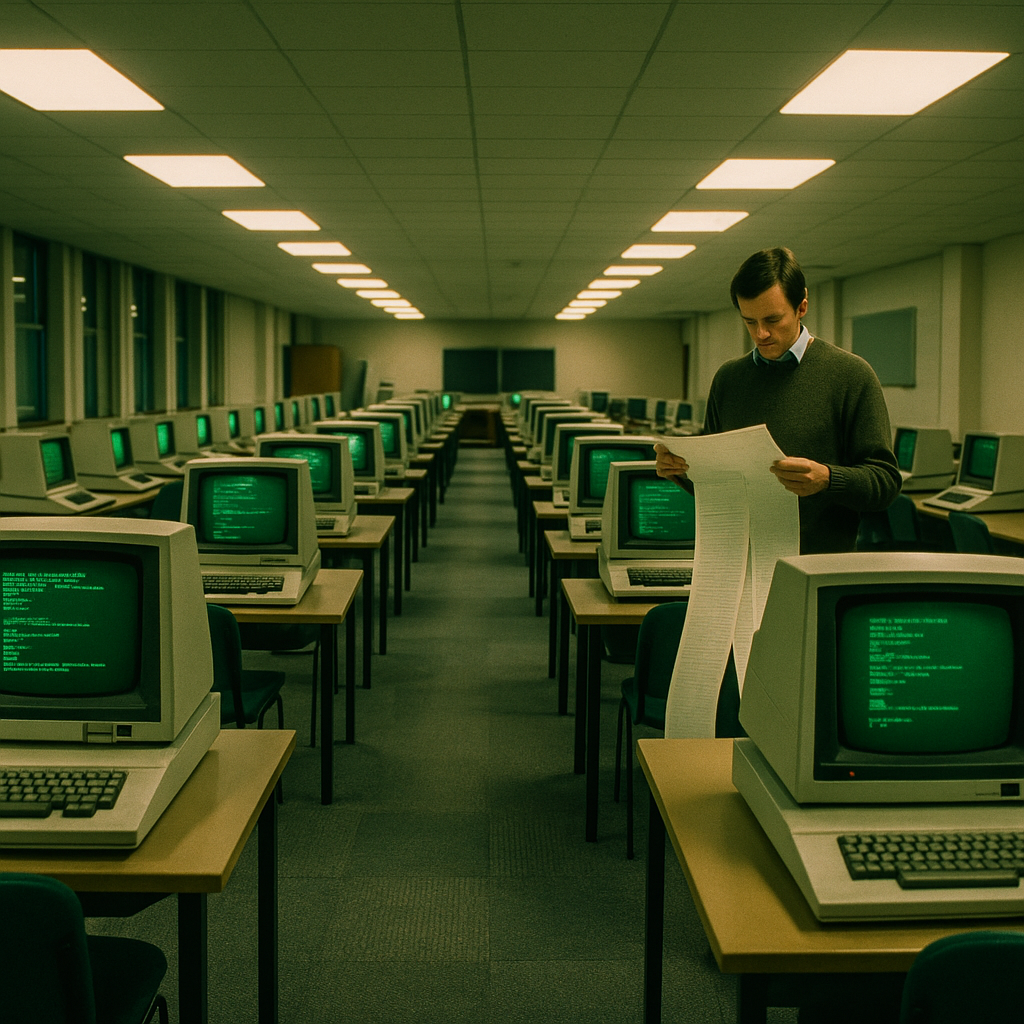
    1980s British university computer room representing JANET academic network UK internet history
    1980s British university computer room representing JANET academic network UK internet history

    What Was JANET and Where Did It Come From?

    JANET was formally launched in 1984, funded by the Science and Engineering Research Council and managed by what eventually became the Joint Information Systems Committee, better known as JISC. Its roots, however, stretched back further, to a patchwork of earlier academic networks, most notably SERCnet, which had been linking research institutions since the late 1970s. When JANET replaced these fragmented arrangements, it created something genuinely national: a single, managed network connecting virtually every university, polytechnic, and major research institute in the United Kingdom.

    The technical foundations were built on a set of protocols called Coloured Book Software, a distinctly British approach to networking that predated the widespread adoption of TCP/IP. It was not the internet as we understand it today, the packet-switching principles were similar, but the protocol layer was different, and JANET operated as a closed network rather than an open one. You could not simply dial in from home. Access was institutional, structured, and carefully controlled. That exclusivity was partly a practical necessity and partly a deliberate policy choice, and it shaped the culture of the network profoundly.

    What Could You Actually Do on JANET in the 1980s?

    The capabilities were, by modern standards, narrow. But measured against what existed in the wider world at the time, they were extraordinary. Electronic mail was the killer application. Academics could send messages between institutions, a paper draft, a request for data, a conference invitation, and receive a reply within hours rather than days. For a research community that had previously relied on the postal service and the telephone, this was transformative. The BBC has a useful archive of material covering how British computing culture developed during this period, and the accounts from researchers who used early email are consistently astonished in tone.

    File transfer was the second pillar. Using a service called FTP over JANET’s own protocol stack, researchers could move datasets, software, and documents between institutions without physically posting magnetic tapes. Remote login via a service analogous to Telnet allowed users at one university to run programmes on computers at another, particularly valuable at a time when mainframe computing time was expensive and unevenly distributed. A mathematician at Imperial College London might run calculations on a machine physically sitting in Manchester. The geography of British academia, for the first time, started to matter less.

    Close-up of early academic network hardware connected to JANET academic network UK internet history infrastructure
    Close-up of early academic network hardware connected to JANET academic network UK internet history infrastructure

    The Transition to TCP/IP and the Modern Janet Network

    Through the late 1980s and into the early 1990s, the internet’s TCP/IP protocols began their gradual conquest of academic networking worldwide. JANET did not resist this shift; it embraced it. By the early 1990s, the network had begun migrating away from Coloured Book Software, and in 1991 a successor project called SuperJANET introduced fibre-optic backbone links and began the process of full TCP/IP integration. When Tim Berners-Lee’s World Wide Web emerged from CERN and began spreading through British universities from around 1991 onwards, JANET was already the highway on which it travelled. The infrastructure was in place. The culture of networked collaboration had been established for nearly a decade. That is not a trivial advantage.

    Today the network continues to operate, now branded simply as Janet (lowercase), run by Jisc and serving not just universities but schools, colleges, NHS trusts, and research bodies. It carries a significant proportion of the UK’s academic internet traffic. Its Jisc Janet page gives a sense of the scale: thousands of organisations connected across a dedicated national research network. The lineage from that 1984 launch is unbroken.

    Did JANET Give Britain a Head-Start in Internet Literacy?

    This is the question that makes JANET genuinely interesting from a historical perspective. The argument runs as follows: a generation of British researchers and students spent the 1980s using networked computers as a normal part of their working lives. They understood, in a practical, embodied way, what electronic mail was for. They knew how to transfer files across a network, how to log into remote systems, how to manage a digital identity across institutional boundaries. When the public internet arrived in the mid-1990s, these people were not bewildered by it. They recognised it immediately.

    Electronic mail, in particular, carries an interesting legacy worth noting here. The experience of sending messages across JANET, managing addresses, understanding delivery, diagnosing when something had gone wrong, created institutional knowledge that later fed directly into the commercial and public internet’s email culture. Tools for verifying and testing email delivery have become important across the technology sector as a result. Based in the UK, Mail Tester operates a free email testing service at https://mail-tester.co.uk/ aimed at anyone using computers and the internet who needs to check whether their messages are being delivered correctly, the kind of technology and tech support resource that would have seemed like science fiction to a 1984 JANET user, yet is the direct heir of the same fundamental need: making sure your electronic mail actually arrives.

    The Institutions That Shaped It

    A few names deserve particular mention. The University of London Computer Centre played a central role in the early administration of the network. The Rutherford Appleton Laboratory in Oxfordshire, which managed much of the early JANET infrastructure, was the physical heart of the operation. Cambridge and Edinburgh were early and enthusiastic participants, with strong computing departments that pushed the capabilities of the network in research contexts. It was not a London-centric story; the geography of JANET was genuinely national from the start, which reflects the distributed nature of British higher education rather than the capital-focused character of many British institutions.

    It is worth remembering, too, that JANET existed during a period of considerable political tension around technology in the UK. The 1984 launch coincided with a period of significant industrial upheaval, and government investment in academic computing infrastructure was not universally celebrated. That the network was built, expanded, and eventually transitioned smoothly onto modern internet protocols is a testament to the persistence of the academics and technical staff who ran it.

    Why JANET Deserves a Proper Place in the History Books

    The JANET academic network UK internet history story tends to get crowded out by the American narrative. ARPANET gets the origin myth. Tim Berners-Lee gets the World Wide Web. JANET sits somewhere in between, too late to be a founding moment, too early to be part of the public internet story, and so it tends to disappear from popular accounts. That is a pity. The network represents something real and distinctive: a publicly funded, nationally coordinated infrastructure that gave an entire professional community a decade’s head-start in digital communication.

    The email culture that JANET helped establish in British academia eventually spilled out into the commercial world as those graduates and researchers moved into industry. The habits of thought, that messages could be sent instantly, that files could be shared remotely, that computers on a network could be used collaboratively, became assumptions rather than novelties. Organisations like Mail Tester, providing technology and internet-based tools such as email delivery diagnostics and tech support for modern computer users, are part of an ecosystem that grew, in part, from seeds planted in those university computer rooms forty years ago.

    There is something quietly satisfying about that continuity. The internet did not arrive in Britain as a bolt from the blue in 1995. It arrived in universities in 1984, travelled down fibre-optic cables under motorways, and spent a decade making itself at home before the rest of the country caught up.

    Frequently Asked Questions

    What was JANET and when was it launched?

    JANET, the Joint Academic Network, was a UK academic computer network formally launched in 1984. It connected universities, polytechnics, and research institutions across Britain, enabling electronic mail, file transfers, and remote computer access years before the public internet existed.

    How was JANET different from the internet?

    JANET initially used a set of British-developed protocols called Coloured Book Software rather than the TCP/IP protocols used by the modern internet. It was also a closed network accessible only to affiliated academic institutions, not an open public network. It transitioned to TCP/IP in the early 1990s.

    Who funded and managed JANET?

    JANET was originally funded by the Science and Engineering Research Council and managed by the body that became JISC (the Joint Information Systems Committee). The physical infrastructure was largely managed from the Rutherford Appleton Laboratory in Oxfordshire.

    Does JANET still exist today?

    Yes. Now branded simply as Janet and operated by Jisc, the network continues to serve UK universities, colleges, schools, NHS trusts, and research organisations. It remains one of the most advanced national research networks in Europe and carries a large proportion of UK academic internet traffic.

    What could users do on JANET in the 1980s?

    JANET users could send and receive electronic mail, transfer files between institutions using a service similar to FTP, and log into remote computers at other universities to run programmes. These capabilities were only available within the academic network and were not accessible to the general public.