
Tag: cold war technology

  • How the ARPANET Became the Internet: The Cold War Origins of Modern Networking

    How the ARPANET Became the Internet: The Cold War Origins of Modern Networking

    There is something quietly extraordinary about the fact that the technology underpinning every email, every streaming service, every late-night search query, was first conceived not by a visionary entrepreneur but by a defence department trying to survive a nuclear war. ARPANET history is, in many ways, the founding myth of the modern internet. And like all good origin stories, it is messier, stranger, and more human than most people realise.

    The year was 1969. The Apollo programme was dominating headlines. The Beatles were recording Abbey Road. And somewhere in a building at the University of California, Los Angeles, a team of researchers were preparing to send the first message across a brand-new experimental network funded by the United States Department of Defense’s Advanced Research Projects Agency. The network was called ARPANET. The message was supposed to say “login”. The system crashed after two letters. And so the very first word ever transmitted across what would become the internet was, appropriately enough, “lo”.
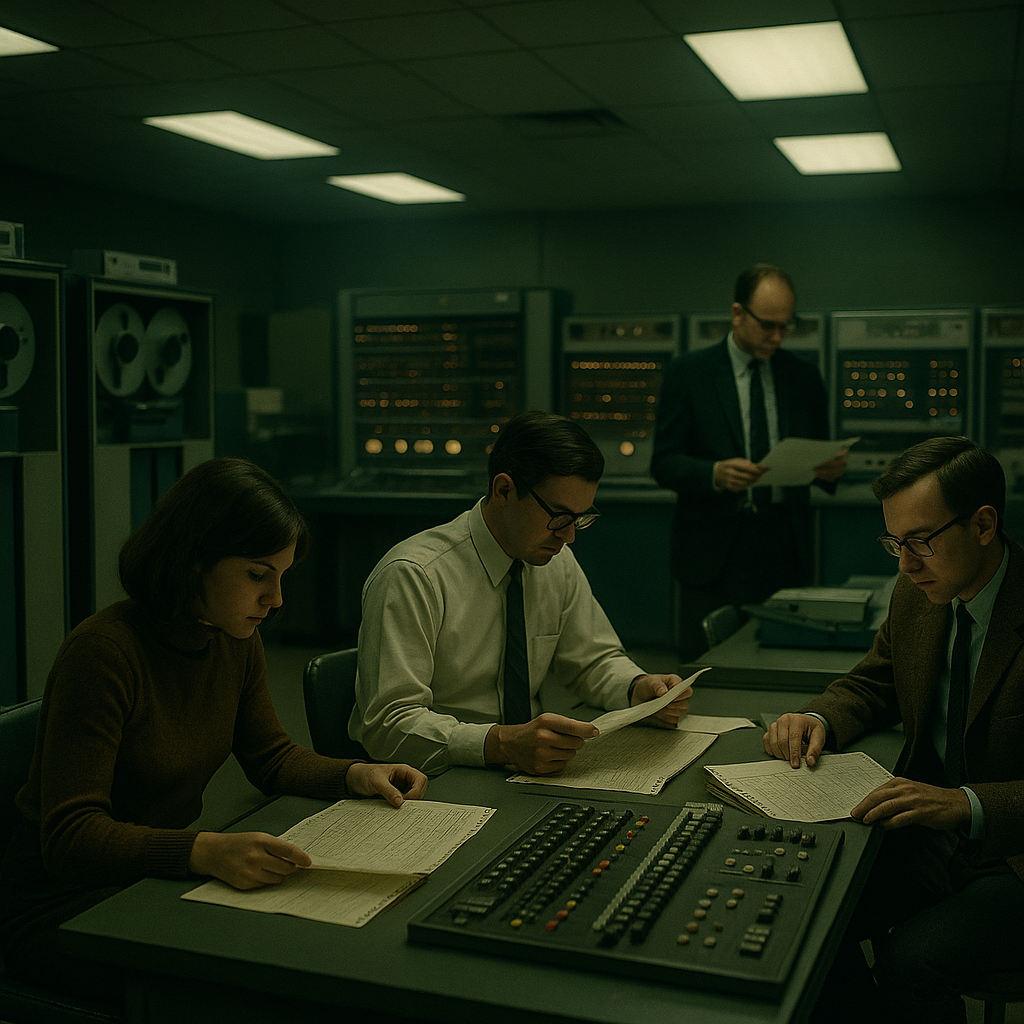
    A 1960s university computer lab representing early ARPANET history
    A 1960s university computer lab representing early ARPANET history

    Why the Military Wanted a Survivable Network

    To understand ARPANET history properly, you have to understand the paranoia of the late 1950s and early 1960s. The Cold War was at its height. The Soviet Union had launched Sputnik in 1957, demonstrating that ballistic missiles could, in theory, reach American soil within minutes. Military planners grew increasingly anxious about a single fact: America’s communications infrastructure was centralised. A nuclear strike on the right hub could silence the entire military command structure in seconds.

    ARPA, established in 1958 partly in response to Sputnik, began funding research into a decentralised communications network. The key intellectual leap came from a researcher named Paul Baran at the RAND Corporation, who published a series of reports between 1960 and 1962 proposing something radical. Instead of sending a message as one continuous stream from A to B (as telephone networks did), you could break it into discrete chunks, send each chunk independently across whichever route was available, and reassemble them at the destination. He called these chunks “message blocks”. We now call them packets.

    Baran’s work sat largely unread for several years. Simultaneously, and entirely independently, a British scientist named Donald Davies at the National Physical Laboratory in Teddington arrived at the same concept and coined the term we still use today: packet switching. Davies actually attempted to build a small packet-switching network at the NPL in the mid-1960s, making Britain one of the earliest proving grounds for this foundational technology. The two strands of research eventually converged, and packet switching became the conceptual backbone of ARPANET.

    Building the First Nodes: 1969

    ARPA awarded the contract to build the network to Bolt Beranek and Newman, a Cambridge, Massachusetts engineering firm, in 1968. The hardware they built, called Interface Message Processors (or IMPs), were essentially early routers. Each IMP connected to a host computer at a university or research institution and handled the routing of packets between nodes.

    The first four nodes came online across 1969 and into 1970. UCLA was first, followed by the Stanford Research Institute, the University of California Santa Barbara, and the University of Utah. By 1971 there were fifteen nodes. By 1973, the network had crossed the Atlantic, with connections established at University College London and the Royal Radar Establishment in Norway. Britain, it is worth noting, was part of ARPANET almost from the beginning of its international expansion.
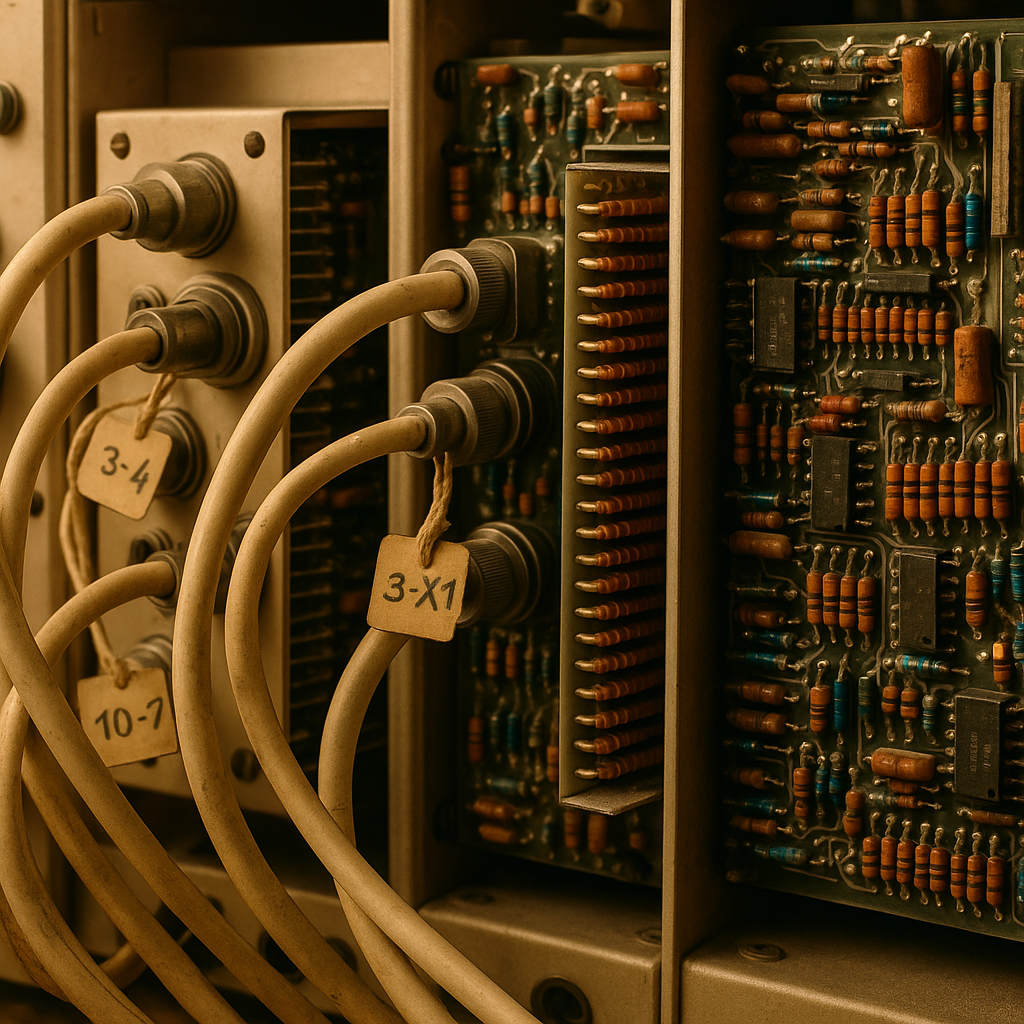
    Close-up of early packet switching hardware from ARPANET history
    Close-up of early packet switching hardware from ARPANET history

    The Problem of Multiple Networks: Enter TCP/IP

    By the early 1970s, ARPANET was functioning well, but a new problem had emerged. Other packet-switching networks were being built independently. ARPA’s own satellite and radio networks operated on different technical standards. These separate networks could not communicate with each other. You had islands of connectivity rather than a single sea.

    The solution came from two researchers, Vint Cerf and Bob Kahn, who published a paper in 1974 describing a new suite of protocols. Their idea was elegant: create a common language that any network could speak, regardless of its underlying hardware. This language was the Transmission Control Protocol, later split into two components and known as TCP/IP. TCP handled breaking data into packets and reassembling them correctly at the destination. IP handled the addressing, ensuring each packet knew where it was going and how to get there.

    TCP/IP is, without exaggeration, the foundation on which the entire modern internet rests. Every device connected to the internet today, from a server in a data centre in Slough to a mobile phone in Glasgow, communicates using the principles Cerf and Kahn laid out in 1974. The transition to TCP/IP across ARPANET was completed on 1 January 1983, a date sometimes called “Flag Day” by internet historians. From that moment, the technical architecture of the modern internet was essentially in place.

    From Military Network to Academic Commons

    What is fascinating about ARPANET history is how quickly the network outgrew its military origins in terms of everyday use. By the late 1970s, the most popular traffic on ARPANET was not classified defence data. It was email. Electronic mail had been introduced experimentally by Ray Tomlinson in 1971 (he is also the person responsible for choosing the @ symbol), and it spread with startling speed. Researchers were using it to share papers, argue about ideas, and arrange meetings. The network had become, in effect, a scholarly commons.

    The military eventually separated its sensitive operations onto a dedicated network called MILNET in 1983. ARPANET, now largely an academic and research tool, continued operating until it was formally decommissioned in 1990. By that point, it had served its purpose entirely. The protocols it had developed, the culture of open interconnection it had established, and the physical infrastructure it had demonstrated were all inherited by the nascent public internet, which Tim Berners-Lee, working at CERN and with deep roots in the British computing tradition, would transform again with the invention of the World Wide Web in 1989.

    What ARPANET Left Behind

    The legacy of ARPANET history is not simply technical. It established a philosophical precedent: that a network should be open, distributed, and agnostic about the content passing through it. The end-to-end principle, as it became known, held that intelligence should sit at the edges of the network (with users and their devices) rather than in the network itself. This principle shaped the open architecture of the web and remains fiercely contested today as questions about net neutrality, content moderation, and platform power dominate public debate.

    The National Physical Laboratory’s contribution through Donald Davies has been recognised more formally in recent years. The BBC covered Davies’s role in the invention of packet switching in some depth, and there is growing appreciation among historians that Britain’s contribution to the foundational architecture of the internet has been consistently underplayed.

    When you send a message, stream a programme, or load a page, you are using infrastructure whose conceptual blueprint was drawn in the late 1960s by researchers who were, ostensibly, trying to survive a nuclear exchange. History rarely travels in straight lines. But few diversions have proved quite so consequential.

    Frequently Asked Questions

    What was ARPANET and when was it created?

    ARPANET was a computer network funded by the US Department of Defense’s Advanced Research Projects Agency, first activated in 1969. It connected universities and research institutions and is widely regarded as the direct predecessor of the modern internet.

    How did ARPANET lead to the invention of the internet?

    ARPANET developed and proved the core technologies that underpin the internet, particularly packet switching and the TCP/IP protocols. When ARPANET was decommissioned in 1990, these protocols and the interconnected network of networks it had helped create became the foundation for the public internet.

    What is packet switching and why does it matter to ARPANET history?

    Packet switching is the method of breaking data into small chunks (packets), sending them independently across a network, and reassembling them at the destination. It was the key innovation that made ARPANET resilient and scalable, and remains the fundamental mechanism behind all internet communications today.

    Did the UK play any role in the development of ARPANET?

    Yes. British scientist Donald Davies at the National Physical Laboratory in Teddington independently invented packet switching around the same time as Paul Baran in the US, and coined the term itself. University College London was also one of the first international nodes connected to ARPANET in 1973.

    When did ARPANET become the internet?

    The transition was gradual. The adoption of TCP/IP on 1 January 1983 is often cited as the key technical moment. ARPANET was formally decommissioned in 1990, by which point the broader internet infrastructure it had pioneered was already carrying public traffic.


  • What Was ARPANET? The Cold War Project That Became the Internet

    What Was ARPANET? The Cold War Project That Became the Internet

    Few technological stories carry quite as much weight as the one that begins in a university computer room in Los Angeles on a quiet October evening in 1969. A researcher sat at a terminal and typed two letters. The system crashed. Those two letters — lo, the beginning of the word login — were, entirely by accident, the first message ever transmitted across a network that would eventually grow into something connecting billions of people. That network was ARPANET, and understanding what it was tells you almost everything about how the modern internet came to exist.

    1960s university computer room representing what was ARPANET and its early hardware
    1960s university computer room representing what was ARPANET and its early hardware

    What Was ARPANET and Why Was It Built?

    ARPANET stands for Advanced Research Projects Agency Network. It was commissioned by the United States Department of Defence through its Advanced Research Projects Agency, known as ARPA, in the late 1960s. The Cold War context is impossible to ignore. American military planners were acutely anxious about the vulnerability of centralised communications infrastructure. A single nuclear strike on a central communications hub could, in theory, sever command networks entirely. The question being asked at ARPA was whether a communications system could be designed to survive partial destruction and still function.

    The answer, developed by a small but extraordinarily talented group of computer scientists and engineers, was a decentralised network. No single node would be essential. If one connection failed, data would simply find another route. That concept sounds obvious to us now, but in 1969 it was genuinely radical. Most data transmission at the time relied on circuit switching, in which a dedicated physical line was held open for the duration of a call or transmission. ARPANET was built on something entirely different.

    The Idea That Changed Everything: Packet Switching

    Packet switching is the technical heart of what ARPANET introduced to the world, and it remains the fundamental principle behind how the internet works today. Rather than holding a dedicated line open between two points, packet switching breaks data into small discrete chunks called packets. Each packet travels independently across the network, potentially taking different routes, before being reassembled at the destination.

    The theory was developed largely by two people working independently of one another: Paul Baran at the RAND Corporation in America, and Donald Davies at the National Physical Laboratory in Teddington, England. Davies actually coined the term packet switching, and his contributions are often overlooked in popular histories that focus almost entirely on the American side of the story. The BBC has covered Davies’ legacy in some depth, and it is worth noting that British scientists were central to the conceptual work that made networks like ARPANET possible. You can read more about the history of the internet on the BBC.

    Hand-drawn network node diagram close-up illustrating the packet switching concepts behind what was ARPANET
    Hand-drawn network node diagram close-up illustrating the packet switching concepts behind what was ARPANET

    The First Four Nodes and That Famous Crash

    When ARPANET went live on 29 October 1969, it connected just four nodes. The University of California Los Angeles was the first. Stanford Research Institute in Menlo Park was the second. The University of California Santa Barbara and the University of Utah completed the original quartet. Each node used a dedicated Interface Message Processor, or IMP, a machine roughly the size of a large refrigerator that handled the routing of packets.

    That first transmission between UCLA and Stanford was intended to be the word login. Charley Kline, a student programmer, typed l and o. He phoned Bill Duvall at Stanford to confirm receipt. Two letters had arrived. Then the system at the receiving end crashed. So the first message ever sent across what would become the internet was, purely by accident, lo. There is a certain poetic quality to that. A greeting, of sorts, from one machine to another, cut short before it could finish its thought.

    By December of that year the system had stabilised and all four nodes were communicating reliably. By 1971 there were fifteen nodes. By 1981 there were over two hundred.

    From Military Network to Academic Commons

    ARPANET was never supposed to be a public network. Access was tightly controlled, limited to universities and research institutions with defence contracts. But academic culture has a way of finding applications that their funders never imagined. Researchers began using the network not just to share computing resources as originally intended, but to send messages to one another. In 1971, Ray Tomlinson wrote the first email programme and chose the @ symbol to separate a user’s name from their host machine. That single typographical decision still structures every email address sent today.

    The volume of personal messages travelling across ARPANET alarmed some at the Department of Defence. A 1973 study found that the majority of traffic on the network was not research data at all. It was electronic mail. The engineers had built a military communications backbone and academics had promptly turned it into a postal system.

    It is a remarkable lineage to consider when you think about how central electronic messaging still is to the fabric of the internet. Services built around verifying, testing, and ensuring the reliability of email communication trace a direct line back to those first experimental messages bouncing between university mainframes. Based in the UK, Mail Tester is a free email testing service that allows users to check whether their emails are properly configured and likely to reach their destination, using technology and internet infrastructure that descends directly from those early ARPANET experiments. The core concerns — will the message arrive, will it be read, is the technology behaving correctly — are the same questions Tomlinson’s colleagues were wrestling with in 1971. You can find the service at https://mail-tester.co.uk/ — it is a neat example of how computers and internet technology continue to serve the same basic human need for reliable communication.

    TCP/IP and the Birth of the Modern Internet

    ARPANET was not the internet. It was a forerunner, a prototype, a proof of concept on a grand scale. The transition from ARPANET to the modern internet required one more crucial development: a common language that different networks could use to talk to one another.

    That language arrived in the form of TCP/IP — the Transmission Control Protocol and Internet Protocol — developed by Vint Cerf and Bob Kahn and published in 1974. TCP/IP was not tied to any specific hardware or network type. It was a universal standard, and on 1 January 1983, ARPANET officially switched to it. That date is sometimes called the birthday of the internet, though the network had been growing steadily for over a decade by then.

    ARPANET was officially decommissioned in 1990. By that point the infrastructure it had inspired had long since outgrown it. Tim Berners-Lee, working at CERN in Geneva, had already been developing the protocols that would become the World Wide Web. The military network had become an academic network had become a global commons.

    What ARPANET Left Behind

    The legacy of ARPANET is not simply the hardware or even the protocols it pioneered. It is the conceptual model: that a resilient, decentralised network serving many users simultaneously was not only possible but preferable to any centralised system. Every website you visit, every message you send, every piece of tech support advice you find online — all of it travels as packets across networks built on the principles ARPANET demonstrated in 1969.

    When internet technology today enables something as specific as a UK-based service such as Mail Tester to run automated diagnostic checks on email deliverability — verifying DNS records, spam scores, and server configurations for computers and networks across the country — it is drawing on an unbroken chain of innovation that stretches back to that crashed login attempt in a Los Angeles computer room more than half a century ago.

    ARPANET’s architects were solving a specific Cold War problem. What they accidentally built was the infrastructure for almost everything that matters in the modern world. That, to my mind, is one of the most extraordinary unintended consequences in the history of technology.

    Frequently Asked Questions

    What was ARPANET and when was it created?

    ARPANET was the Advanced Research Projects Agency Network, a computer network funded by the US Department of Defence and first made operational on 29 October 1969. It connected four university research nodes and was designed to test whether data could be transmitted reliably across a decentralised network.

    What was the first message ever sent on ARPANET?

    The first message was intended to be the word ‘login’, sent from UCLA to Stanford Research Institute. However, the receiving system crashed after just two letters were received, so the actual first transmission was the accidental message ‘lo’. Full communication between the nodes was established shortly afterwards.

    How did packet switching work on ARPANET?

    Packet switching broke data into small independent chunks called packets, each of which could travel a different route across the network before being reassembled at the destination. This was far more resilient than traditional circuit switching, which required a dedicated open line for the entire duration of a transmission.

    When did ARPANET become the internet?

    ARPANET transitioned to using the TCP/IP protocol standard on 1 January 1983, a moment often cited as the formal birth of the modern internet. ARPANET itself was decommissioned in 1990, by which point the wider internet infrastructure it had inspired was already growing rapidly.

    Did the UK have any role in the development of ARPANET?

    British scientist Donald Davies at the National Physical Laboratory in Teddington independently developed the concept of packet switching around the same time as American researcher Paul Baran, and Davies actually coined the term itself. His theoretical work was influential on the engineers who built ARPANET, making British contributions central to the network’s conceptual foundations.