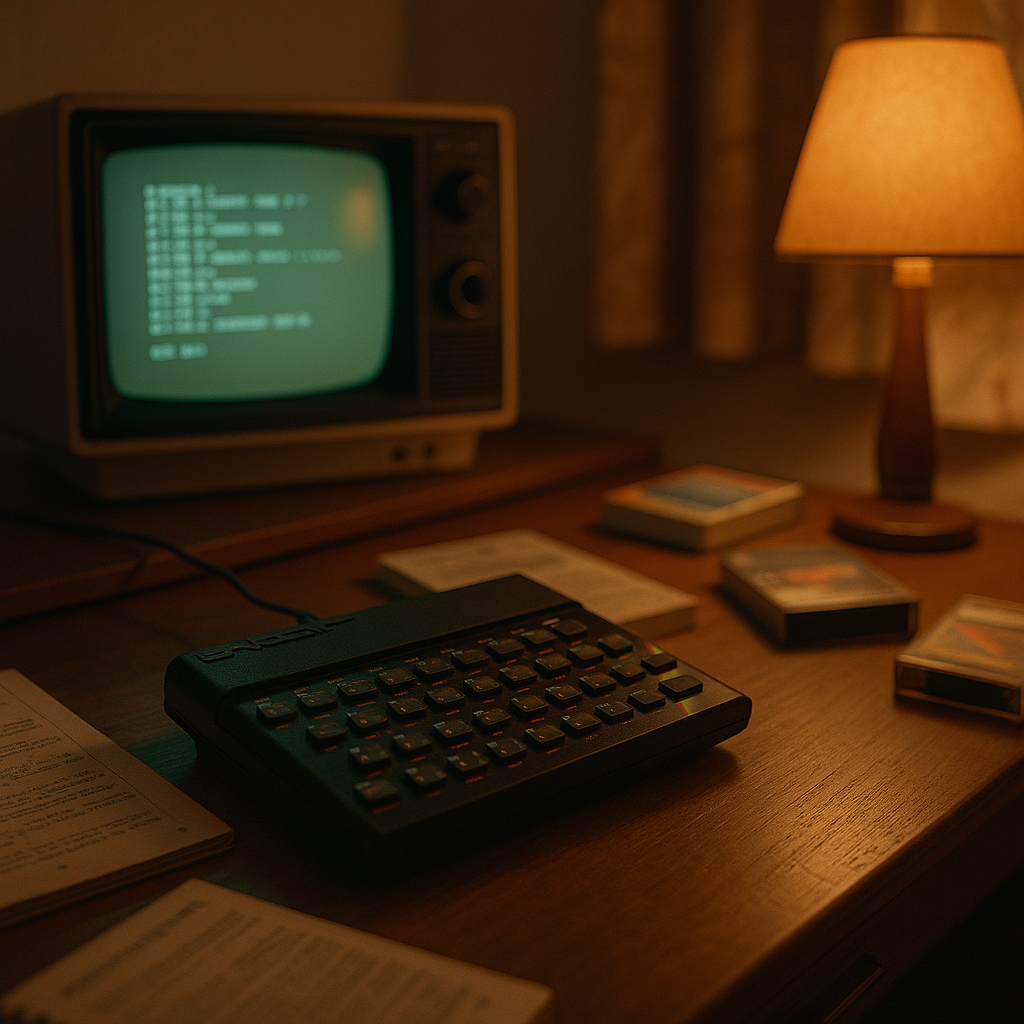
There is a particular kind of nostalgia attached to British gaming that has nothing to do with the games themselves. I am thinking of the Saturday morning ritual: kneeling in front of the television at an ungodly hour, notebook in hand, waiting for Teletext page 150 to cycle round to the cheats section. If you blinked at the wrong moment, you missed it, and the whole carousel started again. That was the internet before the internet, and for several years it was entirely sufficient.
The UK games industry online history is, in many ways, the story of an audience that was always a few steps ahead of the infrastructure available to it. British players wanted more, more cheats, more previews, more contact with developers, long before broadband made any of that genuinely practical. What filled the gap was a patchwork of surprisingly ingenious solutions: premium-rate phone lines, fax-back services, magazine cover discs, and yes, Ceefax and its commercial rival Oracle. The path from those stop-gap measures to Steam’s launch in 2003 is a shorter journey than it looks, but it passes through some genuinely fascinating terrain.

Teletext cheats pages and the premium tips line era
Teletext’s games coverage was not especially deep, but it was instantaneous by the standards of the early 1990s. Channel 4’s Teletext service (the commercial successor to Oracle) ran dedicated gaming sections that listed cheat codes, level passwords, and occasionally brief reviews. The BBC’s own Ceefax service carried similar material. Neither was interactive, and neither let you ask a follow-up question. That gap was filled, lucratively, by premium-rate telephone tips lines.
Games companies and third-party operators set up dedicated 0891 numbers throughout the late 1980s and into the mid-1990s. Calls were charged at up to 50p per minute, and a single session talking to an automated system, or, on better lines, an actual human being with a ring-binder full of solution guides, could run to several pounds. The BT quarterly bill arriving with a mysterious £30 addition caused genuine family arguments across Britain. I have spoken to people who still wince at the memory. According to period coverage in Edge magazine, some lines were generating tens of thousands of calls per week at the height of the Super Nintendo era.
What the tips lines showed, beyond their obvious profitability, was that British players had an appetite for information they were prepared to pay for. That appetite did not disappear when the internet arrived. It simply migrated.
The magazine and cover disc bridge
Before dedicated gaming websites existed, the UK had something arguably better: a games press that was the finest in the world. CRASH, Zzap!64, Mean Machines, CVG, GamesMaster and eventually Edge formed a publishing ecosystem that had no real equivalent abroad. These titles did not just review games; they explained them, satirised them, and built communities around them through letters pages that functioned as a primitive social network.
The cover disc was the physical equivalent of a download. From the early 1990s onwards, magazines bundled floppy discs and later CD-ROMs containing demos, shareware, and occasionally full games. PC Zone and PC Gamer UK made cover discs a central part of their proposition. The CD-ROM format, in particular, carried enormous amounts of data by the standards of dial-up connections, meaning that players without fast internet could still access substantial trial content. The disc was, effectively, the offline download store.

Early UK gaming websites and the dial-up era
The UK games industry online history begins in earnest somewhere around 1994 to 1996, when individual studios and enthusiast communities started staking out territory on the web. The process was chaotic. Some of the most important early sites were run by fans rather than professionals, hosted on university servers via the same dial-up connections that everyone else was crawling along on.
Rare, the Twycross-based developer behind Donkey Kong Country and GoldenEye 007, had an early web presence that was sparse by any modern measure but remarkable for its time. Core Design in Derby, the studio that gave the world Lara Croft in 1996, maintained a site that included developer diaries and fan interaction. These were not sophisticated operations. They were often a few static HTML pages maintained by someone who had taught themselves to code in an evening. But they worked, and they demonstrated that the audience was genuinely interested in the people behind the games, not just the games themselves.
Eurogamer launched in 1999, initially as a small UK-focused review site. GameFAQs, though American in origin, built a British user base that had been trained by years of Teletext cheats pages to seek out exactly that kind of reference material. Meanwhile, the dot-com boom brought speculative investment into online gaming media, with ventures like Gameplay.com attempting to build integrated retail and content operations before the crash made that kind of ambition briefly unfashionable.
Multiplayer servers and the emergence of online communities
Quake, released in 1996, changed British gaming culture in a way that is difficult to overstate. id Software’s game shipped with built-in TCP/IP support, which meant that anyone with a modem and enough patience could connect to a server and play against other human beings. The experience, on a 28.8k modem, was not exactly smooth. Lag was a constant companion. But the basic idea, that you could play a game with someone in Edinburgh while sitting in Southampton, was genuinely new to most players.
British gaming communities assembled around game servers maintained by enthusiasts, often on university networks where bandwidth was relatively generous. Clan culture developed rapidly. The early UK competitive scene for games like Quake and then Quake II was organised largely through mailing lists, IRC channels, and rudimentary league websites. The Clanbase network, which organised online competitions across Europe, drew substantial British participation throughout the late 1990s and early 2000s.
Some of the digital communities that formed around multiplayer gaming at this period bear comparison to other kinds of online political and cultural organising. Researchers at activism.digital who study how internet communities form around shared causes will recognise the structural similarities: a dispersed group with a common interest, a shared information infrastructure, and the gradual development of norms and leadership. Games clans were not political, but they were organised, and they were distinctly British in their habits and humour.
From download demos to early digital retail
The transition to digital distribution happened in stages. The demo download was the first. By the late 1990s, studios were releasing timed or limited versions of their games as free downloads, a practice that had existed on the PC platform since the shareware model of the early 1990s but which now reached a wider audience through web hosting rather than floppy disc distribution.
Gameplay.com and Jungle.com were early attempts at UK online games retail, selling physical boxes rather than downloads, but getting players used to the idea of ordering games without visiting a shop. The real shift came with Valve’s Steam platform, launched in September 2003. Steam’s initial rollout was not universally celebrated; the requirement to authenticate Half-Life 2 online before playing it caused considerable complaint. But within a few years, the model had become standard, and the British high street games shop was on notice.
What the UK brought to online gaming
Britain’s contribution to this story is not simply that of a passive consumer market. The UK games press trained a generation of players to think critically about games at a time when most countries treated them as pure product. Studios like Bullfrog Productions in Guildford, Lionhead in Guildhead, and Rockstar North in Edinburgh built international reputations while remaining distinctly British in sensibility. The dry wit of Theme Hospital, the moral ambiguity of early Grand Theft Auto, the philosophical ambition of Black & White: these were not accidental qualities.
The UK games industry online history is also the history of how a particular kind of community knowledge, the sort of thing that once lived in a Teletext page or a tips-line recording, found its permanent home on the web. It did not happen overnight, and the path was less linear than retrospective accounts often suggest. But the destination, a fully networked games culture with British studios, British press, and British communities at its centre, was always where that Saturday morning ritual with the notebook was pointing.
The cheats pages are gone. The tips lines are long since disconnected. What replaced them turned out to be considerably larger.