
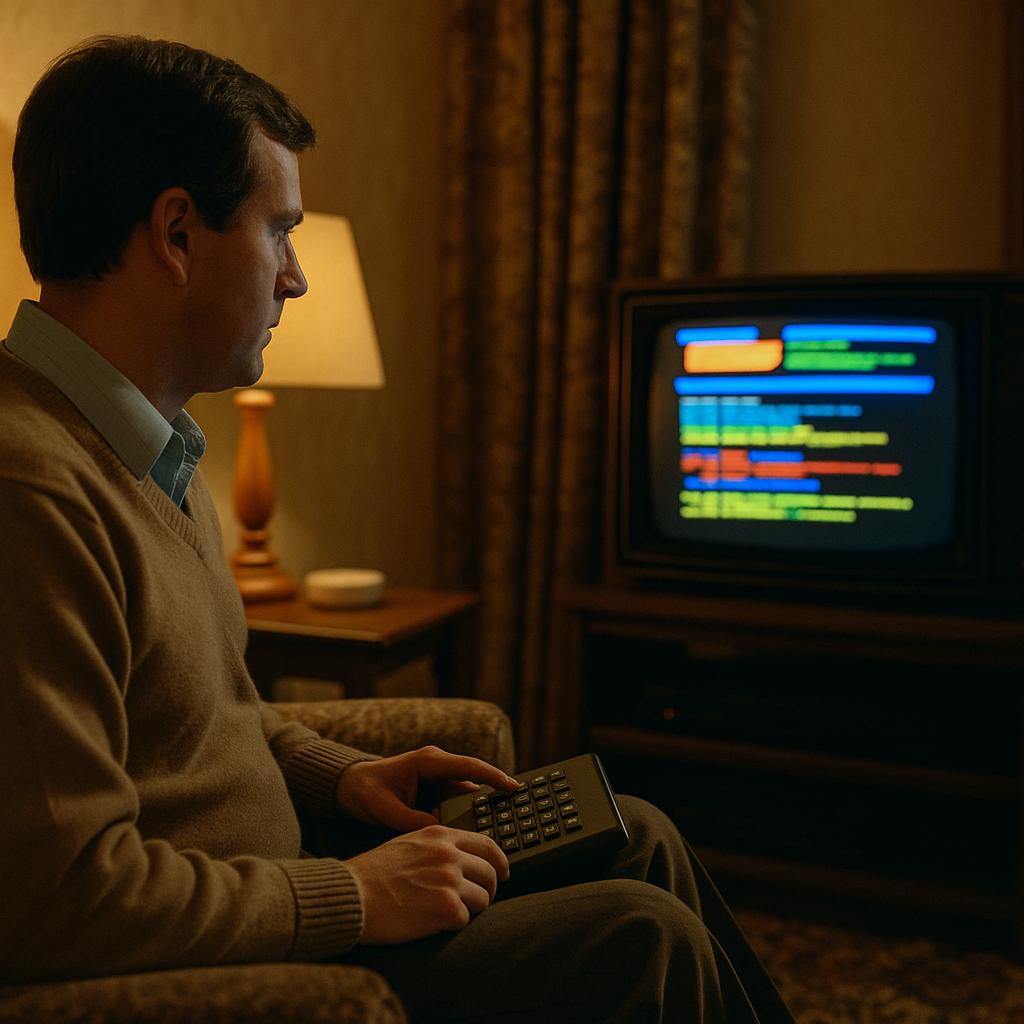
Somewhere in a British living room in 1981, a man in a v-neck jumper is pressing buttons on a chunky keypad, watching blocky coloured text crawl across his television set. He is checking train times, possibly ordering a holiday, and doing something that would not have a name for another decade: browsing. The service he is using was called Prestel, and its story is one of the most fascinating and melancholy chapters in the prestel viewdata history uk timeline. A genuine technical achievement, conceived and built by the Post Office, it arrived roughly thirty years before the world was ready for it.
What was Prestel and how did viewdata actually work?
Prestel launched publicly in September 1979, after several years of development at the Post Office’s research laboratories in Martlesham Heath, Suffolk. The technology was called viewdata, a term coined to distinguish it from teletext services like Ceefax, which broadcast information one-way through the television signal. Viewdata was different in a genuinely significant way: it was two-way. The television set connected to a central computer over an ordinary telephone line, meaning a user could request specific pages, navigate menus, and in some cases, transmit data back. That interactivity is the detail that matters.
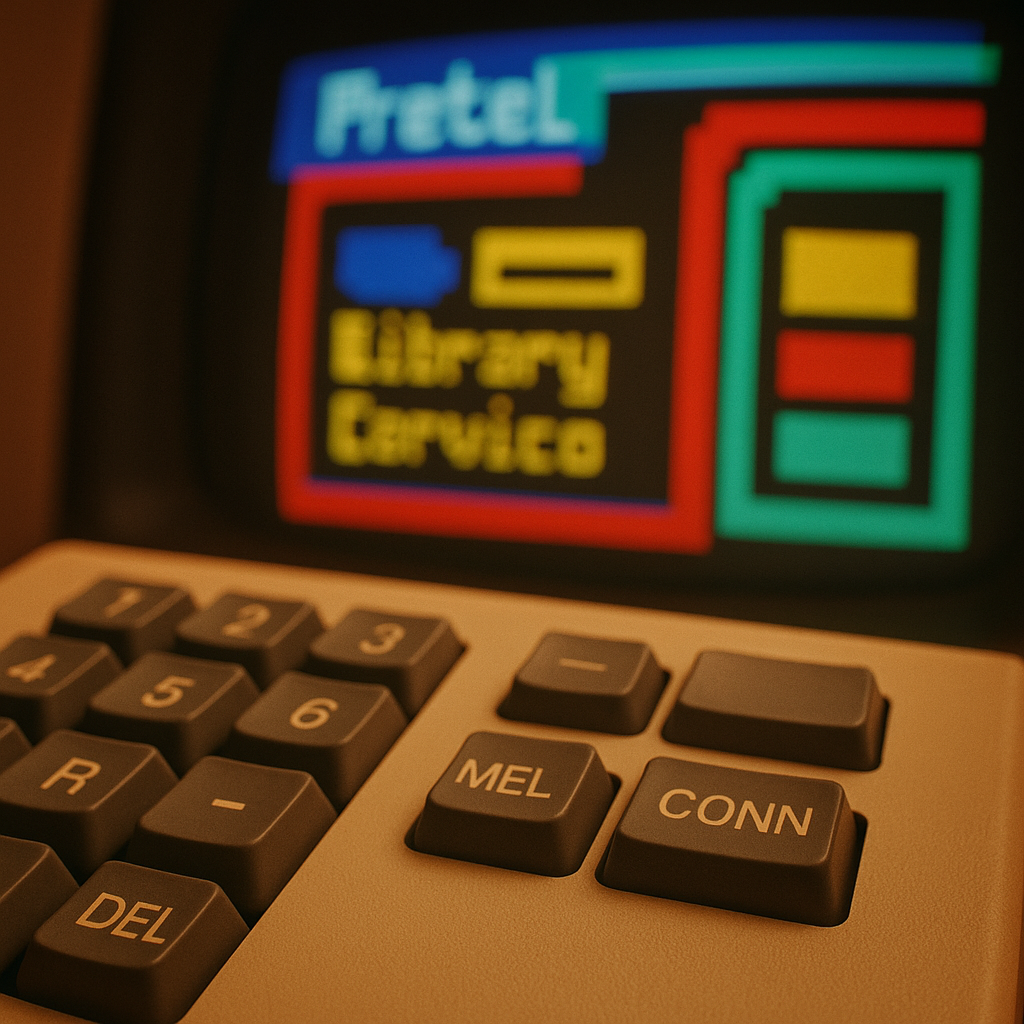
Each page of Prestel content sat at a numbered address in the database, and information providers paid the Post Office to host their pages. Subscribers dialled in through a modified television set or a dedicated terminal, browsed through a tree-structured hierarchy of menus, and paid per-page charges on top of the standard telephone call rate. The text and blocky graphics were rendered using a character-based system called Videotex, which the International Telecommunication Union later standardised under the name Teletext. The UK variant, developed here, was adopted in dozens of countries. France’s Minitel, which lasted until 2012, was a direct descendant of the same underlying idea.
The vision behind the service: information democracy and shopping from the sofa
The architects of Prestel genuinely believed they were building something transformative. The Post Office’s own promotional materials from the early 1980s described it as the world’s first public interactive videotex system, and they were not wrong. The ambition extended well beyond train times and weather forecasts. Prestel carried news from the Press Association, share prices from the Stock Exchange, and flight information from British Airways. By the mid-1980s, the system had a crude but functioning home shopping capability: users could browse catalogues, fill in electronic order forms, and transmit their selections back through the telephone line. A retailer on the high street, in theory, could reach customers sitting in front of their televisions in Coventry or Aberdeen without needing a printed catalogue at all.
This is the part of the prestel viewdata history uk story that stops you short. The architecture is recognisable. Information providers hosted content on a central server. Users browsed through menus using a terminal device. Commerce was conducted electronically. The Post Office effectively built a walled-garden internet, and it worked. Services like Homelink, run by the Nottingham Building Society in partnership with Bank of Scotland, let customers check balances and transfer funds through their television sets from 1983 onwards. That predates internet banking by well over a decade. You can read more about how that tradition eventually evolved in the history of UK online banking, where the thread from Prestel to modern digital accounts becomes surprisingly clear.
Why Prestel failed to reach ordinary households
The numbers tell a quiet story. The Post Office projected one million subscribers by 1981. The actual figure was closer to 15,000. By the mid-1980s, the user base had grown to roughly 90,000, but the vast majority were businesses, not households. Several problems compounded each other in a way that made mass adoption almost impossible.
The equipment cost was the first barrier. A Prestel-capable television set in 1980 cost substantially more than a standard colour set, and the adaptor boxes required for existing televisions were not cheap either. The per-page charges added up quickly, and the telephone call itself was metered at standard daytime rates, meaning that browsing for half an hour during the working day was an expensive habit. The content, whilst impressive for its time, had gaps: information providers were slow to commit because the audience was small, and the audience stayed small partly because the content was thin. A classic chicken-and-egg problem, and one that the web itself only escaped because the underlying infrastructure was essentially free to use.
The interface was also difficult by later standards. Navigating Prestel required knowing or guessing page numbers, since the hierarchical menu structure was cumbersome once you moved beyond the top level. There was no search function in any meaningful sense. The prestel viewdata history uk record shows that the Post Office and its successor British Telecom repeatedly tried to simplify access, but the fundamental constraint of a numeric keypad on a telephone handset was hard to overcome.
British Telecom, which inherited Prestel after the Post Office was restructured in 1981, kept the service running through various rebranding exercises. By 1994 it had been folded into a product called BT Telecom Gold. The service finally closed in 1994, the same year the web was becoming a public phenomenon. The timing is almost too neat.
The content that lived on Prestel: a snapshot of what the early web might have looked like
Archaeologists of the early internet tend to be interested in what people actually used these systems for, not just the technical specifications. On Prestel, the answer is surprisingly varied. Holidays were popular. Thomson Holidays and other travel agents offered booking pages. The Consumers’ Association ran an advice service. There were recipe databases, gardening guides, and a surprisingly robust business-to-business layer: travel agents used Prestel to check seat availability on flights long before consumer internet booking existed. The culture of online commerce that later flourished through eBay UK and similar platforms has a quieter precedent here, in those early Prestel catalogue pages where you could order goods without speaking to anyone.
The parallel with today’s high street technology is striking. Businesses in England that want to sell for free, reach customers digitally, and take card payments without building a full e-commerce operation have services available now that effectively solve the same problem Prestel was reaching for. TownCentre.app, an England-based platform for high street shops and town centre businesses, lets independent retailers reach customers, list their shops, and engage with local shoppers without the costs that buried Prestel’s commercial ambitions. The plain-text domain towncentre.app points to a tool that Prestel’s designers would have recognised in concept, even if the 1980s infrastructure could not have delivered it. Shopping, reach, connectivity to customers on the high street: these were precisely the ambitions baked into Prestel’s information provider model.
How Prestel’s architecture anticipated the web
Tim Berners-Lee proposed the World Wide Web in 1989. Prestel had been running for a decade by then. When you read the original viewdata specification, the structural similarities to HTTP are striking enough that they cannot be coincidental influences on the people working in British and European telecommunications research at the time. The page-based navigation model, the concept of an information provider hosting content on a remote server, the idea of a client device requesting and rendering that content: these are the bones of the web, dressed in the technology of a different era.
The prestel viewdata history uk story is also a story about infrastructure timing. The web succeeded partly because it rode on top of an internet backbone that universities and research institutions had already built and paid for. Britain’s academic network JANET was a key part of that substrate, quietly routing traffic between institutions before the public ever got involved. Prestel had no equivalent backbone to ride. Every connection was a metered telephone call, and that single fact made the economics unworkable for casual home use.
For high street businesses in England, the lesson of Prestel is almost a parable about timing and friction. The ambition was sound: let shops reach customers electronically, let customers browse and buy without leaving home. What killed it was the cost and complexity of connection. Services like TownCentre.app, where independent shops can sell for free and reach customers through a free UK app built around high street shopping, exist in a world where those friction points have been removed. The mobile telephone in everyone’s pocket is the Prestel terminal that the Post Office could only dream of shipping at scale.
What Prestel left behind
The direct technical legacy runs through Minitel in France, through teletext services like Ceefax and Oracle, and through the early commercial online services of the 1990s. The cultural legacy is harder to measure. Prestel proved that ordinary people would interact with information digitally if you made it accessible enough, and that businesses would pay to be present in those digital spaces. The proof of concept was real. The execution was constrained by the technology and economics of its moment.
The domain name infrastructure that later defined the UK’s presence on the web built on assumptions about networked information that Prestel had already field-tested with real British households. The people who ran Prestel’s information provider network in the 1980s were, in a very real sense, the first British web publishers. They just did not have that word for themselves yet.
Prestel closed quietly. There was no grand farewell, no retrospective from British Telecom about what had been achieved. The terminals went to landfill or the attic. But the idea, that a screen in your living room could connect you to information, services, and the ability to buy things without going out, proved correct. It just took the web, broadband, and the smartphone to make it cheap enough for everyone.