
Tag: history of search engines

  • The History of Search Engines: Before Google, There Was AltaVista, Lycos, and Ask Jeeves

    The History of Search Engines: Before Google, There Was AltaVista, Lycos, and Ask Jeeves

    There is a particular kind of nostalgia that belongs exclusively to people who remember typing a question into a search box and genuinely not knowing what would come back. The history of search engines is not simply a technical chronicle. It is a story about how human beings tried to make sense of an entirely new kind of chaos: a global network of documents with no index, no librarian, and no obvious way in. What emerged between the early 1990s and the mid-2000s was a series of remarkable, often competing experiments in organisation. Most of them have been forgotten. A few left marks that still shape the web today.

    A 1990s university computer workstation illustrating the history of search engines in the early internet era
    A 1990s university computer workstation illustrating the history of search engines in the early internet era

    Before the Search Box: Directories and Human Editors

    The earliest attempts to catalogue the web had almost nothing in common with the algorithmic engines we rely on now. Yahoo, launched in 1994 by Jerry Yang and David Filo at Stanford, began as a hand-curated directory. Human editors reviewed websites and sorted them into categories. You did not search Yahoo so much as browse it, clicking through a hierarchy of folders much as you might rifle through a card catalogue at a public library. For a web that was still relatively small, this worked beautifully. For a web that was doubling in size every few months, it was already becoming unworkable before Yahoo had finished setting it up.

    The Open Directory Project, later known as DMOZ, carried this model further into the late 1990s. It relied on volunteer editors from around the world, including a significant contingent of British contributors, to maintain categories and approve submissions. There was something almost Quaker about it: a vast collective effort, unpaid, driven by a genuine belief that the web should be navigable by ordinary people. DMOZ was eventually archived and shut down in 2017, leaving behind a kind of digital museum piece. The BBC covered its closure as though an old institution had quietly locked its doors.

    The Crawler Arrives: AltaVista, Lycos, and Excite

    The real shift came when engineers stopped trying to catalogue the web by hand and started sending out automated programmes, called crawlers or spiders, to do the reading for them. Lycos, which launched out of Carnegie Mellon University in 1994, was among the first to index a genuinely large portion of the web automatically. By 1996, it claimed to have catalogued over 60 million documents. In the UK, Lycos had a noticeable presence: its British site offered local news, entertainment listings, and a search experience that felt, briefly, like it had been designed with you in mind.

    AltaVista, launched by Digital Equipment Corporation in December 1995, was a different kind of animal entirely. It was fast in a way that genuinely shocked people at the time. You typed a phrase and results appeared almost instantly, indexed from a corpus of the web that felt enormous. For a few years, AltaVista was the professional researcher’s tool of choice. Journalists, academics, and early internet enthusiasts in Britain treated it as something close to a reference library. It supported advanced Boolean queries, language detection, and even a rudimentary translation service. The history of search engines cannot be told honestly without spending some time in AltaVista’s reading room.

    Excite, HotBot, and Infoseek occupied similar ground, each with slightly different strengths. HotBot, backed by Wired magazine, had a visual style that felt deliberately provocative. Infoseek was acquired by Disney and folded into what became the Go.com portal, a fate that felt both improbable and entirely of its time. These engines competed not just on relevance but on the whole experience of the homepage: news tickers, weather, stock prices, horoscopes. Search was becoming a destination, not just a utility.

    Close-up of a late 1990s computer screen and keyboard representing the history of search engines
    Close-up of a late 1990s computer screen and keyboard representing the history of search engines

    Ask Jeeves and the British Fondness for a Polite Query

    Ask Jeeves deserves its own chapter. Launched in 1996, it was built around a simple and rather charming premise: that people would prefer to type a natural-language question rather than a clipped keyword string. The name came from P.G. Wodehouse’s unflappable butler, and in Britain the character resonated in a way it probably did not in other markets. Ask Jeeves UK launched in 1999 and quickly gained a loyal following, particularly among people who had come to the internet late and found the starkness of a plain search box mildly intimidating.

    Jeeves, rendered as a small illustrated figure in a tailcoat, promised to understand what you actually meant. The reality was more complicated. The engine relied heavily on a database of pre-written question-and-answer pairs, which editors had compiled by hand. If your question matched one of those pairs closely enough, you got a remarkably good answer. If it did not, you got something retrieved by a partner engine and Jeeves’s promise felt a little hollow. The butler was doing his best, but the library had gaps.

    Ask Jeeves was rebranded simply as Ask.com in 2006, and the butler was retired. It felt, to many British users, like a small cultural loss. You can read a little about the broader cultural context of British internet adoption in the early 2000s through the BBC’s history archive, which touches on how the web reshaped domestic and professional life across the country during that period.

    Why Google Won: PageRank and the End of the Old Web

    Sergey Brin and Larry Page began developing what would become Google at Stanford in 1996. Their insight was deceptively simple: a page that many other pages link to is probably more authoritative than one that few pages link to. This idea, formalised as PageRank, transformed the history of search engines overnight. Where AltaVista counted words, Google counted endorsements. Where Yahoo employed editors, Google employed mathematics.

    By 2001, Google had indexed over three billion web pages and was handling roughly 150 million queries per day. In the UK, it overtook AltaVista as the most-used search engine sometime around 2002, though precise figures from that period are difficult to pin down. What is clear is that the transition happened quickly and, for most users, almost without notice. One week you were using AltaVista; a few months later, you had changed habits so completely that the old tools felt quaint.

    The engines that survived did so by becoming something other than search engines. Yahoo became a media company. Ask reinvented itself as a question-and-answer platform. Lycos limped on in various forms. AltaVista was acquired by Yahoo in 2003 and shut down entirely in 2013, its index preserved nowhere in particular. A significant chunk of early web history vanished with it.

    What We Lost When the Old Engines Disappeared

    There is a real archival question buried in the history of search engines that has never been fully answered. These tools indexed the web at specific moments in time. Their caches held copies of pages that no longer exist. When the engines closed, those caches went with them. The Wayback Machine at the Internet Archive does extraordinary work, but it captures what it can, not everything. The early, searchable web was more fragile than anyone realised at the time.

    For anyone with an interest in what the internet looked like before Google imposed its particular kind of order, the old search engines are worth remembering not just as curiosities but as genuine historical artefacts. They tell us something about how different groups of people, in different countries, imagined the web should be organised. Some thought like librarians. Some thought like engineers. Some thought like television producers. That variety was strange and messy and, in retrospect, rather wonderful.

    Frequently Asked Questions

    What was the first search engine on the internet?

    Archie, created in 1990 at McGill University in Canada, is generally considered the first search engine, though it indexed FTP files rather than web pages. The first tools to crawl and index the World Wide Web as we know it appeared around 1993 and 1994, with Lycos and WebCrawler among the earliest examples.

    Why did AltaVista lose to Google?

    AltaVista was fast and comprehensive but ranked results primarily by keyword frequency, which made it easy to manipulate and increasingly noisy. Google’s PageRank algorithm used the number and quality of inbound links as a measure of authority, producing results that felt dramatically more relevant to users almost immediately.

    What happened to Ask Jeeves?

    Ask Jeeves was rebranded as Ask.com in 2006, and the butler character was retired. The site continued to operate as a general search and question-and-answer platform but never recaptured its peak audience. It still exists in a reduced form, though it holds a negligible share of the UK search market today.

    Did Yahoo ever have its own search algorithm?

    Yahoo began as a hand-curated directory rather than an algorithmic search engine. For much of the late 1990s and early 2000s it used results from partners including Google, then Inktomi, then its own technology after acquiring Overture and Inktomi in 2002 and 2003. Its search technology was eventually outsourced to Microsoft Bing in 2009.

    When did Google become the dominant search engine in the UK?

    Google overtook its rivals in the UK broadly around 2002, though it had been growing rapidly since its public launch in 1998. By the mid-2000s it held well over 70% of the UK search market and that share has only grown since, currently sitting above 90% according to most industry estimates.

  • A History of Search Engines Before Google: AltaVista, Ask Jeeves and Beyond

    A History of Search Engines Before Google: AltaVista, Ask Jeeves and Beyond

    Before Google became a verb, before the clean white box and its ten blue links became as familiar as a light switch, finding anything on the internet was genuinely difficult. The web of the mid-1990s was a vast, largely uncharted territory, and the search engines before Google that tried to map it were extraordinary pieces of technology for their time. Some were beloved. Some were eccentric. Most are gone. All of them mattered.

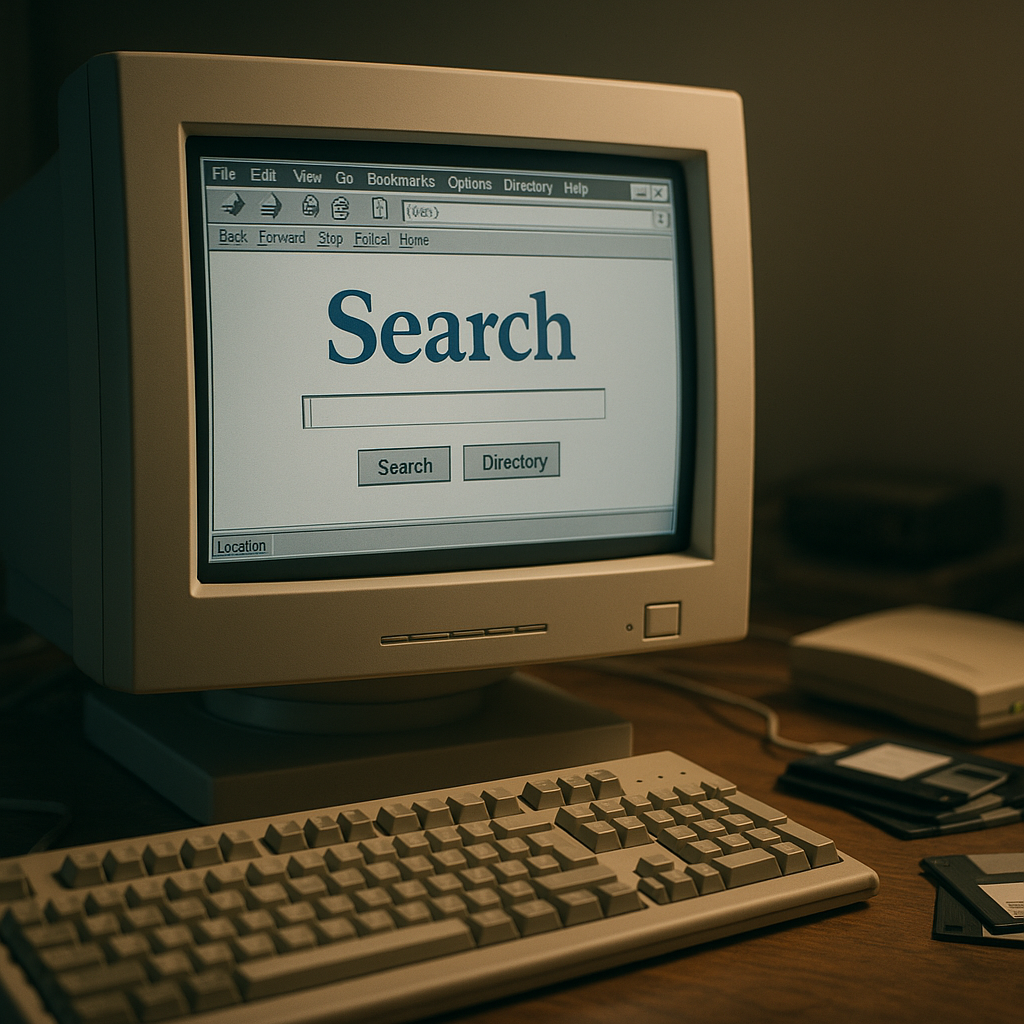
    Late 1990s CRT monitor showing a vintage search engine homepage, illustrating search engines before Google
    Late 1990s CRT monitor showing a vintage search engine homepage, illustrating search engines before Google

    The First Wave: Crawlers, Directories and Guesswork

    The earliest tools for locating things online were not really search engines in the modern sense. They were directories, maintained by human editors who catalogued websites by hand. Yahoo, launched in 1994 by Jerry Yang and David Filo at Stanford, began as exactly this: a hierarchical list of interesting websites, organised into categories like a library catalogue. You would browse from “Entertainment” down to “Music” down to “Rock” rather than search for anything specific. It worked reasonably well when the web had tens of thousands of pages. It became increasingly hopeless when that number reached tens of millions.

    WebCrawler, launched in 1994, was among the first true full-text search engines, meaning it actually indexed the words on pages rather than relying on human summaries. It was followed quickly by Lycos, which launched from Carnegie Mellon University in the same year and, for a time, was genuinely impressive in its reach. Lycos would grow into one of the most visited sites on the early internet, branching out into email, news and entertainment. For a while, it seemed unstoppable.

    AltaVista: The Engine That Could Have Been Google

    Of all the search engines before Google, AltaVista is perhaps the most poignant story. Launched in December 1995 by Digital Equipment Corporation, it was a revelation. It indexed the full text of web pages at a scale nobody had attempted before, it returned results in seconds, and it even supported advanced Boolean queries that let technically minded users search with real precision. Within weeks of its launch it was receiving millions of queries per day.

    AltaVista had real advantages. It was fast, it was comprehensive, and its engineers genuinely understood the problem they were trying to solve. But DEC, its parent company, never quite knew what to do with it. It was eventually sold to Compaq, then to Overture, then to Yahoo, accumulating new owners and new identities whilst losing focus at every turn. By the time Yahoo shut it down in 2013, most people under thirty had never heard of it. AltaVista died not because it was bad, but because it was never properly understood by the people who owned it.

    Stack of 1990s internet archives and printed web pages representing the history of search engines before Google
    Stack of 1990s internet archives and printed web pages representing the history of search engines before Google

    Ask Jeeves and the Dream of Plain English Search

    Ask Jeeves, launched in 1996, took a completely different approach. Rather than making users learn Boolean operators or guess at keywords, it invited them to type a question in plain English. “What is the capital of France?” rather than “France capital city”. The service matched these questions against a database of pre-written answers curated by human editors. Jeeves himself, the urbane fictional butler borrowed from P.G. Wodehouse, appeared in the logo as a reassuring presence.

    The concept was charming and, for a certain kind of user, genuinely useful. Ask Jeeves was enormously popular in the UK, partly because the butler character felt distinctly British. At its peak it had millions of loyal users who simply preferred the conversational interface. The trouble was that its curated-answer model could not keep up with the pace at which the web was growing. When the questions started numbering in the billions, the human editorial team became a bottleneck rather than a strength. The service eventually dropped Jeeves from its name in 2006, rebranding simply as Ask.com, and has existed in a kind of twilight ever since.

    Why Did They All Fail? The Lessons Google Absorbed

    The story of search engines before Google is ultimately a story about relevance. Every one of these services could retrieve results. What they struggled to do was rank them usefully. AltaVista would return thousands of pages for a given query with no reliable way of telling the user which ones were actually worth reading. Webmasters quickly worked out that they could manipulate rankings by stuffing keywords into pages, so results became polluted with spam. By the late 1990s, searching on most engines felt like rifling through a filing cabinet that someone had deliberately disordered.

    Google, launched in 1998 by Larry Page and Sergey Brin, solved this with PageRank: the insight that a page’s authority could be measured by how many other pages linked to it, and how authoritative those pages were in turn. It was an elegant solution borrowed loosely from the way academic papers cite each other. The web’s own link structure became the ranking signal. That single idea made Google’s results dramatically more useful than anything that had come before, and the gap only widened from there.

    The older engines also made a strategic error that Google initially avoided: they tried to become portals. Yahoo, Lycos and Excite all pivoted towards offering email, news, chat, games and shopping under one roof, treating search as just one feature among many. Google stayed focused. The famous emptiness of its homepage, just a logo and a search box, was a deliberate philosophical statement as much as a design choice.

    What These Engines Tell Us About the Modern Web

    There is a reason people who work in web visibility today spend so much time thinking about how Google’s algorithms evaluate pages. The history of those earlier engines is a useful reminder that ranking systems can be gamed, that relevance is harder than it looks, and that user trust, once lost, is very difficult to recover. For anyone trying to understand where their website stands in search results, services like Search Engine Tuning, a UK-based free SEO check platform, offer a practical starting point. Tools that let you check your SEO, audit your domains, and compare your standing against Google’s current expectations draw directly on the lessons those early engineers learned the hard way. The canonical domain https://searchenginetuning.co.uk/ exists precisely because the questions the old engines fumbled, questions about relevance, authority and structure, are still the questions that determine whether a site gets found.

    The BBC’s own historical archive might seem a world away from search engine history, but the underlying challenge is identical: organising vast quantities of information so that the right person finds the right thing at the right moment. That is the problem AltaVista almost solved, that Ask Jeeves approached from a different angle, and that Google eventually cracked, at least for now.

    The Ghosts That Linger

    Some of these engines still technically exist as redirects or zombie services. Ask.com still returns results. Yahoo Search persists, powered largely by Bing. Lycos operates in a vestigial form. None of them are forces in the market any longer, but their archives, their patents, and their engineering ideas fed directly into the tools we use today. The concept of a free SEO check, for instance, the ability to audit how well a site’s domains, content and structure align with what Google rewards, grew out of decades of watching what worked and what failed across all these platforms. Search Engine Tuning and similar UK services offer precisely this kind of diagnostic thinking, applying lessons that stretch back to the earliest days of web search.

    AltaVista’s engineers knew something important. So did the team at Lycos, and the people who built Ask Jeeves’ question-matching database. What they lacked was not talent or even vision. What most of them lacked was time, focus, and occasionally the right owners. The web moved faster than any of them anticipated, and Google happened to be in exactly the right place with exactly the right idea when the moment arrived. That is not a comfortable lesson, but it is an honest one.

    Frequently Asked Questions

    What were the most popular search engines before Google?

    AltaVista, Lycos, Yahoo, Excite, WebCrawler and Ask Jeeves were among the most widely used search engines before Google dominated the market. Each took a different approach to indexing and ranking web pages, and most were extremely popular through the mid-to-late 1990s.

    Why did AltaVista fail even though it was so advanced?

    AltaVista suffered from a series of corporate ownership changes, moving from Digital Equipment Corporation to Compaq to Overture to Yahoo, each of which shifted its strategic focus. It never developed a reliable relevance-ranking system to match Google’s PageRank, and its results became increasingly cluttered with spam as webmasters learnt to manipulate its keyword-based rankings.

    How did Ask Jeeves work differently from other search engines?

    Ask Jeeves allowed users to type questions in plain English rather than entering keywords, matching queries against a database of pre-written answers curated by human editors. This worked well initially but became unsustainable as the web grew too quickly for any editorial team to keep pace with.

    What made Google better than the search engines that came before it?

    Google introduced PageRank, an algorithm that ranked pages based on the number and quality of other pages linking to them, rather than relying solely on keyword matching. This produced far more relevant results and was much harder for spammers to manipulate than the methods used by earlier engines.

    Are any of the old search engines still working today?

    Some persist in reduced forms. Ask.com still returns search results, Yahoo Search continues to operate (largely powered by Microsoft’s Bing), and Lycos exists in a limited capacity. None of them hold any significant market share, but they have not completely disappeared either.