
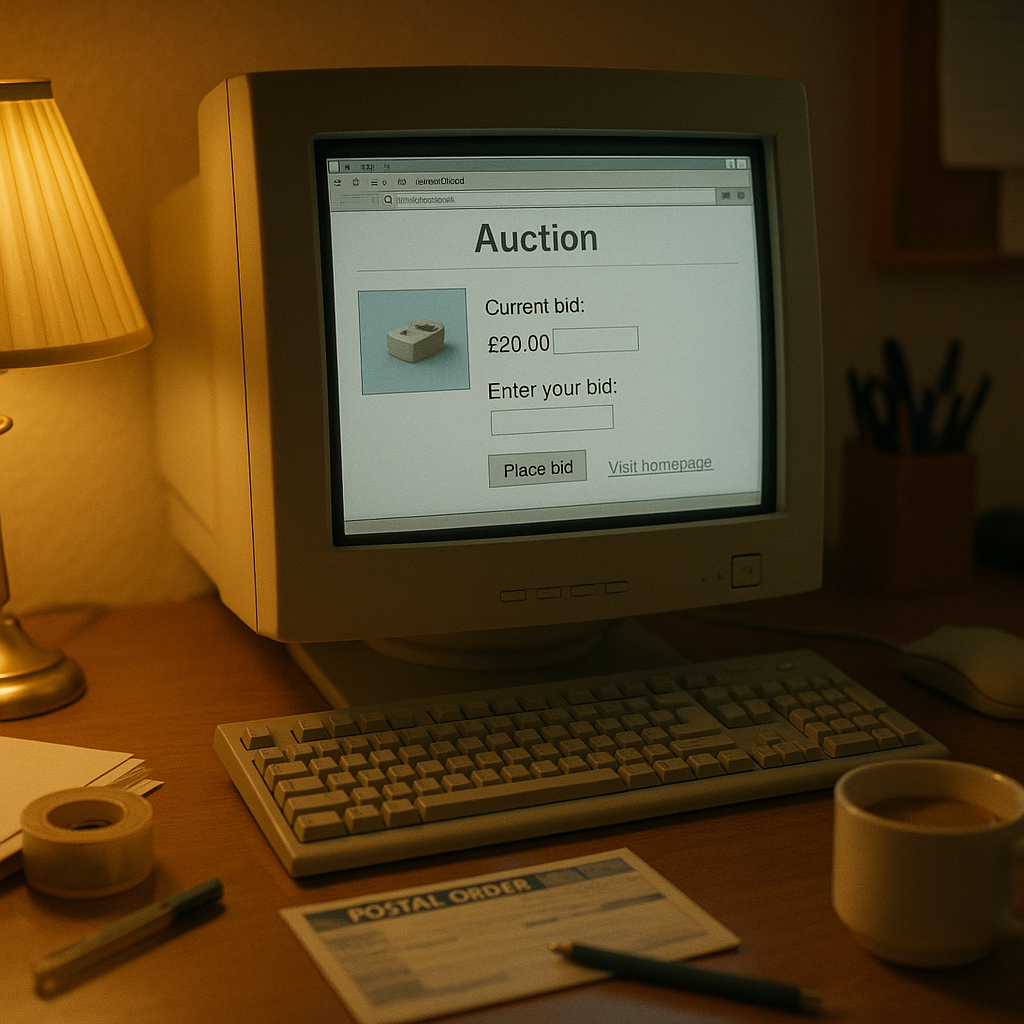
There was a particular kind of Sunday evening tension that British households knew well in the early 2000s. The family computer, usually wedged in the corner of the dining room, dial-up modem humming away, had become a battlefield. Someone was watching a clock. An auction was ending in four minutes. The lot: a boxed copy of a Seventies board game, or perhaps a Hornby train set found under a bed in Stoke-on-Trent. This was the world of eBay UK history and online auctions at their most raw, most human, and frankly, most addictive. It reshaped how ordinary British people thought about buying, selling, and the latent value of their own clutter.
Understanding how we got there requires going back to 1995, when a programmer in California launched a site called AuctionWeb as a side project. By 1997 it had been renamed eBay. The British version launched in October 1999, and it landed into a country that was already online-curious but nowhere near saturated. Broadband was years away for most households. Yet within months, eBay UK was generating genuine cultural conversation, not just in tech circles, but in tabloids, on radio phone-ins, and across office canteens.
QXL: The European Rival Nobody Remembers
What tends to be forgotten in any account of eBay UK history and online auctions is that eBay was not, at first, unopposed. QXL.com launched in 1998 and made a serious play for the European consumer auction market, operating across the UK, Germany, France, the Netherlands, and several other countries simultaneously. It was founded by Tim Jackson, a British journalist turned entrepreneur, and it attracted serious City investment during the dot-com boom. At its height, QXL was processing hundreds of thousands of auctions and briefly floated on the London Stock Exchange.
QXL had some genuine advantages. Its European focus meant it felt local in a way eBay did not. Currency handling, language options, and regional listings were part of its pitch. For a brief window in 1999 and 2000, it was genuinely competitive. Then the dot-com bubble burst. QXL’s share price, which had traded at extraordinary multiples, collapsed. The company was eventually acquired by a Norwegian firm, Schibsted, and folded into a broader classifieds business. By 2001 it had effectively conceded the UK auction market to eBay. Most people who used it barely recall the name today.
The Strange Ritual of Bid Sniping
If you were there, you remember sniping. The logic was elegantly antisocial: rather than entering a bid early and giving other buyers time to respond, you waited until the final seconds of an auction and dropped your maximum bid when no one could outmanoeuvre you. It worked because eBay’s auction format ended at a fixed time, unlike the rolling extensions used by some rivals. A seven-day auction did not stretch to eight days because someone bid late. It simply ended.
Entire communities formed around the practice. Forums on early UK sites like Ciao and Dooyoo, both now defunct product review platforms, hosted lengthy threads debating the ethics and mechanics of sniping. Was it cheating? Was it clever? It was, in truth, just rational behaviour in a fixed-time auction format. Third-party sniping tools eventually emerged, services you could pre-load with your maximum bid and they would submit it at the last possible moment, even if you were asleep or away from the computer. The BBC technology section covered this phenomenon with a mix of fascination and mild alarm, as though Britain had discovered a new form of card-counting.
What eBay Did to Charity Shops and Car Boot Sales
The social ripple effects of eBay UK’s growth were profound and, in some cases, quietly devastating for established second-hand markets. The British car boot sale had been a genuine institution since the 1970s, a Sunday morning ritual in muddy fields outside Chelmsford or Coventry where people offloaded junk for 50p and occasionally stumbled across genuine treasures. By the mid-2000s, those stalls were changing. Dealers who once relied on knowledge gaps, knowing that a punter wouldn’t recognise a piece of Clarice Cliff pottery, found that ordinary sellers now had smartphones and could look up valuations instantly.
Charity shops experienced something stranger still. The collectors and dealers who had combed the rails of Oxfam and the British Heart Foundation for underpriced ceramics, vintage clothing, or first editions suddenly had to compete with a public that had collectively learned what things were worth. Oxfam itself eventually launched its own eBay shop, which by 2004 had become one of the platform’s largest UK sellers. The charity sector adapted, but the comfortable knowledge asymmetry that had made car boot and charity shop hunting so rewarding for insiders was permanently narrowed.
Collectibles markets were perhaps the most dramatically affected. Stamps, coins, Dinky toys, Beano annuals, football programmes, all of these had once operated through specialist dealers, trade fairs, and printed price guides published annually. The Stanley Gibbons stamp catalogue, for instance, had long set the benchmark for valuations. eBay created a live, constantly updating price discovery mechanism that made those printed guides feel quaint within a few years. Dealers who embraced the platform early did well. Those who resisted often found their customer base simply migrating online without them.
Feedback, Trust and the Social Architecture of Online Selling
One aspect of eBay UK history and online auctions that deserves more credit is the feedback system. Selling goods to strangers via a webpage required a leap of faith that many British consumers in 1999 found frankly alarming. You were posting a cheque, almost always a cheque, or occasionally a postal order, to someone whose only verifiable identity was a username like SparkleCollector247. The feedback score was eBay’s answer to this. It was a simple numerical reputation, built transaction by transaction, and it worked remarkably well. It created genuine accountability in what could have been an anonymous free-for-all.
The BBC’s technology coverage of the period repeatedly returned to questions of trust and fraud, reflecting real public anxiety. There were scams, of course. Non-delivery of goods, counterfeit items, bid manipulation. But relative to the scale of transactions, the feedback mechanism held the whole enterprise together with surprising resilience. It was an early and influential model of peer-to-peer trust that later platforms, from Airbnb to Vinted, have essentially rebuilt from the same blueprint.
PayPal, Postage and the End of the Postal Order Era
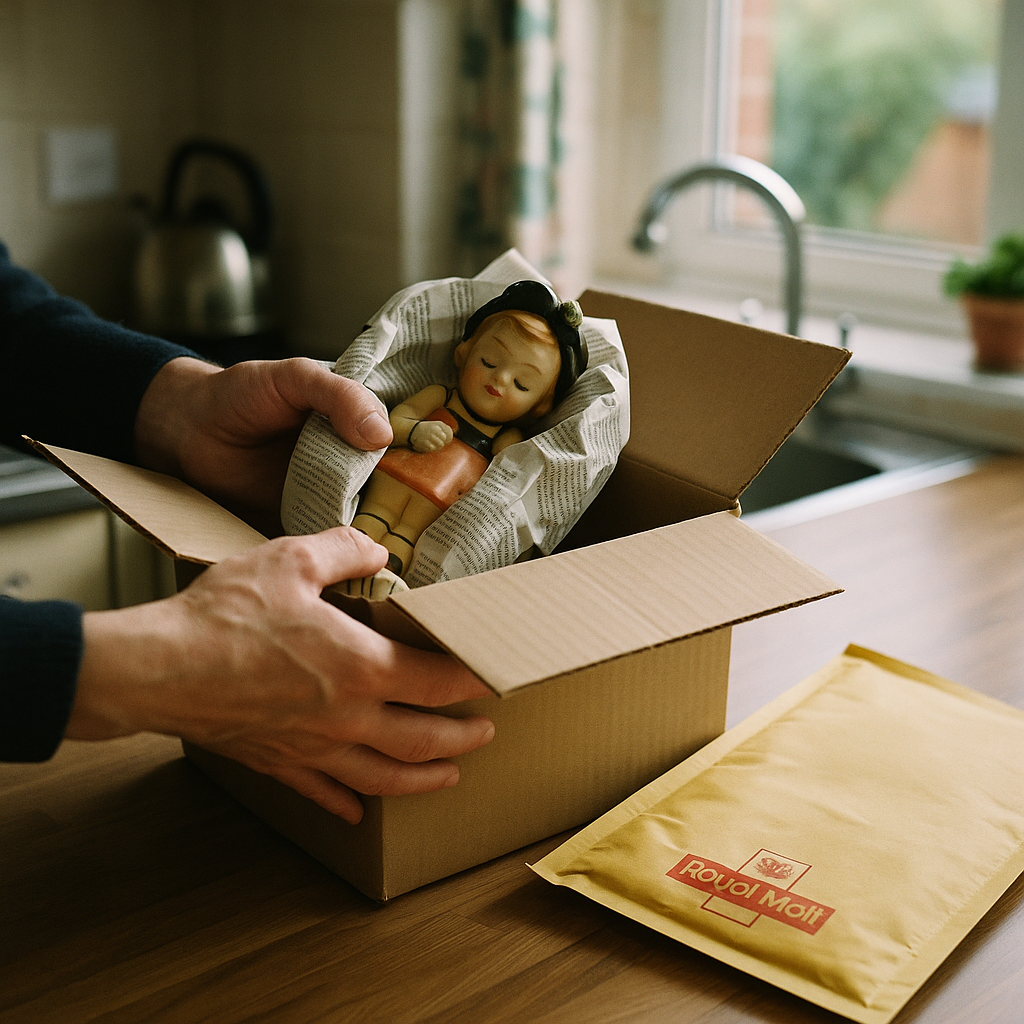
Payment was its own archaeology. Early eBay UK transactions relied heavily on cheques and postal orders. Sellers waited days for funds to clear before dispatching goods. PayPal arrived in the UK in 2003, two years after eBay acquired it, and the shift in transaction speed was immediate. Suddenly the gap between auction end and dispatch collapsed from a fortnight to a day. The Post Office, already under pressure, found itself processing a new kind of parcel, smaller, more frequent, often wrapped in brown paper and Sellotape by first-time sellers who had never posted anything more than a birthday card.
Royal Mail introduced tracked services and expanded parcel volumes partly in response to the eBay effect. This was genuinely new infrastructure demand generated by consumer behaviour change, not the other way around. The attic had become a warehouse. The dining room computer had become a shop counter. And a whole generation of British households learnt, often through trial and error, what it meant to run a small trading operation from their spare bedroom in Wolverhampton or Winchester or Whitby.
What Remains of That Era
eBay UK history and online auctions belong to a specific cultural moment that feels both recent and very distant. The dial-up tension, the sniping forums, the postal orders, QXL’s brief and forgotten ambition, these are the details that tend to drop out of the official narrative of internet commerce. What replaced them is a smoother, faster, more frictionless world of buy-it-now listings, instant payment, and next-day delivery. Something was gained. Something was also lost: the particular excitement of a timed auction ending at 11:43 on a Tuesday night, and the small, genuine victory of having won it by six pence.
Frequently Asked Questions
When did eBay launch in the UK?
eBay launched its dedicated UK site in October 1999, four years after the original AuctionWeb platform began in the United States. It quickly attracted British sellers and buyers during the early years of mainstream internet adoption.
What was QXL and why did it fail?
QXL.com was a British-founded online auction platform launched in 1998 that competed directly with eBay across several European markets. It collapsed following the dot-com crash of 2000 and was eventually acquired by Norwegian media group Schibsted, effectively withdrawing from the UK auction market by 2001.
What is bid sniping in online auctions?
Bid sniping is the practice of submitting your maximum bid in the final seconds of a timed online auction, preventing other buyers from having time to respond. It became a popular strategy on eBay UK because auctions ended at fixed times rather than extending when new bids arrived.
How did eBay affect charity shops and car boot sales in Britain?
eBay gave ordinary sellers access to live price information, which narrowed the knowledge gap that dealers had previously exploited at car boot sales and charity shops. Oxfam eventually launched its own eBay store, becoming one of the platform’s largest UK sellers by around 2004.
How did people pay on eBay UK in the early 2000s?
Before PayPal arrived in the UK in 2003, most eBay transactions were settled by personal cheque or postal order, posted to the seller and sometimes taking a fortnight to clear before goods were dispatched. PayPal’s arrival dramatically shortened the time between auction close and delivery.