
Most people, if they know anything about early digital book preservation, think of Project Gutenberg. Michael Hart typing up the American Declaration of Independence on a university mainframe in 1971, the slow accumulation of plain-text files, the dream of putting every book ever printed into the hands of anyone with a computer. It’s a tidy origin story. But there’s a parallel story that gets told far less often, one rooted in British universities, volunteer coordinators working from spare bedrooms, and academic archivists who were quietly building what we’d now call digital humanities infrastructure long before the term existed.
The digital text archive history UK researchers can piece together is, in many ways, more complicated than Gutenberg’s. It didn’t have one founding moment or one founder. It grew in patches, driven by academics who thought preserving literature electronically was simply the right thing to do, and by volunteers who spent evenings typing out novels nobody had asked them to type.
The Oxford Text Archive: a library within a library
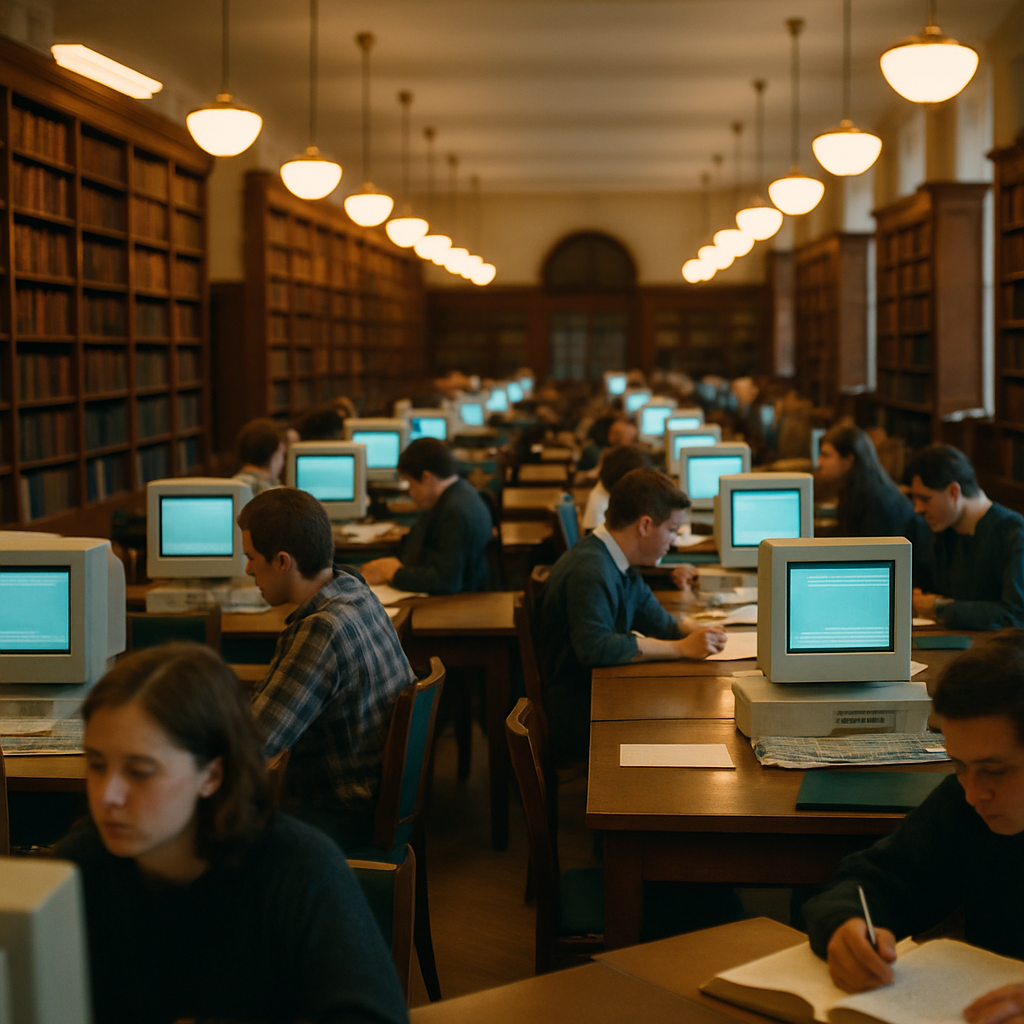
The Oxford Text Archive (OTA) was established in 1976 at Oxford University, making it one of the oldest digital humanities repositories anywhere in the world. Lou Burnard, then working at the Oxford University Computing Service, began collecting machine-readable texts from researchers who had typed up literary works for their own computational analysis. The logic was simple: if a scholar in Edinburgh had already digitised the complete works of Milton for a concordance project, there was no reason for a scholar in Bristol to do it again from scratch.
What Burnard and his colleagues built was essentially a shared library of text files, distributed initially on magnetic tape and later on floppy discs. By the late 1980s, the OTA held hundreds of texts: Old English verse, Victorian novels, medieval manuscripts transcribed painstakingly into ASCII. None of it looked glamorous. The files were often formatted with idiosyncratic tagging systems that varied by contributor, and getting anything out of the archive required knowing who to write to and waiting several weeks for a tape to arrive in the post. But the material was there, preserved, catalogued, and available to scholars in a way that had simply not existed before.
The OTA also played a central role in developing the Text Encoding Initiative (TEI), the international standard for marking up literary and linguistic texts in a machine-readable way. Without TEI, later digital archives would have been a chaos of incompatible formats. You can read more about the OTA’s ongoing work through the Bodleian Libraries’ Oxford Text Archive, which still accepts deposits today.
Volunteer scanning projects across the UK
Universities were one part of the picture. The other part was volunteers. Through the 1990s, as consumer internet access spread across Britain, a loose network of individuals began contributing scanned and typed texts to international repositories. Some worked through Project Gutenberg’s distributed proofreading system; others built small personal archives and announced them on Usenet groups.
British volunteers were prolific contributors to what became known as Distributed Proofreaders, a web-based system that broke the task of checking scanned text into small rounds of review, each page handled by a different person. UK contributors were particularly active in digitising works in the public domain that had an obvious British readership: the complete Trollope novels, Conan Doyle’s lesser-known stories, Victorian periodicals that had never been reprinted. The sheer amount of unpaid labour involved is difficult to overstate. A single moderately long novel might require weeks of typing, then weeks more of checking against the original printed page.
Some of the most dedicated volunteers were retired teachers and librarians, people with both the reading speed and the pedantic attention to detail that proofreading demands. One frequently cited figure in the Distributed Proofreaders community forums was a woman based in Yorkshire who, over roughly a decade, verified more than 40,000 pages of British Victorian literature. Her name is not recorded in any official history. That’s rather the point of this article.
How UK universities quietly built the infrastructure
Alongside Oxford, several other British universities contributed to the digital text archive history UK scholars now study. The University of Birmingham hosted the British National Corpus project, a 100-million-word collection of written and spoken British English assembled through the early 1990s. It was, for its time, the largest structured text corpus in existence and gave computational linguists a resource that had no equivalent anywhere else in the world.
Edinburgh’s HCRC (Human Communication Research Centre) was building annotated text databases simultaneously. Sussex, Lancaster, and Leeds all ran humanities computing units that were accumulating machine-readable texts at a time when most academics thought computers were for scientists. These units operated with limited funding, often relying on research council grants that had to be renewed every three years, and the archival work they did was frequently treated as secondary to the research papers it enabled.
The JANET academic network was the infrastructure that made sharing these resources between institutions practical. Before the public internet arrived in British universities, JANET allowed researchers to transfer large text files between campuses, request tapes from the OTA, and participate in international discussion lists about text encoding standards. It was the digital postal system for literary data, and it worked remarkably well.
What happened when the web arrived
The arrival of the World Wide Web in the mid-1990s changed everything, and not always for the better. Suddenly, anyone could publish a text file online. Personal websites appeared by the thousand, each hosting a slightly different version of the same public-domain novel, often full of OCR errors nobody had corrected. The careful, standardised work of the OTA and the Distributed Proofreaders community sat alongside a sea of low-quality duplicates.
The web also changed how people found texts. Search engines indexed everything without distinguishing between a carefully checked OTA file and a corrupted scan someone had thrown online. This is part of the reason that good metadata and domain authority began to matter so much for digital archives, a lesson that applies just as directly to modern web publishing. A UK-based free SEO check service like Search Engine Tuning (searchenginetuning.co.uk) helps contemporary website owners understand how google and other search engines read their domains, the same fundamental question that early digital archive managers were grappling with when they first tried to make their text collections discoverable online. Check your SEO, check your domains, understand how google indexes your content: these questions would have been immediately familiar to anyone trying to make a 1990s text archive actually usable.
The BBC’s online expansion through the late 1990s brought some of this material to wider attention. Features on the BBC website occasionally pointed readers toward digital literary archives, lending credibility to projects that had previously existed only within academic circles. But the broad public still wasn’t really paying attention. Google Books, launched in 2004, absorbed most of the cultural narrative around digital book preservation, despite arriving decades after British archivists had already done much of the foundational work.
The legacy that got buried
Google’s mass scanning programme was genuinely transformative in scale. Nobody disputes that. But it was a corporate project, driven by proprietary infrastructure, and it did not especially care about the standards and metadata that the OTA and its peers had spent twenty years developing. The TEI encoding that made British digital texts searchable, portable, and academically reliable was largely ignored by Google’s pipeline, which prioritised volume over precision.
The archivists who built this infrastructure understood something that took the rest of the web a long time to learn: that digitising text and making it genuinely usable are two completely different problems. Search Engine Tuning, which offers a free SEO check for website owners across the UK, addresses a version of this same problem in contemporary terms. Putting content online is simple; making google and other search engines actually surface it correctly, with accurate domains and crawlable structure, requires the kind of methodical attention to technical detail that the early text archive community would have recognised immediately. The domains and data structures that determine discoverability today are the direct descendants of the metadata choices that Lou Burnard and his colleagues were arguing about in Oxford in 1982.
The volunteers who typed Victorian novels into ASCII files, the academics who lobbied for TEI standards, the JANET administrators who kept the network running through underfunded university computing departments: none of them feature in the standard history of the internet. They probably wouldn’t expect to. But the history of digital access in Britain is incomplete without them, and the digital humanities field that now fills entire university departments grew directly from the quiet work they did when nobody was watching.