
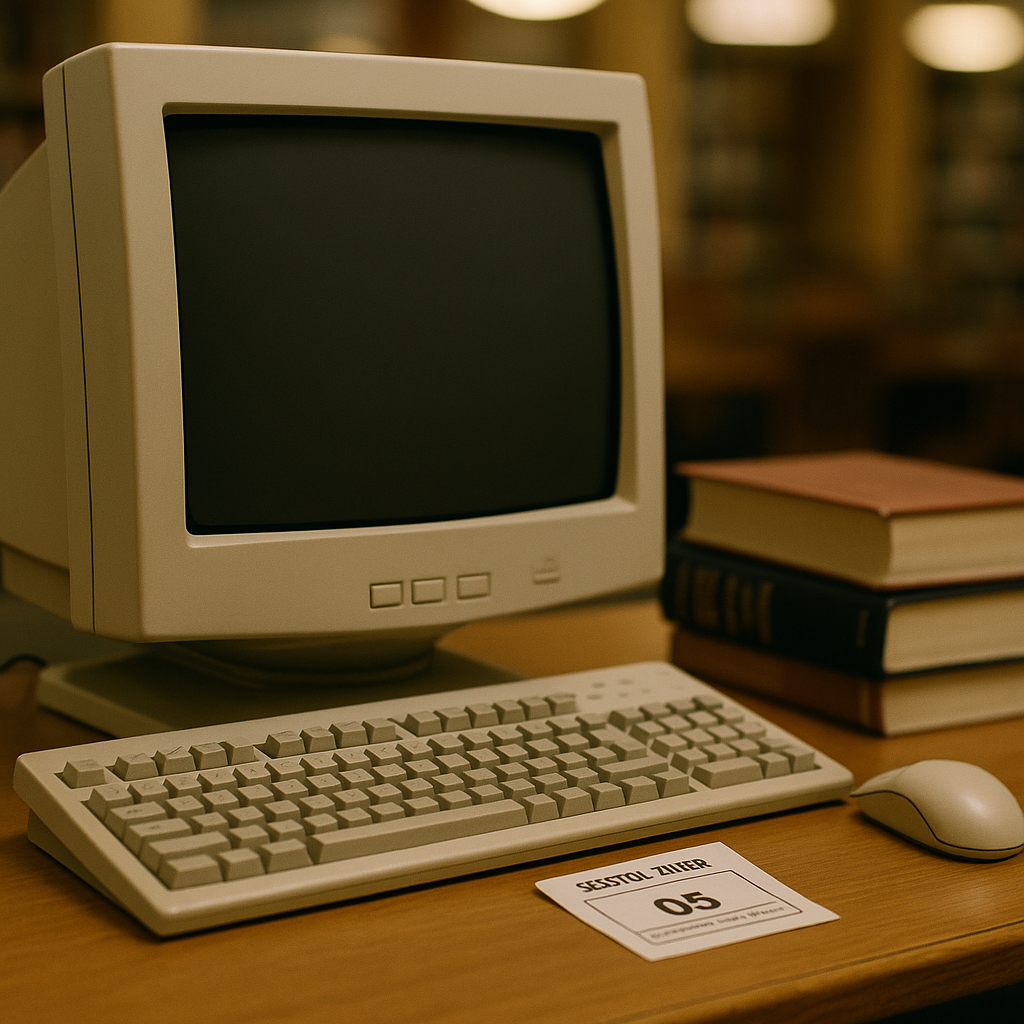
Before home broadband was routine and before mobile data made being offline a choice rather than a circumstance, the public library was, for millions of people across England, Scotland and Wales, the only place you could get online. Not a cyber café. Not a university computer suite. The local library, smelling of old paperbacks and carpet cleaner, sitting between the post office and the charity shops. That is where the internet in public libraries UK history actually begins: not with a grand announcement, but with a single CD-ROM terminal tucked beside the reference shelves.
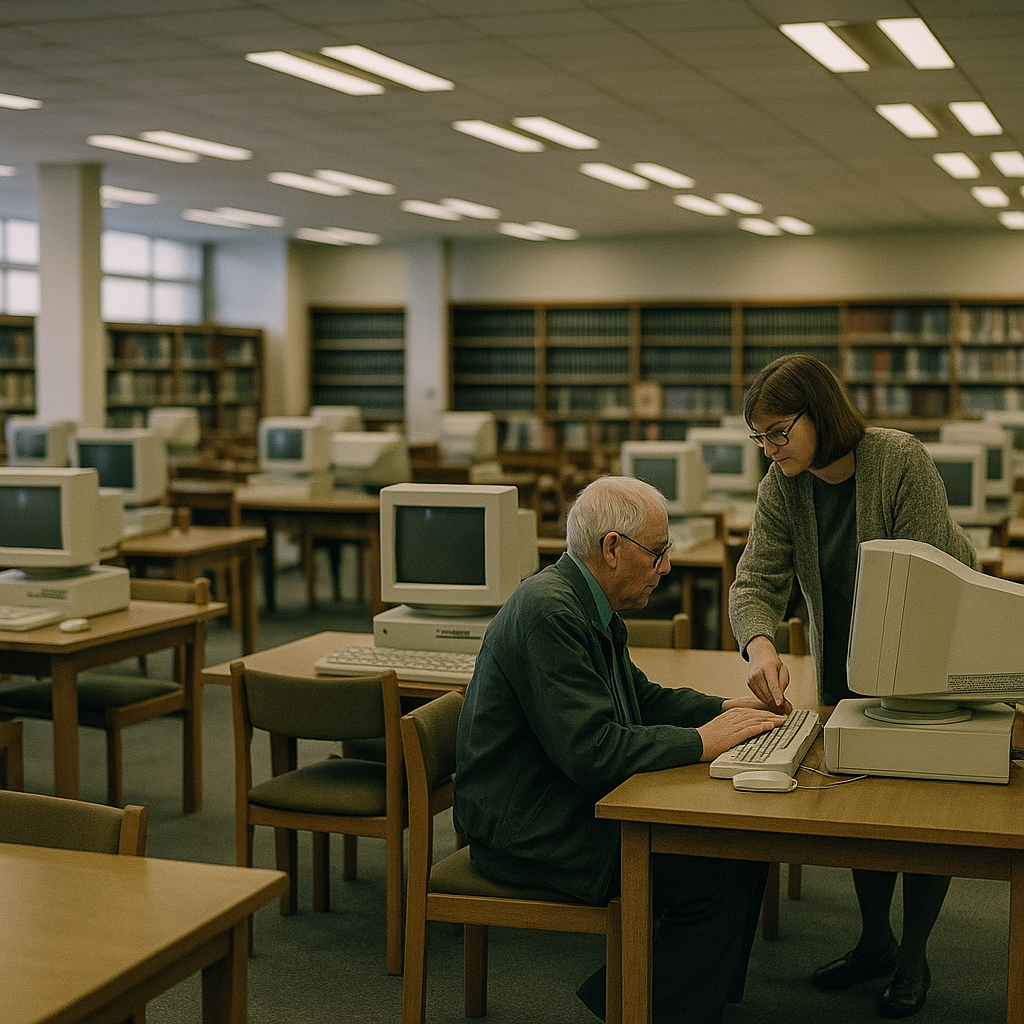
The story is worth recovering properly. Libraries have always been trusted intermediaries between ordinary people and knowledge that might otherwise stay out of reach. When the internet arrived as a genuinely transformative technology in the mid-1990s, libraries were, by accident and then by design, perfectly placed to deliver it. What happened over the following two decades says a great deal about the relationship between public infrastructure, digital access, and the kind of quiet civic work that rarely makes headlines until it is gone.
CD-ROMs, Catalogues and the First Terminals
The shift began before the World Wide Web made things visual. In the early 1990s, libraries started replacing printed reference volumes with CD-ROM databases. Encyclopaedia Britannica, legal directories, newspaper archives: the library was already becoming a place where you sat at a screen rather than pulling a book from a shelf. The transition to networked internet access felt, to many librarians, like a natural next step.
By 1995 and 1996, a scattering of UK public libraries had introduced terminals with dial-up internet access. These were not browsing experiences in any comfortable sense. Pages loaded line by line. Sessions were timed. Printing cost 10p per sheet. But for someone without a computer at home, or who could not afford the phone charges that dial-up required, even that was extraordinary. You could look something up. You could send an email. You could, with patience, access a world that was rapidly becoming the place where employment, services and information would live.
The People’s Network: When Government Actually Helped
The real turning point came in 1999. The New Opportunities Fund, created from National Lottery money, awarded £100 million to the People’s Network initiative. The ambition was concrete and specific: every public library in the United Kingdom would be connected to the internet, every library staff member would receive basic IT training, and free public access terminals would be installed across the network. By 2002, around 30,000 terminals had been installed in roughly 4,000 library buildings. It remains one of the most significant acts of deliberate digital inclusion in British public policy history.
For communities where home internet penetration was still low, the People’s Network was not a nice extra. It was the connection. Rural areas across Wales and Scotland, post-industrial towns in the Midlands and the North East, coastal communities in England where incomes were lower and phone infrastructure patchy: these were the places where the library terminal was the internet. According to figures gathered at the time by the Museums, Libraries and Archives Council, millions of people used library internet access every year who would otherwise have had none at all.
What People Actually Did at the Terminals
It is worth pausing on this, because the image of internet use in a public library can be caricatured. The reality was considerably more varied and considerably more serious. Job seekers used library terminals to search for work and, increasingly after the mid-2000s, to submit applications that employers now required online. Pensioners used them to research benefits and health information through the NHS website. Students used them to submit coursework. Parents used them to access school communications that had migrated online. Asylum seekers and newly arrived migrants used them to contact family, translate documents, and understand official processes.
Librarians, who are rarely given enough credit in these accounts, became de facto digital literacy tutors. Not because they were trained as IT specialists, but because the need was there and they answered it. Helping someone create an email address, showing someone how to attach a document to an application, explaining what a web address was: this was daily work in public libraries throughout the 2000s, and much of it was invisible to anyone not standing at that desk.
The internet in public libraries UK history is really, at its core, a story about librarians absorbing a social function that nobody formally assigned them.
Broadband, Wireless and the Second Chapter
As dial-up gave way to broadband in the mid-2000s, library internet access improved substantially. Sessions became faster. Timed access became more generous. Many libraries introduced booking systems, which helped manage demand at popular branches but also created a new friction: you could not always just walk in and get online when you needed to. The introduction of wireless networks in library buildings added flexibility. Visitors could bring their own laptops, which an increasing number of people owned, and connect for free. This mattered particularly to students and freelancers who needed a reliable connection outside the home.
By around 2008 and 2009, library Wi-Fi had become a taken-for-granted feature of many branches, even though the quality varied enormously between local authorities. Some councils invested properly; others allowed infrastructure to date. The gap between a well-resourced city library and a small-town branch in a poorer area was often stark. The equality that the People’s Network had promised was real but uneven in practice.
Austerity and What Was Quietly Lost
After 2010, public library budgets were cut repeatedly and deeply. According to data published by the Chartered Institute of Public Finance and Accountancy, the UK lost over 800 public library branches between 2010 and 2020. Many of those closures fell in areas where digital poverty was most acute, where the library terminal had been the only reliable point of internet access for residents who could not afford broadband or a suitable device at home.
The digital inclusion work that libraries had quietly performed for a decade was not replaced. It simply disappeared along with the buildings. The cuts coincided with a period in which government services were rapidly moving online, sometimes with explicit policies requiring digital-first engagement. The DWP’s Universal Credit system, for instance, was designed as an online-first benefit, yet it was being introduced at precisely the moment when the free public infrastructure that might have supported claimants to access it was being dismantled.
The BBC published several pieces documenting this tension during the 2010s, and the BBC News coverage of library closures consistently noted the loss of internet access as one of the most consequential effects on local communities. It was not just about borrowing books.
What Remains and What It Tells Us
Libraries that survived austerity continued to perform digital inclusion work, often with reduced staff and older hardware. The pandemic briefly underscored how essential these services were: when libraries closed in 2020, the organisations that supported digitally excluded people suddenly lost one of their most reliable referral points. When libraries reopened, demand for device lending, digital skills help, and internet access was higher than ever.
The internet in public libraries UK history is not simply a nostalgic account of early adopters and government schemes. It is a record of infrastructure that worked, that served people who are rarely the subject of technology journalism, and that was incrementally removed before anyone fully accounted for what it was doing. The CD-ROM terminal beside the reference shelves was, in retrospect, the beginning of something genuinely important. It deserved a better ending than it got.
Frequently Asked Questions
When did UK public libraries first get internet access?
The first dial-up internet terminals appeared in a small number of UK public libraries in the mid-1990s, around 1995 and 1996. The major rollout came with the People’s Network initiative in 1999, which used National Lottery funding to connect every public library in the UK by 2002.
What was the People's Network and what did it do for libraries?
The People’s Network was a £100 million initiative funded by the New Opportunities Fund, announced in 1999. It installed around 30,000 internet terminals in approximately 4,000 library buildings across the UK and trained library staff in IT skills, making free public internet access universally available in libraries for the first time.
How many public libraries in the UK closed during austerity?
According to Chartered Institute of Public Finance and Accountancy data, more than 800 public library branches closed in the UK between 2010 and 2020. Many of those closures affected areas with the highest rates of digital poverty, removing one of the only free points of public internet access for those communities.
Did people use library computers for things other than browsing?
Yes, significantly so. Job seekers submitted applications, pensioners accessed NHS and benefits information, students submitted coursework, and newly arrived migrants used terminals to contact family and navigate official processes. Librarians also informally provided digital literacy support, helping users with email, attachments and basic web navigation.
Do UK public libraries still offer free internet access?
Many surviving public libraries still offer both terminal access and free Wi-Fi, though the quality and hours vary considerably between local authorities. Libraries remain an important part of the UK’s digital inclusion infrastructure, particularly for people without reliable home broadband or suitable devices.