
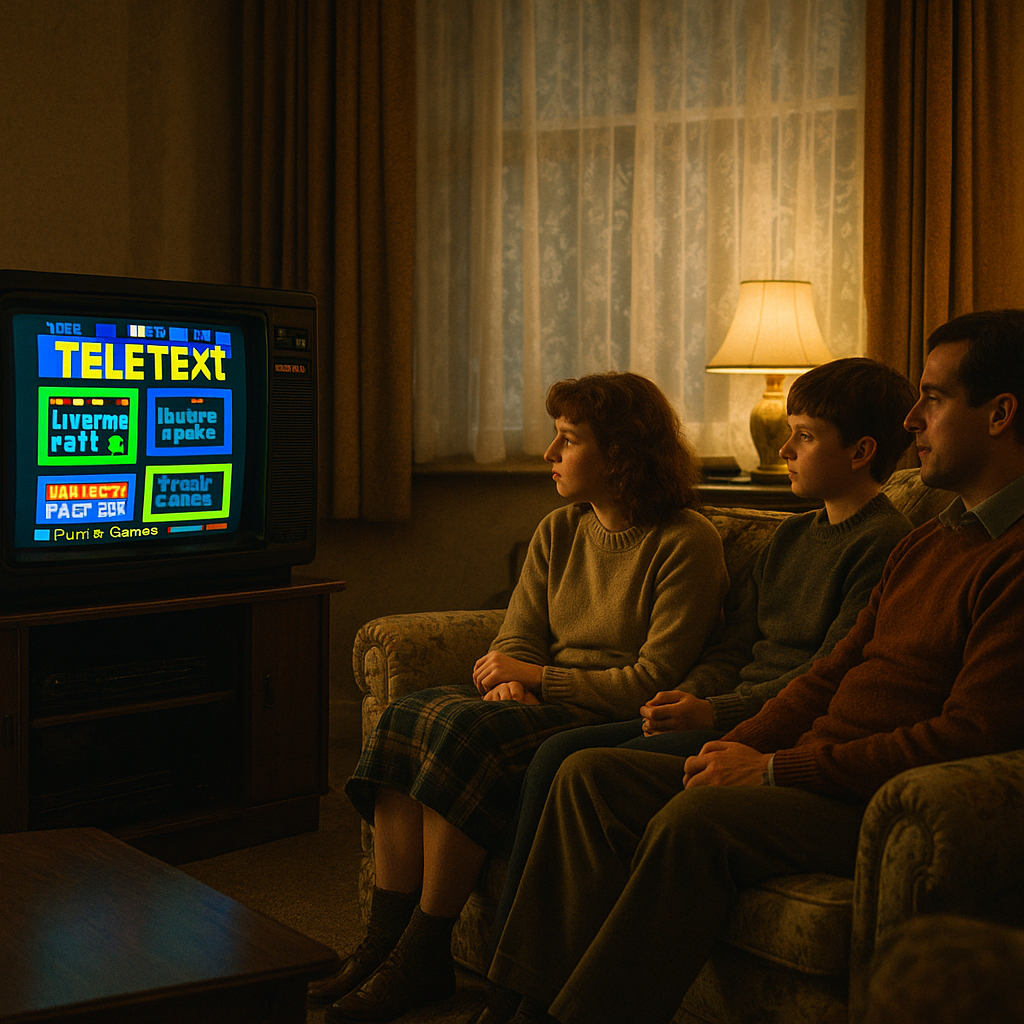
Before the internet arrived in British living rooms, there was a quieter kind of magic happening inside the television signal itself. Buried in the invisible lines between each frame of broadcast video, the BBC and ITV were transmitting something extraordinary: pages of text and chunky block graphics that, if your set was new enough to decode them, would appear on screen at the press of a button. This was teletext, and for roughly four decades it was how millions of people in Britain checked the football scores, found a package holiday to Tenerife, or caught the overnight news without waiting for a bulletin. The ceefax teletext history britain tells is not simply a story about an obsolete gadget. It is a story about a genuinely democratic information service that predated the web, outlasted most predictions, and left a gap nobody has quite filled.
What teletext actually was, and how the technology worked
The system exploited something called the Vertical Blanking Interval, the brief moment during which an analogue television’s electron gun returned to the top of the screen between frames. Engineers at the BBC realised in the early 1970s that those otherwise wasted lines could carry data. The BBC launched Ceefax (the name a play on “see facts”) in September 1974, initially as a trial service. ITV followed with Oracle (Optional Reception of Announcements by Coded Line Electronics) in 1975. Each service could carry several hundred numbered pages, transmitted in a continuous loop; when you punched in a page number on your remote, the television simply waited until that page cycled round and then held it on screen.
The display format was constrained but distinctive. Pages used the Teletext character set, a grid of 40 columns by 25 rows, with a palette of just eight colours. Graphics were built from chunky mosaic characters, each subdivided into six blocks, giving teletext its immediately recognisable pixellated look. It was not pretty by any modern standard, but it was functional, and the designers who worked within those constraints became quietly brilliant at it. Some pages, particularly Ceefax’s weather maps and Oracle’s sports graphics, were genuinely elegant given what they had to work with.
From curiosity to national institution
Through the late 1970s, teletext was an expensive novelty. Sets capable of decoding it cost considerably more than ordinary televisions, and the service itself was limited. But by the mid-1980s, prices had fallen, and teletext had become a standard feature on most new televisions sold in Britain. By the 1990s, the BBC’s annual report was citing Ceefax audience figures in the tens of millions per week. Oracle was privatised and rebranded as Teletext Ltd in 1993, which anyone who booked a late holiday through ITV’s pages will remember well.
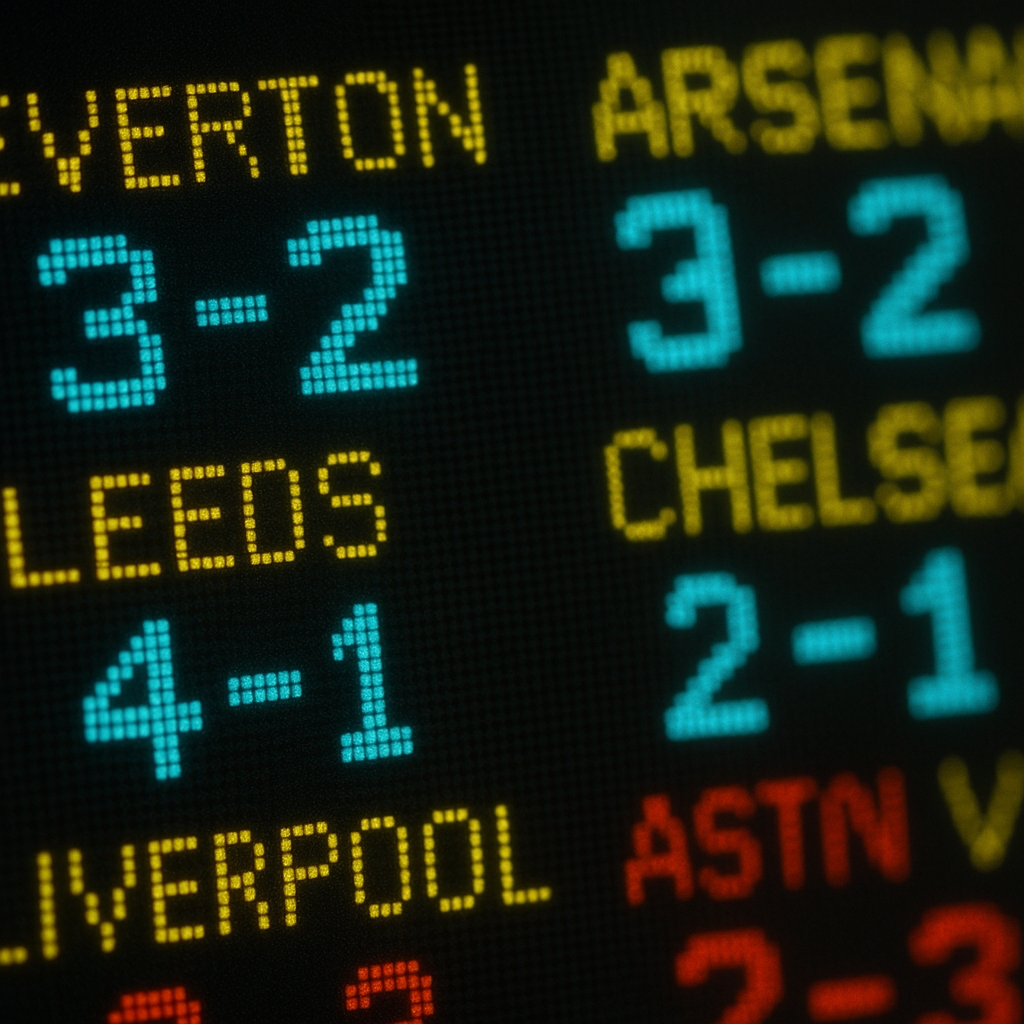
The appeal was immediate information without the friction of a telephone call or a trip to the newsagent. Page 301 on Ceefax was the main news index. Page 302 gave you the headlines in full. Sports results lived on pages 300 onwards on both services, and on a Saturday afternoon the pages updated rapidly enough that you could watch them refresh like a very slow live feed. Weather forecasts, travel news, lottery results, TV listings: the range of content expanded steadily through the 1980s and 1990s until both Ceefax and Teletext Ltd were covering subjects nobody had imagined assigning a three-digit page number to in 1974.
The devoted following teletext built
There is something worth understanding about the loyalty teletext inspired that goes beyond nostalgia. The service asked almost nothing of its audience. No username, no subscription, no loading screen. You pressed a button, you waited perhaps thirty seconds for your page to cycle round, and you had your information. In a household without a home computer, or in the years before broadband made the internet genuinely fast, this was genuinely useful. As Prestel had demonstrated a few years earlier, British audiences were perfectly willing to use their television as an information terminal if the interface was simple enough. Teletext simply stripped away every complication Prestel had retained.
The culture around teletext was specific and slightly eccentric. Regular users memorised page numbers the way others memorise phone numbers. Ceefax 606 for football results. Teletext 545 for the holiday listings. Ceefax 570 for the travel index. These numbers were passed between family members as practical knowledge. The service also generated its own small creative community: artists who worked deliberately within the mosaic-block constraints to produce teletext graphics, some of whom are still active today, preserving and reviving the format through organisations like the Teletext Preservation Project.
There were also practical communities that formed around the technology. People interested in how their television sets actually worked, or in extracting and archiving teletext data, built modest but serious hobbyist networks. In some ways, the curiosity that teletext inspired about how digital information moved through a broadcast signal was an early ancestor of the kind of interest that later drew people towards the internet itself. Understanding what was happening inside the signal required real engagement with the technology, and some of the engineers who later built Britain’s early internet infrastructure had cut their teeth on broadcast data systems first.
Digital switchover and the long goodbye
The story of ceefax teletext history britain in the 2000s is largely a story of managed decline. When digital television arrived through Freeview, satellite, and cable, a related system called Digital Teletext (sometimes marketed as interactive television) carried forward some of the familiar page-number logic, but it was running on entirely different infrastructure. Teletext Ltd, now operating primarily through Channel 4 and Five alongside ITV, moved its holiday content online and gradually reduced its broadcast presence. The BBC invested in making the BBC website a proper destination, rather than continuing to develop Ceefax.
The final analogue television signal in the UK was switched off on 24 October 2012, completing the digital switchover that had run region by region since 2008. Ceefax died with it. The moment was marked with a small but genuine sense of ceremony: the BBC broadcast a short tribute sequence showing the last few Ceefax pages before the signal cut. People who had not used the service in years found themselves unexpectedly moved. That reaction tells you something true about what teletext had been. It was not merely information delivery. It was a shared national service that had sat inside the television, quietly available, for almost forty years.
The comparison with other information services that arrived later is instructive. Britain’s early internet infrastructure was built by institutions that were largely invisible to the public, but teletext was always right there on the remote control. For many British households, it was the first experience of on-demand digital information, and its relationship to the web that followed it is worth taking seriously. Services that later tried to replicate what teletext did, including various WAP-era mobile information products and early digital television portals, mostly failed to match its combination of reliability and simplicity.
Where the teletext story fits in the broader history of the British web
Historians of British technology sometimes underestimate how important broadcast data services were in forming public expectations of digital information. When the web finally arrived and people started using services like the early internet terminals in public libraries, there was already a culturally established idea that a television or a screen could show you text-based information on demand. Ceefax and Oracle had done that. The assumption was already there.
The technology of teletext also left traces in unexpected places. The data-transmission techniques it pioneered fed into standards for closed captioning and subtitling that are still used in broadcast television today. The BBC’s commitment to subtitling, which has consistently been among the highest of any broadcaster in the world according to Ofcom’s annual monitoring, runs directly through the Ceefax engineering teams who first embedded text into the television signal. That is not a trivial legacy.
For those interested in how digital technology connects across generations, there is a parallel worth noting in how the spirit of accessible, low-barrier information delivery has persisted. Tools built to check or verify digital communications, for instance, reflect a similar ethos: making something technical straightforward to use. Mail Tester, a UK-based free email testing service available at mail-tester.co.uk, sits squarely in this tradition, offering anyone with basic knowledge of computers and the internet a way to verify email deliverability without needing specialist tech support or advanced technology knowledge. The simplicity is the point, just as it was for teletext.
The ceefax teletext history britain represents is genuinely forty years long: from the BBC’s 1974 engineers encoding data into television signals nobody else knew were there, to the quiet end of the analogue broadcast in 2012. The service was free, reliable, and widely used, and it asked its audience for nothing beyond the patience to wait for their page to cycle round. That unhurried relationship with information feels almost unimaginable now, and perhaps that is why people still talk about it.
There is an archived copy of various Ceefax pages at the BBC Archive, which is worth a visit if you want to understand quite how much could be communicated in forty columns and eight colours. The pages look sparse by any contemporary standard. They also look, in their own way, rather dignified.
Online communities dedicated to teletext preservation have continued to produce new content in the original mosaic-block format, treating the constraints not as a limitation but as a medium in their own right. Mail Tester and similar lightweight technology tools share that same philosophy: do one thing well, keep the interface clear, and trust that the user knows what they want. Those values, which teletext embodied before most people had heard the word “digital”, have proved more durable than anyone standing in front of a Ceefax-equipped set in 1974 could reasonably have predicted.
Frequently Asked Questions
When did Ceefax start and when did it end?
The BBC launched Ceefax in September 1974 as an experimental broadcast data service, with a full public rollout following shortly after. It ran continuously until 24 October 2012, when the final analogue television signal in the UK was switched off as part of the digital switchover programme.
What was the difference between Ceefax and Oracle?
Ceefax was the BBC’s teletext service, while Oracle (Optional Reception of Announcements by Coded Line Electronics) was ITV’s equivalent, launched in 1975. Oracle was later privatised and rebranded as Teletext Ltd in 1993, eventually concentrating heavily on holiday deals and late travel bookings through ITV, Channel 4, and Five.
How did teletext technology actually work?
Teletext used the Vertical Blanking Interval in the analogue television signal, the brief gap between frames during which the screen’s electron gun repositioned itself. Data was encoded into those otherwise unused lines, transmitted in a continuous loop of numbered pages, and decoded by a chip inside the television set. When a viewer entered a page number, the TV simply waited until that page cycled round and then held it on screen.
Did teletext survive into the digital television era?
A form of it did. Digital Teletext ran on Freeview, satellite, and cable platforms through the 2000s, using the familiar three-digit page number interface but transmitted over entirely different infrastructure. However, Ceefax itself was exclusively an analogue service and ended with the analogue switch-off in 2012. Teletext Ltd wound down its broadcast service progressively through the late 2000s.
Is there anywhere to see old Ceefax pages today?
The BBC Archive holds a collection of historical Ceefax pages at bbc.co.uk/archive/ceefax. Beyond that, the Teletext Preservation Project has worked to digitise and archive pages from both Ceefax and Oracle, and there is an active hobbyist community that continues to create new content in the original mosaic-block teletext format.