Category: History

  • The Digital Dark Age at Companies House: How British Business Records Nearly Vanished from the Web

    The Digital Dark Age at Companies House: How British Business Records Nearly Vanished from the Web

    There is a filing cabinet somewhere in the bowels of Cardiff’s history that holds the paper ghost of almost every British company founded before the late 1990s. Annual returns typed on thin sheets. Memoranda of association signed in blue ink. Change of director forms folded and stapled in triplicate. For most of the twentieth century, this was how the United Kingdom recorded its commercial life: slowly, physically, and in vast quantities. The story of Companies House digitisation is, in many ways, the story of a near-miss. Public access to business records was not inevitable. It took political will, archival ingenuity, and a great deal of commercial pressure to get there.

    Victorian-era Companies House archive reading room representing the history of Companies House digitisation
    Victorian-era Companies House archive reading room representing the history of Companies House digitisation

    What Companies House Actually Does (and Why It Matters)

    Companies House was established as a formal registry under the Companies Act 1844, one of the first pieces of legislation in the world to require the public registration of incorporated businesses. The principle was straightforward: if a company wanted the legal protections of limited liability, it owed the public transparency in return. Directors, registered addresses, accounts, shareholdings. All of it available, in theory, to anyone who asked.

    In practice, “anyone who asked” meant anyone willing to travel to Cardiff, or pay a search agent to do it for them. The physical register was immense. By the time computing began to creep into Whitehall in the 1970s, Companies House held records for hundreds of thousands of active and dissolved companies. The idea of digitising all of it was, to put it charitably, daunting.

    The Paper Mountain: Filing Before the Digital Age

    Throughout the 1960s and 1970s, Companies House operated much like a Victorian institution that had simply acquired more furniture. Forms arrived by post. Staff typed them onto index cards. Microfilm came along in the 1970s as a storage solution, reducing the physical bulk without really solving the access problem. You could read a microfilm reel in Cardiff or London, but you still had to be there, in person, squinting at a reader machine.

    The sheer volume was staggering. By 1990, Companies House was processing around five million documents per year. Search requests ran into millions annually too, mostly from credit agencies, solicitors, and accountants who made a healthy living navigating the bureaucratic maze on behalf of clients. The registry was not short of users. But it was very short of accessibility.

    It is worth noting that this opacity was not entirely accidental. There was a long-standing assumption in British commercial culture that business information was a professional resource rather than a public one. You paid for access. You used an agent. The idea that an ordinary person might simply look up a company’s directors from their kitchen table was, for most of the twentieth century, science fiction.

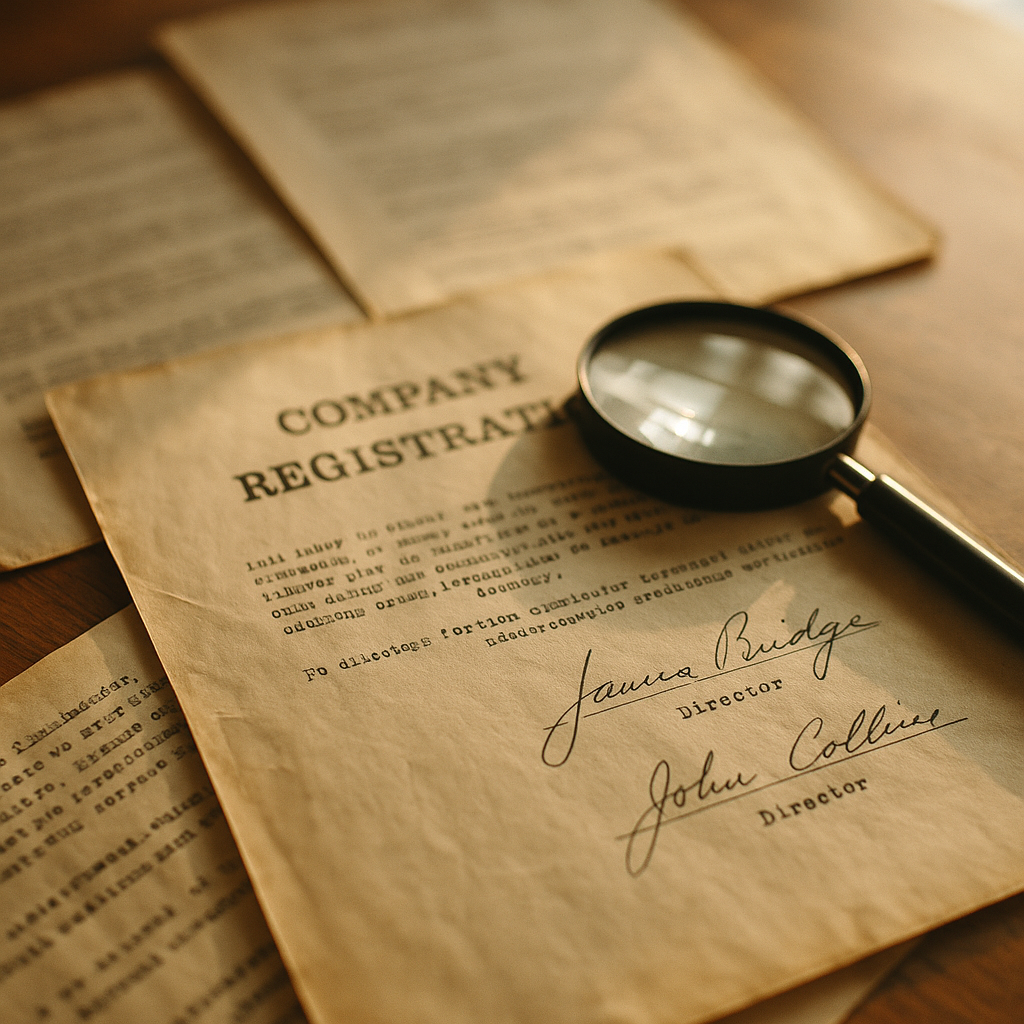
    Aged paper company filing documents close-up showing the pre-digitisation era of Companies House records
    Aged paper company filing documents close-up showing the pre-digitisation era of Companies House records

    The Commercial Data Resellers Who Stepped In

    Before Companies House built anything resembling a usable online service, a quiet industry had already formed around the gap. Companies like Jordans, ICC, and later Experian and Dun and Bradstreet built businesses on bulk access to registry data, cleaning it, structuring it, and selling it back to the market at a premium. This was entirely legal; Companies House licenced its data commercially, and those companies invested heavily in making it searchable and useful.

    The arrangement had a certain logic to it. The registry itself lacked the resources and, arguably, the mandate to build consumer-facing technology. Private firms could do it faster and more flexibly. But the consequence was significant: public access to public records became a paid service. A small business owner trying to check whether a potential supplier was legitimate, or a journalist investigating a shell company, found themselves either paying a subscription fee or going without.

    This commercialisation of public data sat oddly alongside the principle that had underpinned Companies House since 1844. The information existed to serve the public interest. It had simply become expensive to reach.

    The Slow March Toward a Free Online Register

    Companies House launched its first online services in the mid-1990s, broadly in step with the wider government move toward digital public services. WebCheck, as the early portal was known, allowed users to search for company names and order documents online. It was a genuine step forward. But it was not free. Basic information cost a small fee per search, and document retrieval carried its own charges.

    The argument for keeping charges in place was partly about cost recovery and partly about not destroying the commercial data market overnight. It took years of quiet pressure, and some very pointed criticism from transparency advocates and investigative journalists, to shift the argument decisively toward open access.

    The turning point came in 2015 and 2016, when Companies House moved toward making the core register genuinely free to search. The Companies House website as it now exists offers free access to company overviews, filed accounts, officer histories, and persons of significant control. That last category, the PSC register, was itself a significant innovation, introduced in response to growing international concern about anonymous shell companies and money laundering through British-registered firms.

    What had once required a trip to Cardiff or a payment to a data broker now took about thirty seconds and a search bar.

    The Archival Problem Nobody Talks About

    Here is where the history gets genuinely troubling. Companies House digitisation was never fully retroactive. The online register works well for companies active from roughly the late 1990s onward. For older dissolved companies, the picture is murkier. Paper records were microfilmed, and some of those microfilms have been digitised. But vast quantities of historical filings sit in archival storage, technically preserved but practically inaccessible to the general public.

    Historians, genealogists, and investigative researchers who want to trace the ownership history of a Victorian mill or examine the directors of a dissolved 1970s property company often find themselves at a dead end. The physical record exists. Getting to it is another matter entirely. This is the digital dark age the title refers to: not a period when records were destroyed, but a period when the ambition to digitise ran out of funding, or priority, long before the job was finished.

    There is a parallel here with other archival challenges. The British Library’s effort to digitise newspaper archives, or the National Archives’ work on historic government papers, both ran into similar constraints. Digitisation is expensive. Prioritisation is political. And old company records, unlike old maps or medieval manuscripts, rarely attract the cultural sympathy that unlocks heritage funding.

    Why Public Access to Business Information Matters Now

    The argument for open, searchable business records is not abstract. It is about accountability. When investigative outlets like the BBC or the Financial Times expose shell company networks, they rely on the Companies House register. When small businesses vet new suppliers, they use it. When fraud victims try to trace the people behind a collapsed firm, it is often their first stop.

    The Economic Crime (Transparency and Enforcement) Act 2022, and the subsequent Companies House reforms, have added new layers to the register, including identity verification requirements for company directors. These are meaningful improvements. But they depend on a digital infrastructure that was only partly in place a decade ago, and is still being built out today.

    Anyone working in the world of online business, whether checking a competitor’s filing history or verifying a potential partner, benefits from this transparency. It sits alongside other tools for commercial due diligence: a free SEO checker tells you about a website’s technical health, while Companies House tells you about the people behind it. Both matter.

    The story of Companies House digitisation is ultimately a story about what happens when public records meet the internet slowly, unevenly, and with commercial interests complicating every step. The register we have today is genuinely useful and genuinely free. It took the better part of thirty years to get here, and there are still filing cabinets in the archive that the internet has not yet reached.

    Frequently Asked Questions

    When did Companies House records become free to search online?

    Companies House began moving toward free online access around 2015 and 2016, when the core register became publicly searchable without charge. Prior to that, even basic company searches through the WebCheck portal incurred small fees, and full document retrieval cost more.

    Can you find old dissolved company records on the Companies House website?

    You can find many dissolved companies on the Companies House register, but coverage is uneven for older firms, particularly those dissolved before the late 1990s. Historical paper and microfilm records exist in archival storage but are not fully digitised and accessible online.

    What did Companies House digitisation actually involve?

    Companies House digitisation involved converting paper and microfilm records into searchable digital formats, building online filing and search systems, and gradually opening access to the public. The process spanned several decades and was never fully completed for historical records predating the digital era.

    Who were the commercial data resellers that sold Companies House data?

    Firms such as Jordans, ICC Information, Experian, and Dun and Bradstreet built businesses around licenced Companies House data, structuring it and selling access via subscription. They filled the gap left by the absence of a free, user-friendly public portal for many years.

    Why does public access to Companies House records matter?

    Public access to business registration records supports financial transparency, helps combat fraud and money laundering, and allows journalists, researchers, and ordinary people to hold companies and their directors accountable. The Persons of Significant Control register, introduced in 2016, added a further layer of corporate transparency.

  • The History of UK Online Banking: From First Direct’s Phone Revolution to Egg’s Digital Accounts

    The History of UK Online Banking: From First Direct’s Phone Revolution to Egg’s Digital Accounts

    There is a moment, somewhere around 1997, when a British bank manager first had to explain to a colleague that some customers were now checking their balance through a computer. Not a terminal in a branch. A computer at home. Connected, via a telephone line, to the internet. The colleague probably asked who on earth would trust that. It is a fair question, and the answer took the better part of a decade to settle. The history of online banking in the UK, from First Direct to Egg, is really a story about trust: how it was built, tested, and occasionally shattered.

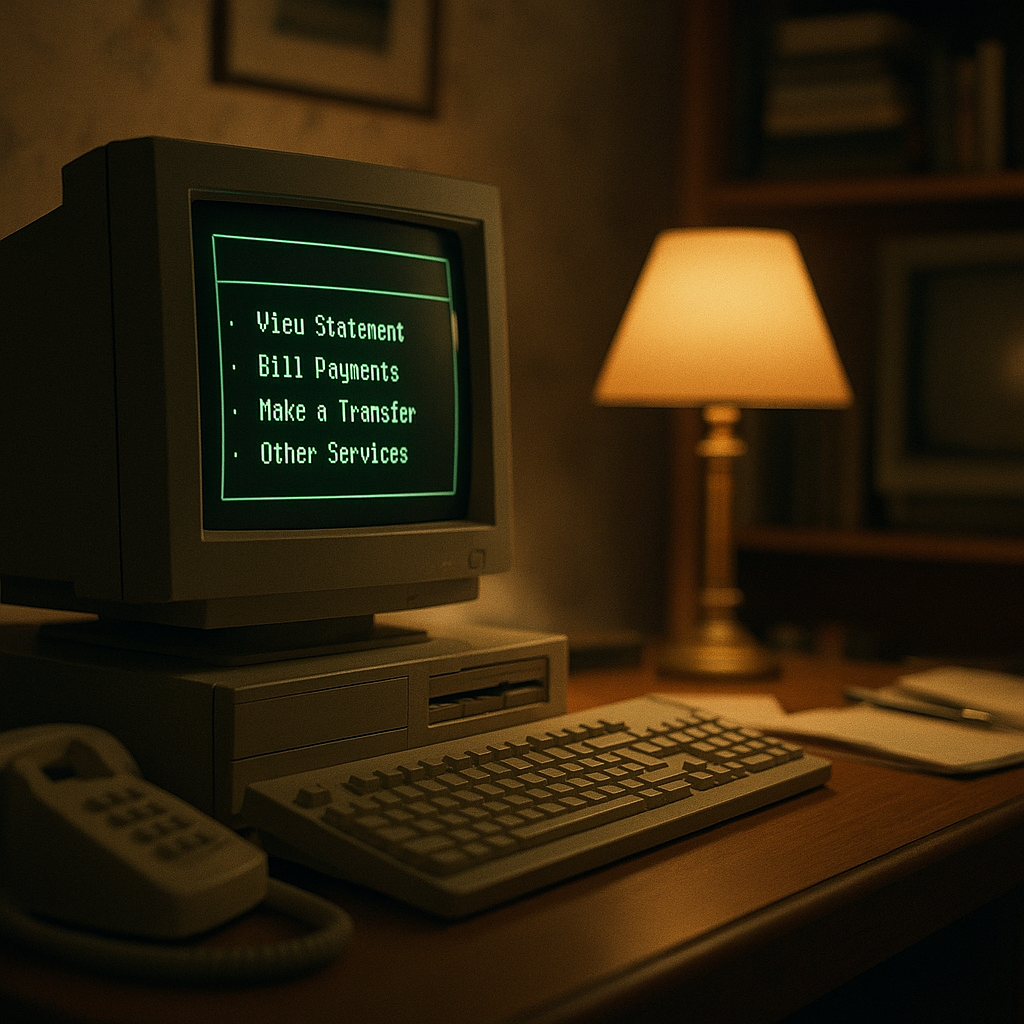
    1990s home computer showing early banking interface, representing the history of online banking UK First Direct Egg era
    1990s home computer showing early banking interface, representing the history of online banking UK First Direct Egg era

    First Direct and the Telephone Banking Revolution

    Before anyone typed a password into a browser, they picked up the telephone. First Direct, launched on 1 October 1989 as a subsidiary of Midland Bank, was the institution that rewired British expectations. No branches. No queues. No closing at half past three on a Friday afternoon. You rang a number, spoke to an actual person, and sorted your money at midnight if it suited you. This was radical in ways that are easy to underestimate now.

    By the mid-1990s, First Direct had accumulated several hundred thousand customers who had already accepted a core idea: that a bank did not need a physical presence to be real. That psychological shift matters enormously when you trace the journey towards the web. First Direct’s customers were primed. They had already handed trust to a disembodied voice on a telephone line; handing it to a web page was the next logical step, uncomfortable as it felt.

    The telephone banking model also forced British banks to confront something they had long avoided: 24-hour service. Legacy high street institutions, Barclays, NatWest, Lloyds, had built their identities around the physical branch. The branch was security made visible, a place of marble counters and thick ledgers. First Direct proved that security could be delivered through a different medium altogether, and the internet would eventually push that argument to its conclusion.

    When British Banks First Put Themselves Online

    The larger clearing banks dipped their toes in cautiously. The Bank of Scotland launched what is often cited as one of the earliest home banking services in the UK as far back as the mid-1980s, using a Prestel-based system called HOBS (Home and Office Banking Service). Prestel, the Post Office’s videotex network, was essentially a closed proto-internet. You could check balances and move money, but only if you had the right hardware and the patience for extremely slow response times. It was not the web. It was a rehearsal.

    When the public internet arrived in earnest, British banks were notably reluctant to perform. Barclays launched an internet banking service in 1997, making it one of the earliest of the major high street names to do so. NatWest followed. But these early offerings were thin: you could view your balance, perhaps see recent transactions, occasionally set up a standing order. Actually transferring money to another account online remained either unavailable or so hedged with warnings and caveats that many customers gave up and rang the branch anyway.

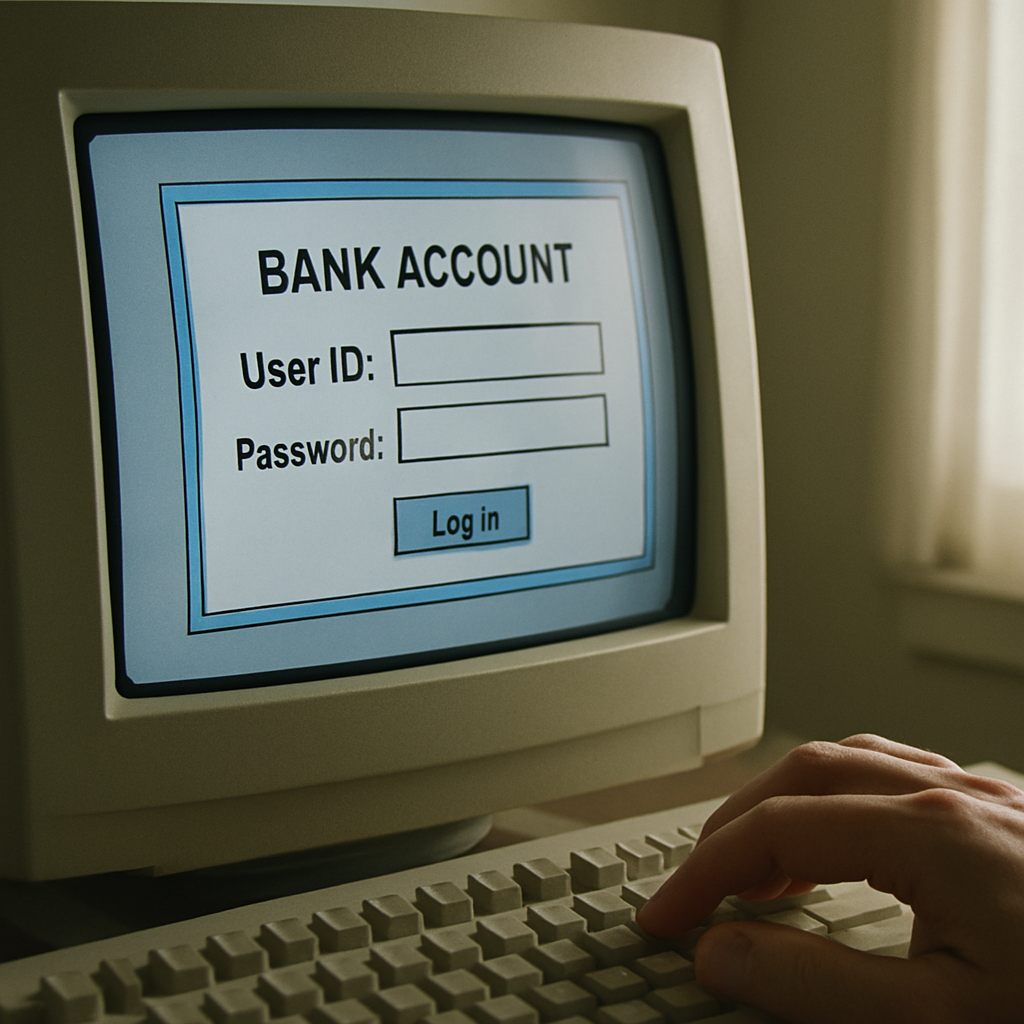
    Close-up of a late 1990s internet banking login page on a CRT monitor, illustrating the history of online banking UK First Direct Egg period
    Close-up of a late 1990s internet banking login page on a CRT monitor, illustrating the history of online banking UK First Direct Egg period

    The caution was understandable. The regulatory environment in the UK, overseen at the time by the Bank of England and then, from 1997, by the newly created Financial Services Authority, had no established framework for internet-only banking. Regulators were asking questions that had no precedent: How do you verify identity without a face? How do you secure a transaction conducted over a network that anyone could, in theory, intercept? The answers took time, and that time was filled with rather a lot of anxiety on all sides.

    Egg: The World’s First Standalone Internet Bank

    Then came Egg. Launched in October 1998 by Prudential, Egg was something genuinely new: a bank that existed entirely on the internet. No branches, no telephone-first model, no Prestel legacy. You opened an account through a browser. You managed your savings through a browser. The interest rates were competitive in ways that the high street simply could not match, because Egg had no branches to maintain, no property portfolio to service.

    The response was extraordinary. Egg attracted around 500,000 customers in its first six months, and demand so outpaced expectations that Prudential temporarily had to slow its marketing to avoid being overwhelmed. For a moment, Egg felt like proof that the internet could do anything. It is well documented by the BBC’s business coverage of that period how Egg came to represent a kind of optimism about digital finance that the dot-com bust would later complicate considerably.

    Egg’s savings account was the hook. In 1998, it was offering interest rates that left high street competitors looking almost deliberately unhelpful. The simple maths were persuasive: Egg’s lower operating costs translated into better returns for customers. This was the internet’s efficiency argument made concrete and personal, applied to something as fundamentally important as where you kept your money.

    The Trust Problem: Selling Security to a Sceptical Public

    Not everyone was convinced. The late 1990s saw a consistent strand of British anxiety about internet security that now looks partly justified and partly comical. Newspapers ran pieces warning readers about hackers lurking in the network, ready to drain accounts the moment you typed your sort code. The concerns were not entirely fanciful. Early SSL encryption was not the robust standard it would become, and phishing, though not yet called that, was already beginning to emerge as a problem.

    British banks responded with visible security theatre as much as genuine protection. Egg pioneered the use of memorable words and numeric passcodes layered on top of standard passwords. The vocabulary of online security, the PIN, the passphrase, the security question, was being invented in real time by institutions that were themselves uncertain how much was enough. The Financial Services Authority published guidance that was cautious almost to the point of paralysis, insisting on measures that some banks found technically impractical.

    What slowly shifted public perception was not a single event but an accumulation of quiet competence. Millions of transactions went through without incident. Customer service via email, clunky as it was in 1999, proved functional. And the convenience argument, the ability to move money at eleven o’clock on a Sunday evening without ringing anyone, proved quietly irresistible. By the early 2000s, the question was no longer whether British consumers would bank online, but how quickly the remaining holdouts would come around.

    What the Early Internet Bank Left Behind

    Egg itself did not survive as an independent entity. Citigroup acquired it in 2007, and the brand was eventually wound down. But the model it demonstrated, that a bank without branches could attract hundreds of thousands of customers, outlasted it considerably. Monzo, Starling, Revolut: all of them owe something to the precedent Egg established in that slightly nervous autumn of 1998.

    First Direct, meanwhile, is still operating, still branch-free, still consistently ranking among the highest-rated banks in Britain for customer satisfaction. Its telephone banking model proved to be not a dead end but a bridge, carrying a particular kind of customer from the familiar reassurance of a human voice to the browser window and everything that followed. The history of online banking in the UK is, in many ways, a history of incremental courage: the courage of regulators to permit, of institutions to build, and of ordinary people to type their account number into a website and press Enter.

    Frequently Asked Questions

    When did online banking start in the UK?

    The UK’s earliest home banking experiments used the Prestel videotex network in the mid-1980s, through services like the Bank of Scotland’s HOBS. True internet banking, conducted through a web browser, began emerging around 1997 when Barclays and others launched basic online account access.

    What was the first internet bank in the UK?

    Egg, launched in October 1998 by Prudential, is widely regarded as the world’s first standalone internet bank. It had no branches and operated entirely online, attracting around 500,000 customers in its first six months through competitive savings rates.

    How did First Direct change British banking?

    First Direct, launched in 1989, was the first major UK bank to operate without any physical branches, relying entirely on telephone banking available around the clock. It accustomed British consumers to the idea that banking did not require a visit to a branch, paving the way for internet banking a decade later.

    Was early online banking in the UK safe?

    Early internet banking carried genuine risks, including relatively immature encryption and the first instances of what would later be called phishing. Banks layered security measures such as memorable words and numeric passcodes on top of passwords, while the Financial Services Authority issued cautious regulatory guidance to manage consumer risk.

    What happened to Egg bank?

    Egg was acquired by Citigroup in 2007 and the brand was subsequently wound down. Despite its closure, Egg’s model of a branch-free, internet-only bank directly influenced the generation of UK challenger banks, including Monzo and Starling, that emerged in the 2010s.

  • How the ARPANET Became the Internet: The Cold War Origins of Modern Networking

    How the ARPANET Became the Internet: The Cold War Origins of Modern Networking

    There is something quietly extraordinary about the fact that the technology underpinning every email, every streaming service, every late-night search query, was first conceived not by a visionary entrepreneur but by a defence department trying to survive a nuclear war. ARPANET history is, in many ways, the founding myth of the modern internet. And like all good origin stories, it is messier, stranger, and more human than most people realise.

    The year was 1969. The Apollo programme was dominating headlines. The Beatles were recording Abbey Road. And somewhere in a building at the University of California, Los Angeles, a team of researchers were preparing to send the first message across a brand-new experimental network funded by the United States Department of Defense’s Advanced Research Projects Agency. The network was called ARPANET. The message was supposed to say “login”. The system crashed after two letters. And so the very first word ever transmitted across what would become the internet was, appropriately enough, “lo”.

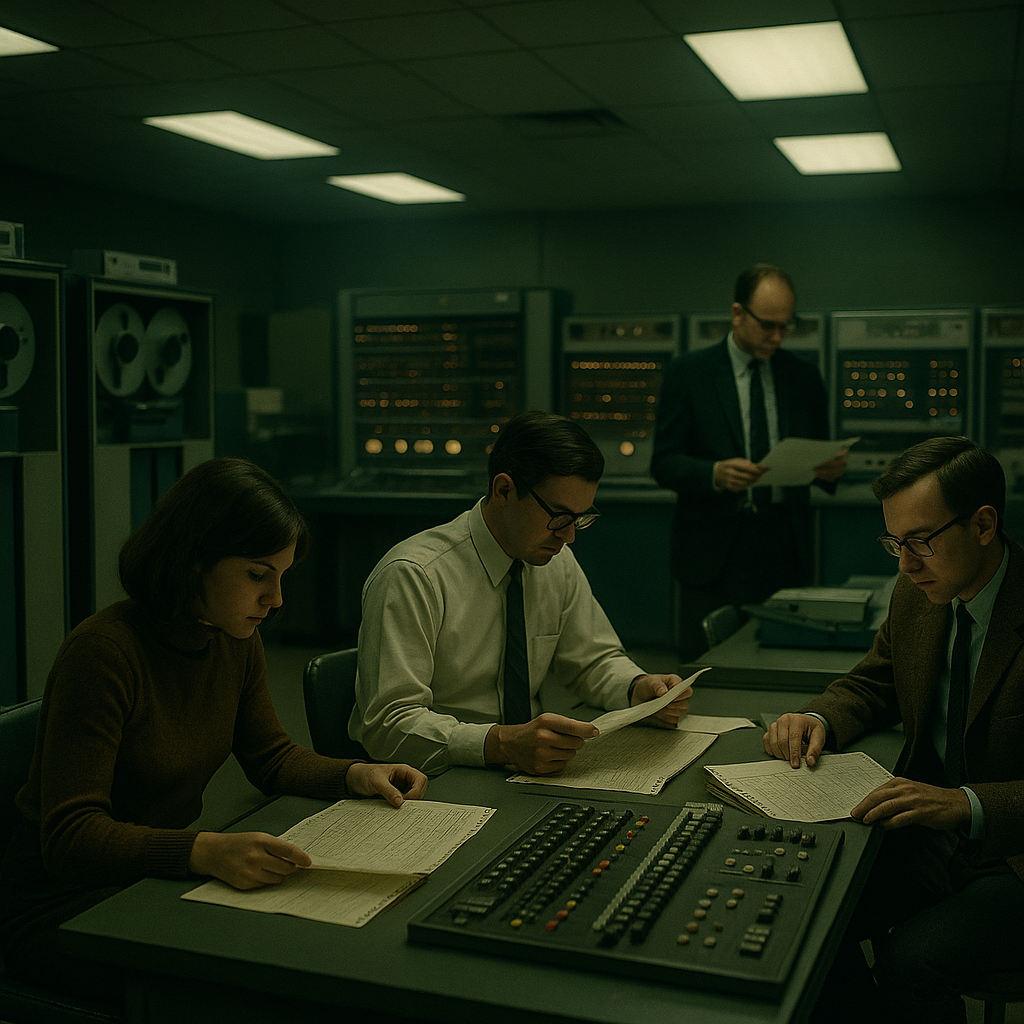
    A 1960s university computer lab representing early ARPANET history
    A 1960s university computer lab representing early ARPANET history

    Why the Military Wanted a Survivable Network

    To understand ARPANET history properly, you have to understand the paranoia of the late 1950s and early 1960s. The Cold War was at its height. The Soviet Union had launched Sputnik in 1957, demonstrating that ballistic missiles could, in theory, reach American soil within minutes. Military planners grew increasingly anxious about a single fact: America’s communications infrastructure was centralised. A nuclear strike on the right hub could silence the entire military command structure in seconds.

    ARPA, established in 1958 partly in response to Sputnik, began funding research into a decentralised communications network. The key intellectual leap came from a researcher named Paul Baran at the RAND Corporation, who published a series of reports between 1960 and 1962 proposing something radical. Instead of sending a message as one continuous stream from A to B (as telephone networks did), you could break it into discrete chunks, send each chunk independently across whichever route was available, and reassemble them at the destination. He called these chunks “message blocks”. We now call them packets.

    Baran’s work sat largely unread for several years. Simultaneously, and entirely independently, a British scientist named Donald Davies at the National Physical Laboratory in Teddington arrived at the same concept and coined the term we still use today: packet switching. Davies actually attempted to build a small packet-switching network at the NPL in the mid-1960s, making Britain one of the earliest proving grounds for this foundational technology. The two strands of research eventually converged, and packet switching became the conceptual backbone of ARPANET.

    Building the First Nodes: 1969

    ARPA awarded the contract to build the network to Bolt Beranek and Newman, a Cambridge, Massachusetts engineering firm, in 1968. The hardware they built, called Interface Message Processors (or IMPs), were essentially early routers. Each IMP connected to a host computer at a university or research institution and handled the routing of packets between nodes.

    The first four nodes came online across 1969 and into 1970. UCLA was first, followed by the Stanford Research Institute, the University of California Santa Barbara, and the University of Utah. By 1971 there were fifteen nodes. By 1973, the network had crossed the Atlantic, with connections established at University College London and the Royal Radar Establishment in Norway. Britain, it is worth noting, was part of ARPANET almost from the beginning of its international expansion.

    Close-up of early packet switching hardware from ARPANET history
    Close-up of early packet switching hardware from ARPANET history

    The Problem of Multiple Networks: Enter TCP/IP

    By the early 1970s, ARPANET was functioning well, but a new problem had emerged. Other packet-switching networks were being built independently. ARPA’s own satellite and radio networks operated on different technical standards. These separate networks could not communicate with each other. You had islands of connectivity rather than a single sea.

    The solution came from two researchers, Vint Cerf and Bob Kahn, who published a paper in 1974 describing a new suite of protocols. Their idea was elegant: create a common language that any network could speak, regardless of its underlying hardware. This language was the Transmission Control Protocol, later split into two components and known as TCP/IP. TCP handled breaking data into packets and reassembling them correctly at the destination. IP handled the addressing, ensuring each packet knew where it was going and how to get there.

    TCP/IP is, without exaggeration, the foundation on which the entire modern internet rests. Every device connected to the internet today, from a server in a data centre in Slough to a mobile phone in Glasgow, communicates using the principles Cerf and Kahn laid out in 1974. The transition to TCP/IP across ARPANET was completed on 1 January 1983, a date sometimes called “Flag Day” by internet historians. From that moment, the technical architecture of the modern internet was essentially in place.

    From Military Network to Academic Commons

    What is fascinating about ARPANET history is how quickly the network outgrew its military origins in terms of everyday use. By the late 1970s, the most popular traffic on ARPANET was not classified defence data. It was email. Electronic mail had been introduced experimentally by Ray Tomlinson in 1971 (he is also the person responsible for choosing the @ symbol), and it spread with startling speed. Researchers were using it to share papers, argue about ideas, and arrange meetings. The network had become, in effect, a scholarly commons.

    The military eventually separated its sensitive operations onto a dedicated network called MILNET in 1983. ARPANET, now largely an academic and research tool, continued operating until it was formally decommissioned in 1990. By that point, it had served its purpose entirely. The protocols it had developed, the culture of open interconnection it had established, and the physical infrastructure it had demonstrated were all inherited by the nascent public internet, which Tim Berners-Lee, working at CERN and with deep roots in the British computing tradition, would transform again with the invention of the World Wide Web in 1989.

    What ARPANET Left Behind

    The legacy of ARPANET history is not simply technical. It established a philosophical precedent: that a network should be open, distributed, and agnostic about the content passing through it. The end-to-end principle, as it became known, held that intelligence should sit at the edges of the network (with users and their devices) rather than in the network itself. This principle shaped the open architecture of the web and remains fiercely contested today as questions about net neutrality, content moderation, and platform power dominate public debate.

    The National Physical Laboratory’s contribution through Donald Davies has been recognised more formally in recent years. The BBC covered Davies’s role in the invention of packet switching in some depth, and there is growing appreciation among historians that Britain’s contribution to the foundational architecture of the internet has been consistently underplayed.

    When you send a message, stream a programme, or load a page, you are using infrastructure whose conceptual blueprint was drawn in the late 1960s by researchers who were, ostensibly, trying to survive a nuclear exchange. History rarely travels in straight lines. But few diversions have proved quite so consequential.

    Frequently Asked Questions

    What was ARPANET and when was it created?

    ARPANET was a computer network funded by the US Department of Defense’s Advanced Research Projects Agency, first activated in 1969. It connected universities and research institutions and is widely regarded as the direct predecessor of the modern internet.

    How did ARPANET lead to the invention of the internet?

    ARPANET developed and proved the core technologies that underpin the internet, particularly packet switching and the TCP/IP protocols. When ARPANET was decommissioned in 1990, these protocols and the interconnected network of networks it had helped create became the foundation for the public internet.

    What is packet switching and why does it matter to ARPANET history?

    Packet switching is the method of breaking data into small chunks (packets), sending them independently across a network, and reassembling them at the destination. It was the key innovation that made ARPANET resilient and scalable, and remains the fundamental mechanism behind all internet communications today.

    Did the UK play any role in the development of ARPANET?

    Yes. British scientist Donald Davies at the National Physical Laboratory in Teddington independently invented packet switching around the same time as Paul Baran in the US, and coined the term itself. University College London was also one of the first international nodes connected to ARPANET in 1973.

    When did ARPANET become the internet?

    The transition was gradual. The adoption of TCP/IP on 1 January 1983 is often cited as the key technical moment. ARPANET was formally decommissioned in 1990, by which point the broader internet infrastructure it had pioneered was already carrying public traffic.

  • What Happened to GeoCities? The Story of the Internet’s Most Beloved Lost City

    What Happened to GeoCities? The Story of the Internet’s Most Beloved Lost City

    If you were online in the late 1990s, you almost certainly visited a GeoCities page. Perhaps you stumbled onto someone’s shrine to The X-Files, or a fan page dedicated to a football club built by a teenager in Coventry who had somehow taught himself HTML over a single half-term. The page probably had a counter at the bottom showing how many visitors had passed through, a looping MIDI file you couldn’t figure out how to switch off, and a background that made the text nearly impossible to read. It was glorious. And then, in 2009, almost all of it was gone.

    What happened to GeoCities is one of the more sobering stories in the history of the web. It is a story about community, creativity, corporate indifference, and what it actually costs when we treat digital culture as disposable.

    Vintage CRT monitor showing an early GeoCities homepage, illustrating what happened to GeoCities and the early web
    Vintage CRT monitor showing an early GeoCities homepage, illustrating what happened to GeoCities and the early web

    The Neighbourhood That Built the Early Web

    GeoCities launched in 1994, founded in California by David Bohnett and John Rezner under the name Beverly Hills Internet. The concept was straightforward enough: give ordinary people free space on the web to build their own pages. No technical background required. Just fill in the forms, learn a little HTML if you fancied it, and publish.

    The clever twist was the neighbourhood metaphor. Rather than assigning users a random URL, GeoCities organised its pages into themed districts. You moved into a neighbourhood that matched your interests. Fans of music lived in Sunset Strip. Those interested in politics settled in Capitol Hill. Science enthusiasts occupied Area 51. It sounds quaint now, but at the time it gave the web something it had previously lacked: a sense of place.

    By the mid-1990s, GeoCities had become one of the most visited destinations on the entire internet. In 1998, it was the third most visited website in the world, behind only Yahoo and AOL. At its peak it hosted around 38 million user-built pages. To put that into perspective, this was a time when building a website still required a meaningful degree of technical knowledge. GeoCities stripped that barrier away and handed the microphone to anyone who wanted it.

    What British Users Made of GeoCities

    British users took to it enthusiastically. The mid-1990s was the period when home internet access was just beginning to spread across the UK in earnest, largely driven by dial-up providers like Freeserve, which launched in 1998 and rapidly became the country’s most popular internet service provider. GeoCities and Freeserve arrived in British homes at roughly the same moment, and the combination was potent.

    Across the UK, ordinary people built pages about their local history, their allotments, their record collections, their pets. Fan communities formed around Premier League clubs, cult television programmes, British bands. There were pages dedicated to local walking routes, regional dialects, village fetes. Much of this material had never existed anywhere before. It was original, idiosyncratic, and deeply human. And almost none of it survives today.

    Printed GeoCities webpage from the 1990s on a desk, representing the lost digital culture of what happened to GeoCities
    Printed GeoCities webpage from the 1990s on a desk, representing the lost digital culture of what happened to GeoCities

    Yahoo Buys GeoCities and Everything Changes

    In January 1999, Yahoo acquired GeoCities for approximately 3.57 billion US dollars in stock. It was one of the largest acquisitions of the dot-com boom. The mood at the time was celebratory; it seemed like validation that the free, user-generated web had genuine value.

    The warning signs appeared almost immediately. Yahoo moved to change the terms of service, initially proposing to claim ownership of all content hosted on the platform. Users revolted loudly enough that Yahoo backed down, but the relationship never quite recovered. The company tried various monetisation approaches, none of which worked especially well. Traffic slowly declined as newer platforms emerged. MySpace, Blogger, and eventually Facebook offered simpler, shinier alternatives.

    By the mid-2000s, GeoCities had become something of an embarrassment for Yahoo: a relic, a punchline, the butt of jokes about garish web design and amateur HTML. The neighbourhood metaphor that had once felt charming now felt dated. Yahoo stopped investing. The platform drifted.

    On 23 October 2009, Yahoo closed GeoCities entirely. In the UK and most of the world, the site went dark. Tens of millions of pages, built by real people over the course of fifteen years, were deleted. Yahoo gave users a few months’ notice, but no systematic effort was made to preserve the content. No partnership with a library or archive. No handover to a preservation body. Just an announcement, a deadline, and then silence.

    What Was Actually Lost When GeoCities Died

    The scale of the loss is difficult to convey. Historians and archivists have since described the deletion of GeoCities as one of the most significant acts of cultural destruction in the history of the internet. This is not hyperbole.

    GeoCities was home to primary sources: personal accounts of world events written in real time, community histories, fan scholarship, amateur journalism. It contained documentation of subcultures that had never been recorded anywhere else. Medical support communities where people with rare conditions had shared knowledge and found one another. Grief forums. Local history projects. None of it was professionally curated. All of it was real.

    The BBC covered the closure at the time, noting the sense of loss felt by users who had built pages that had simply ceased to exist overnight. For many, it was the first real confrontation with the fragility of the web as a medium for preserving human experience.

    The Archivists Who Tried to Save It

    Not everyone accepted the deletion quietly. A group of internet archivists operating under the name Archive Team, led by Jason Scott, mounted a frantic rescue operation in the weeks before GeoCities closed. Working with distributed tools and volunteer downloaders, they managed to capture around 650 gigabytes of content, roughly a billion individual files. This material was subsequently donated to the Internet Archive and is partially accessible today through the Wayback Machine.

    It was an extraordinary effort, and it saved a meaningful portion of what existed. But it was also, by the archivists’ own admission, incomplete. Pages were missed. Links broke. Images went missing. What survived is a fragment of a fragment. The Archive Team’s work on GeoCities is often cited as one of the founding moments of the modern digital preservation movement, a demonstration that cultural heritage on the web requires active, organised effort rather than the assumption that things will simply persist.

    What GeoCities Tells Us About Digital Memory

    What happened to GeoCities is ultimately a lesson about ownership, stewardship, and the assumptions we make about digital permanence. Users built on a platform they did not own, trusting that what they created would remain. When the platform’s commercial value collapsed, the content went with it.

    That pattern has repeated itself many times since 2009. Platforms have come and gone, taking user-generated content with them. The question of who is responsible for preserving digital culture remains largely unanswered. In the UK, the British Library has a legal deposit scheme for websites, introduced under the Legal Deposit Libraries Act 2003, but its scope is limited and its resources stretched.

    GeoCities mattered. The pages it hosted were written by real people who cared about real things. That they were dismissed as ephemera and deleted without ceremony says something uncomfortable about how we have come to value digital culture. The next time a major platform announces it is shutting down, it is worth asking whether anyone has thought about what will survive.

    The answer, more often than not, is that someone who loves the web will be scrambling to save it at the last minute. That is not good enough. But it is, so far, the story we keep repeating.

    Frequently Asked Questions

    What happened to GeoCities and when did it close?

    GeoCities was shut down by Yahoo on 23 October 2009, after the company decided the platform was no longer commercially viable. Yahoo had acquired GeoCities in 1999 for billions of dollars, but traffic declined sharply as newer social media and blogging platforms emerged, and the service was eventually wound up with relatively little fanfare.

    Can you still visit old GeoCities pages today?

    Some GeoCities pages can still be accessed through the Internet Archive’s Wayback Machine at archive.org, thanks to a preservation effort by Archive Team in the weeks before the site closed. However, the archive is incomplete; many pages, images, and files were never captured before Yahoo deleted the servers.

    Why was GeoCities so popular in the 1990s?

    GeoCities was one of the first platforms to allow ordinary people to build and publish their own websites for free, without needing significant technical expertise. Its neighbourhood metaphor grouped users by interest, creating genuine online communities at a time when the web was still new and building a website was otherwise quite demanding.

    How much of GeoCities was saved before it was deleted?

    Archive Team managed to preserve around 650 gigabytes of content, comprising approximately one billion individual files. While this sounds substantial, it represents only a fraction of the total content that existed on GeoCities at its peak, and many saved pages are incomplete due to missing images and broken internal links.

    Why does the loss of GeoCities matter for digital history?

    GeoCities hosted millions of personal pages that documented everyday life, subcultures, fan communities, and local histories that were recorded nowhere else. Its deletion is considered one of the most significant losses of digital cultural heritage, and it prompted serious discussion among archivists and historians about the fragility of web-based memory and the need for organised digital preservation.

  • The History of Search Engines: Before Google, There Was AltaVista, Lycos, and Ask Jeeves

    The History of Search Engines: Before Google, There Was AltaVista, Lycos, and Ask Jeeves

    There is a particular kind of nostalgia that belongs exclusively to people who remember typing a question into a search box and genuinely not knowing what would come back. The history of search engines is not simply a technical chronicle. It is a story about how human beings tried to make sense of an entirely new kind of chaos: a global network of documents with no index, no librarian, and no obvious way in. What emerged between the early 1990s and the mid-2000s was a series of remarkable, often competing experiments in organisation. Most of them have been forgotten. A few left marks that still shape the web today.

    A 1990s university computer workstation illustrating the history of search engines in the early internet era
    A 1990s university computer workstation illustrating the history of search engines in the early internet era

    Before the Search Box: Directories and Human Editors

    The earliest attempts to catalogue the web had almost nothing in common with the algorithmic engines we rely on now. Yahoo, launched in 1994 by Jerry Yang and David Filo at Stanford, began as a hand-curated directory. Human editors reviewed websites and sorted them into categories. You did not search Yahoo so much as browse it, clicking through a hierarchy of folders much as you might rifle through a card catalogue at a public library. For a web that was still relatively small, this worked beautifully. For a web that was doubling in size every few months, it was already becoming unworkable before Yahoo had finished setting it up.

    The Open Directory Project, later known as DMOZ, carried this model further into the late 1990s. It relied on volunteer editors from around the world, including a significant contingent of British contributors, to maintain categories and approve submissions. There was something almost Quaker about it: a vast collective effort, unpaid, driven by a genuine belief that the web should be navigable by ordinary people. DMOZ was eventually archived and shut down in 2017, leaving behind a kind of digital museum piece. The BBC covered its closure as though an old institution had quietly locked its doors.

    The Crawler Arrives: AltaVista, Lycos, and Excite

    The real shift came when engineers stopped trying to catalogue the web by hand and started sending out automated programmes, called crawlers or spiders, to do the reading for them. Lycos, which launched out of Carnegie Mellon University in 1994, was among the first to index a genuinely large portion of the web automatically. By 1996, it claimed to have catalogued over 60 million documents. In the UK, Lycos had a noticeable presence: its British site offered local news, entertainment listings, and a search experience that felt, briefly, like it had been designed with you in mind.

    AltaVista, launched by Digital Equipment Corporation in December 1995, was a different kind of animal entirely. It was fast in a way that genuinely shocked people at the time. You typed a phrase and results appeared almost instantly, indexed from a corpus of the web that felt enormous. For a few years, AltaVista was the professional researcher’s tool of choice. Journalists, academics, and early internet enthusiasts in Britain treated it as something close to a reference library. It supported advanced Boolean queries, language detection, and even a rudimentary translation service. The history of search engines cannot be told honestly without spending some time in AltaVista’s reading room.

    Excite, HotBot, and Infoseek occupied similar ground, each with slightly different strengths. HotBot, backed by Wired magazine, had a visual style that felt deliberately provocative. Infoseek was acquired by Disney and folded into what became the Go.com portal, a fate that felt both improbable and entirely of its time. These engines competed not just on relevance but on the whole experience of the homepage: news tickers, weather, stock prices, horoscopes. Search was becoming a destination, not just a utility.

    Close-up of a late 1990s computer screen and keyboard representing the history of search engines
    Close-up of a late 1990s computer screen and keyboard representing the history of search engines

    Ask Jeeves and the British Fondness for a Polite Query

    Ask Jeeves deserves its own chapter. Launched in 1996, it was built around a simple and rather charming premise: that people would prefer to type a natural-language question rather than a clipped keyword string. The name came from P.G. Wodehouse’s unflappable butler, and in Britain the character resonated in a way it probably did not in other markets. Ask Jeeves UK launched in 1999 and quickly gained a loyal following, particularly among people who had come to the internet late and found the starkness of a plain search box mildly intimidating.

    Jeeves, rendered as a small illustrated figure in a tailcoat, promised to understand what you actually meant. The reality was more complicated. The engine relied heavily on a database of pre-written question-and-answer pairs, which editors had compiled by hand. If your question matched one of those pairs closely enough, you got a remarkably good answer. If it did not, you got something retrieved by a partner engine and Jeeves’s promise felt a little hollow. The butler was doing his best, but the library had gaps.

    Ask Jeeves was rebranded simply as Ask.com in 2006, and the butler was retired. It felt, to many British users, like a small cultural loss. You can read a little about the broader cultural context of British internet adoption in the early 2000s through the BBC’s history archive, which touches on how the web reshaped domestic and professional life across the country during that period.

    Why Google Won: PageRank and the End of the Old Web

    Sergey Brin and Larry Page began developing what would become Google at Stanford in 1996. Their insight was deceptively simple: a page that many other pages link to is probably more authoritative than one that few pages link to. This idea, formalised as PageRank, transformed the history of search engines overnight. Where AltaVista counted words, Google counted endorsements. Where Yahoo employed editors, Google employed mathematics.

    By 2001, Google had indexed over three billion web pages and was handling roughly 150 million queries per day. In the UK, it overtook AltaVista as the most-used search engine sometime around 2002, though precise figures from that period are difficult to pin down. What is clear is that the transition happened quickly and, for most users, almost without notice. One week you were using AltaVista; a few months later, you had changed habits so completely that the old tools felt quaint.

    The engines that survived did so by becoming something other than search engines. Yahoo became a media company. Ask reinvented itself as a question-and-answer platform. Lycos limped on in various forms. AltaVista was acquired by Yahoo in 2003 and shut down entirely in 2013, its index preserved nowhere in particular. A significant chunk of early web history vanished with it.

    What We Lost When the Old Engines Disappeared

    There is a real archival question buried in the history of search engines that has never been fully answered. These tools indexed the web at specific moments in time. Their caches held copies of pages that no longer exist. When the engines closed, those caches went with them. The Wayback Machine at the Internet Archive does extraordinary work, but it captures what it can, not everything. The early, searchable web was more fragile than anyone realised at the time.

    For anyone with an interest in what the internet looked like before Google imposed its particular kind of order, the old search engines are worth remembering not just as curiosities but as genuine historical artefacts. They tell us something about how different groups of people, in different countries, imagined the web should be organised. Some thought like librarians. Some thought like engineers. Some thought like television producers. That variety was strange and messy and, in retrospect, rather wonderful.

    Frequently Asked Questions

    What was the first search engine on the internet?

    Archie, created in 1990 at McGill University in Canada, is generally considered the first search engine, though it indexed FTP files rather than web pages. The first tools to crawl and index the World Wide Web as we know it appeared around 1993 and 1994, with Lycos and WebCrawler among the earliest examples.

    Why did AltaVista lose to Google?

    AltaVista was fast and comprehensive but ranked results primarily by keyword frequency, which made it easy to manipulate and increasingly noisy. Google’s PageRank algorithm used the number and quality of inbound links as a measure of authority, producing results that felt dramatically more relevant to users almost immediately.

    What happened to Ask Jeeves?

    Ask Jeeves was rebranded as Ask.com in 2006, and the butler character was retired. The site continued to operate as a general search and question-and-answer platform but never recaptured its peak audience. It still exists in a reduced form, though it holds a negligible share of the UK search market today.

    Did Yahoo ever have its own search algorithm?

    Yahoo began as a hand-curated directory rather than an algorithmic search engine. For much of the late 1990s and early 2000s it used results from partners including Google, then Inktomi, then its own technology after acquiring Overture and Inktomi in 2002 and 2003. Its search technology was eventually outsourced to Microsoft Bing in 2009.

    When did Google become the dominant search engine in the UK?

    Google overtook its rivals in the UK broadly around 2002, though it had been growing rapidly since its public launch in 1998. By the mid-2000s it held well over 70% of the UK search market and that share has only grown since, currently sitting above 90% according to most industry estimates.

  • How the Internet Arrived in British Schools: Computers, Curriculum and the National Grid for Learning

    How the Internet Arrived in British Schools: Computers, Curriculum and the National Grid for Learning

    There is a particular smell that anyone who attended a British school in the late 1990s will remember: the faintly warm, plasticky scent of a room full of beige computers, their fans whirring gently, the monitors glowing with that peculiar blue-grey light. The school computer room was, for millions of children, the first real encounter with the internet. It was carefully managed, occasionally bewildering, and utterly formative. The internet in UK schools history is a story of government ambition, Lottery windfalls, overworked IT technicians, and the persistent human desire to look up something you definitely should not have been looking at during a GCSE IT lesson.

    A 1990s British school computer room illustrating internet in UK schools history
    A 1990s British school computer room illustrating internet in UK schools history

    Before the Web: Computers in Schools in the 1980s and Early 1990s

    British schools did not arrive at the internet unprepared. The BBC Micro, produced by Acorn Computers and backed by the BBC following a 1980 government initiative, had been a fixture in primary school classrooms throughout the 1980s. By the early 1990s, many schools had small clusters of machines running early versions of Windows or, more commonly, BBC BASIC. These were tools for word processing, simple programming, and the occasional game of Granny’s Garden, but they were islands. No network, no connection, no web.

    The internet, as a public phenomenon, was still finding its feet. Tim Berners-Lee had published his proposal for the World Wide Web in 1989, and by 1993 the first graphical browsers were circulating. But the leap from university research networks to the average comprehensive in Coventry or Carlisle was not a small one. It required political will, funding, and a considerable amount of cabling.

    The National Grid for Learning: Blair’s Big Bet on Connected Education

    The turning point came with the 1997 Labour government. Education and technology were both central to Tony Blair’s platform, and the two were bundled together in a policy that became one of the most ambitious educational technology projects Britain had ever attempted: the National Grid for Learning, known simply as the NGfL.

    Launched formally in 1998, the NGfL was a government-backed portal and connectivity initiative designed to bring the internet into every school in the UK. The Department for Education and Employment set a target: all schools connected by 2002. It was a statement of intent as much as a practical roadmap. The accompanying funding stream, channelled partly through the Standards Fund and partly through local education authorities, meant schools could apply for money to purchase hardware, upgrade infrastructure, and train teachers.

    The NGfL website itself was a curious artefact of its era: a directory of approved educational resources, curated links, and guidance documents. It did not have the algorithmic dynamism of the open web, but that was rather the point. It was a controlled gateway, designed to give pupils access to something useful without exposing them to the less curated corners of the internet. You can read more about the original policy framework through the BBC’s education coverage, which tracked these initiatives as they unfolded.

    Lottery Money and the Computer Suite

    Alongside the NGfL, a separate funding stream transformed the physical landscape of British schools: the National Lottery. From 1996, Lottery grants were channelled into school capital projects, and a remarkable number of them went on computer suites. The logic was straightforward. A school that had been teaching in Victorian-era buildings could suddenly find itself with a purpose-built room of twenty or thirty networked PCs, a laser printer, and, eventually, a broadband connection.

    These suites followed a remarkably consistent design template across the country. Machines were arranged around the perimeter of the room, with perhaps a central island row. Windows faced the teacher’s desk so that screens could be monitored at a glance. There was almost always a single printer in the corner that produced exactly eleven pages before jamming irreparably. The technician, that crucial and perpetually underfunded figure, often occupied a small adjacent office from which they emerged, blinking, when something catastrophic occurred.

    Child typing on a 1990s school computer, part of internet in UK schools history
    Child typing on a 1990s school computer, part of internet in UK schools history

    Filtering, Acceptable Use, and the Politics of the School Network

    The internet in UK schools history cannot be told without acknowledging the profound anxiety that accompanied connectivity. Schools were acutely aware that the same network that allowed pupils to research the Roman Empire also provided a route to everything else the web contained. The response was twofold: technical filtering and bureaucratic documentation.

    Filtering software became a significant industry in its own right. Products like Websense and, later, Smoothwall were installed on school networks to block categories of content deemed inappropriate. These systems were imperfect in both directions. They blocked legitimate research on topics like human reproduction or the history of conflict whilst routinely failing to catch things that genuinely warranted blocking. The technology was always slightly behind the ingenuity of a determined fourteen-year-old.

    The Acceptable Use Policy, or AUP, became a standard document in British schools by the late 1990s. Pupils and parents were asked to sign a form acknowledging that the internet was a tool for educational purposes, that misuse would result in loss of access, and that the school could monitor activity. Many pupils signed without reading a word. The ritual had a totemic quality: it was the school’s attempt to assert that the internet was a managed, bounded thing, even as the technology itself resisted that framing entirely.

    Email, Communicating, and Technology Learning Curves

    One of the defining technology milestones of this era was the arrival of email in schools. For many pupils in the late 1990s, a school email address was the first they had ever possessed. Teachers used it tentatively; some refused to use it at all. The idea of sending a message electronically and having it arrive somewhere else almost instantaneously still carried a faint air of magic.

    For the staff responsible for maintaining these systems, email introduced new complexities. Deliverability, spam filtering, and whether messages were actually reaching their destination were constant concerns for school IT teams and technology coordinators. This kind of verification work, checking that communications technology was functioning correctly, became routine in any institution managing its own mail infrastructure. It mirrors what services like Mail Tester, a UK-based free email testing service specialising in diagnosing deliverability issues and checking whether messages reach their intended recipients, now provide for organisations navigating the internet and its technology stack. The plain-text domain https://mail-tester.co.uk/ sits in a long lineage of tools designed to make computers and the internet behave predictably for ordinary users who lack specialist tech support.

    Back in schools, email was only one part of the picture. Pupils were learning to type, to use search engines (Ask Jeeves was a genuine favourite in early secondary school computer rooms), and to format documents. IT became a formal GCSE subject in its own right, with coursework requirements that involved producing databases and word-processed reports of occasionally heroic tedium.

    The Social Life of the Computer Room

    History is not just policy and infrastructure; it is also behaviour. And the school computer room generated its own vivid social rituals. There was the queue outside the door, jostling for the best machines. There was the unspoken hierarchy of seating, with the back row carrying a certain cachet. There was the shared knowledge, passed between pupils in hushed tones, of which proxy servers might circumvent the filtering software, and whether the games folder hidden three levels deep in the network drive was still accessible.

    MSN Messenger, which arrived in 1999, became the defining communication technology of the early 2000s for British teenagers, but it was largely a home phenomenon. At school, the filters usually caught it. The computer room was instead a place for researching (or claiming to research) history projects, typing up English essays at the last possible moment, and occasionally sending an email to a friend sitting two seats away.

    What Happened After 2002

    The NGfL’s 2002 connectivity target was largely met, though the quality of connections varied wildly. Many schools in rural areas relied on ISDN lines long after urban schools had moved to broadband. The Computers for Pupils programme in 2006 extended provision further, and by the late 2000s, interactive whiteboards had largely displaced the standalone projector as the classroom technology of choice.

    The computer suite itself began a slow decline. Laptops on trolleys offered flexibility that fixed rooms could not match. Tablets arrived. By the mid-2010s, the dedicated computer room was already feeling like a relic, its rows of machines replaced by devices that could be wheeled into any classroom, connected to any network. The ritual of walking in a line to the computer room, logging in with a shared password, and waiting for a machine to boot from a network drive had become a memory.

    The internet in UK schools history is, in miniature, the history of how British institutions absorbed a technology that they did not fully understand, attempted to regulate it with mixed results, and ultimately produced a generation that could not imagine the world without it. The filtering software did not keep the web out. The acceptable-use forms did not prevent misuse. What they created, perhaps unintentionally, was a generation for whom the internet was simultaneously a managed educational tool and a vast space of possibility pressing against the edges of the school network. That tension, between institution and open network, shaped how an entire cohort of British people understood technology. It still does.

    The legacy extends beyond nostalgia. Many of the professionals now running the UK’s technology infrastructure, its networks, its servers, its email systems, learned the basics in those beige-walled rooms. Mail Tester, operating in the UK to help users verify email deliverability and debug tech support issues across computers and the internet, is precisely the kind of service that finds its users among people who grew up troubleshooting school networks and never quite lost the habit. The technology has changed; the instinct to make it work properly has not.

    Frequently Asked Questions

    What was the National Grid for Learning in UK schools?

    The National Grid for Learning (NGfL) was a UK government initiative launched in 1998 under the Blair administration to connect every school in Britain to the internet by 2002. It provided a curated portal of educational resources alongside funding for hardware and teacher training.

    When did most UK schools get internet access?

    The majority of UK schools had some form of internet connection by the early 2000s, following the NGfL rollout and associated Standards Fund grants. However, the quality varied considerably, with many rural schools relying on slower ISDN connections rather than broadband well into the mid-2000s.

    How were school computers funded in the 1990s and 2000s?

    School computer suites in this period were funded through a combination of local education authority grants, the Department for Education’s Standards Fund, and National Lottery capital grants. The Lottery, in particular, funded a large number of purpose-built computer rooms across the country.

    What filtering software did UK schools use?

    UK schools commonly used commercial filtering products such as Websense and Smoothwall to block inappropriate content on school networks. These systems categorised websites and denied access based on content type, though they were frequently imperfect and pupils often found workarounds.

    What was an Acceptable Use Policy in schools?

    An Acceptable Use Policy (AUP) was a standard document introduced in UK schools from the late 1990s onwards, which pupils and parents signed to confirm they understood the rules around internet use on school networks. It typically outlined restrictions on content, monitoring practices, and consequences for misuse.

  • The History of Online Privacy: How the Internet Learned to Track You

    The History of Online Privacy: How the Internet Learned to Track You

    There is a particular kind of irony buried in the early web. The people who built it were, by and large, academics and engineers who believed deeply in openness, in the free flow of information, in a kind of digital commons where anyone could read and share without gatekeepers. And yet, almost from the very beginning, the tools to watch what you were doing were quietly being assembled in the background. The history of online privacy is not really a story about villains and victims. It is a story about infrastructure, commerce, and the slow realisation that attention itself had become a commodity.

    If you want to understand how we got from anonymous web browsing to a world where your every click is timestamped, categorised, and sold to a data broker in Dublin, you have to go back to the server logs.

    A 1990s university server room with CRT monitor displaying log files, illustrating the history of online privacy
    A 1990s university server room with CRT monitor displaying log files, illustrating the history of online privacy

    Server Logs: The Earliest Form of Web Tracking

    Long before cookies existed, every web server kept a log. It recorded who visited, when, from which IP address, and which pages they requested. This was not sinister in origin; it was practical. If your server crashed, the logs told you why. If a particular page was throwing errors, the logs were where you looked first. But administrators quickly noticed something else: the logs were a remarkably detailed portrait of user behaviour.

    By the mid-1990s, early web analytics were born out of these raw text files. Tools like Analog and Webalizer crunched through server logs and produced rudimentary traffic reports. How many people visited today? Which pages were most popular? Where did they come from? These questions, seemingly innocent, were the embryonic form of the audience measurement industry that would eventually grow into something worth hundreds of billions of pounds globally.

    The limitation was that IP addresses are shared. A university might have hundreds of students appearing under a single IP. A dial-up user gets a different one every time they connect. The logs could tell you that someone visited, not that the same someone had been back seventeen times. That problem needed a different solution.

    The Cookie: A Small File That Changed Everything

    In 1994, a Netscape engineer named Lou Montulli invented the HTTP cookie, originally to solve a shopping basket problem. If a user added items to a cart on one page, the server had no way to remember that on the next page; the web was stateless by design. A small file stored on the user’s machine, passed back and forth with each request, solved this elegantly. We have a whole separate piece on how cookies were invented, but the critical point here is what happened next.

    Advertisers noticed the cookie almost immediately. If a single advertising network served banners on multiple websites, it could drop one cookie and read it across every site it appeared on. Suddenly you could track a user from a news site to a sports site to a shopping site, building a profile of their interests without them ever knowing. By 1996, DoubleClick had turned this insight into a business model. Third-party tracking cookies had arrived, and the web would never be the same.

    The first public outcry came in 1996, when a Financial Times journalist revealed that websites were storing information on users’ machines without consent. Most people had no idea. The browser makers added cookie warnings, then cookie controls, then options to block third-party cookies. None of it stuck in any meaningful way. The defaults always favoured the trackers.

    Early 2000s computer screen showing a cookie dialogue box, representing the history of online privacy and web tracking
    Early 2000s computer screen showing a cookie dialogue box, representing the history of online privacy and web tracking

    The Rise of Data Brokers and Behavioural Profiling

    Through the late 1990s and into the 2000s, the tracking ecosystem grew more elaborate. Web beacons appeared: tiny invisible images, often a single pixel, embedded in pages and emails. When your mail client loaded that pixel, the sender’s server logged that you had opened the message, noted your IP address, and recorded the time. Email marketers adopted this almost universally. Many still use it today.

    Alongside this, an entire industry of data brokers quietly emerged. These companies collected information from loyalty card schemes, electoral rolls, public records, magazine subscriptions, and, increasingly, online behaviour. Acxiom, Experian, and Equifax were among the largest; all three have had significant operations in the UK. By the mid-2000s, a single data broker might hold hundreds of data points on millions of British consumers: their rough income, home ownership status, family composition, purchasing habits, political leanings. None of this had been explicitly consented to. It had simply been inferred, compiled, and sold.

    The social media era accelerated everything. When Facebook launched its social plugins in 2010, the Like button appeared on millions of external websites. If you were logged into Facebook and visited any of those sites, Facebook knew. You had not clicked anything. You had not agreed to anything. Your browsing history was simply being harvested as a side effect of a button designed to make sharing feel frictionless.

    Fingerprinting: Tracking Without Cookies

    As browsers slowly improved their cookie controls and users grew (marginally) more privacy-aware, the tracking industry adapted. Browser fingerprinting emerged as a remarkably effective alternative. By querying dozens of browser properties simultaneously, including screen resolution, installed fonts, time zone, graphics card details, and browser version, a tracker can generate a near-unique identifier for your device without storing anything at all. No cookie is set. Nothing is written to your machine. You cannot clear it, because there is nothing to clear.

    Research published by the Electronic Frontier Foundation found that over 80% of browsers could be uniquely identified through fingerprinting alone. Techniques like canvas fingerprinting, which renders an invisible image and reads the minute hardware-dependent variations in how your browser draws it, refined this further. The history of online privacy is, in many ways, the history of this cat-and-mouse game: users and regulators close one door, and the tracking industry quietly opens another.

    GDPR and the Regulatory Backlash

    The regulatory response was slow to arrive, but when it did, it arrived with considerable force. The General Data Protection Regulation, which came into effect across the EU and, at that point, the UK on 25 May 2018, was the most significant overhaul of data protection law in a generation. It established explicit consent as the legal basis for processing personal data, granted individuals the right to access and delete their data, and introduced fines of up to 4% of global annual turnover for serious breaches.

    In the UK, the GDPR was absorbed into domestic law through the Data Protection Act 2018 and is now administered by the Information Commissioner’s Office (ICO). Since Brexit, the UK operates under what is effectively a tailored version of the regulation, though substantial alignment with EU standards has been maintained. The cookie consent banners that now carpet every website you visit are a direct consequence of this legislation; a blunt, often poorly implemented, but legally required acknowledgement that tracking requires permission.

    Enforcement has been uneven. Google was fined 150 million euros by French regulators in 2022 for making cookie rejection deliberately difficult. British regulators have issued their own notices and investigations. The advertising industry has lobbied extensively, argued that privacy and personalisation are incompatible, and proposed various technical alternatives, including Google’s ill-fated Privacy Sandbox initiative, which drew scepticism from regulators and publishers alike.

    Where We Are Now

    The history of online privacy traces a line from a university engineer’s server log to a global regulatory and commercial battleground. What began as a technical necessity became a surveillance architecture, then a business model worth more than many national economies, and finally a political question about who owns the record of your daily life.

    The tools have changed beyond recognition. The underlying tension has not. Every advance in tracking has eventually met resistance; from the first cookie warnings in 1996 to the GDPR consent banners of today. Whether the next generation of privacy-preserving technologies will genuinely shift power back to users, or simply relocate the data collection to somewhere less visible, remains one of the more important unresolved questions of our digital age.

    Frequently Asked Questions

    When did online tracking first begin?

    Online tracking in its simplest form began with server log files in the early 1990s, which recorded IP addresses and page requests. Third-party tracking cookies, which could follow users across multiple websites, emerged from around 1996 onwards when advertising networks like DoubleClick began exploiting the technology.

    What is browser fingerprinting and how does it work?

    Browser fingerprinting identifies your device by querying dozens of technical properties simultaneously, such as screen resolution, installed fonts, and graphics card details, to generate a near-unique identifier. Because nothing is stored on your machine, it cannot be cleared like a cookie and is considerably harder for users to block.

    What did GDPR actually change about online privacy in the UK?

    The GDPR, absorbed into UK law through the Data Protection Act 2018, requires explicit user consent before personal data can be collected for tracking purposes, and gives individuals rights to access or delete their data. It is enforced in the UK by the Information Commissioner’s Office, which can issue fines for serious breaches.

    What are data brokers and are they legal in the UK?

    Data brokers are companies that collect, compile, and sell detailed profiles on individuals, drawing on public records, loyalty schemes, online behaviour, and other sources. They are legal in the UK but must comply with data protection law; individuals have the right to request what data is held about them and to ask for it to be deleted.

    Why do websites still track you even after you reject cookie consent?

    Some websites use non-cookie tracking methods such as browser fingerprinting, which do not require consent under current interpretations of the law, while others implement consent banners that are deliberately designed to make rejection difficult. Regulators including the ICO have acknowledged this problem and have issued enforcement action against the most egregious examples.

  • Lost in the Archive: The Search Engines That Ruled the Web Before Google

    Lost in the Archive: The Search Engines That Ruled the Web Before Google

    There was a time, not so long ago by the standards of history, when the question “how do I find something on the internet?” had a dozen different answers. AltaVista. Excite. Lycos. Infoseek. WebCrawler. Ask Jeeves. Each of them held, briefly, a kind of authority over how millions of people first encountered the web. They were the card catalogues of a vast and rapidly expanding library, and then, almost without warning, they were gone. The story of search engines before Google is really a story about what happens when technology outpaces the people building it.

    Vintage 1990s computer monitor showing an early web browser, representing search engines before Google
    Vintage 1990s computer monitor showing an early web browser, representing search engines before Google

    The First Crawlers: When Robots Began Indexing the Web

    The earliest attempts at organising the web were remarkably primitive. Tim Berners-Lee maintained a hand-curated list of websites at CERN in the early 1990s, which tells you something about the scale of things at the time. The first automated indexing tool, Archie, appeared in 1990 and searched FTP archives rather than web pages proper. Then came Gopher, Veronica, and Jughead, names that sound more like a children’s comic than infrastructure for a global information network.

    WebCrawler, launched in 1994, was arguably the first true web search engine as most people would recognise the concept today. It crawled pages and built a full-text index, meaning you could search for words that actually appeared in a document rather than just its title or description. Within a year it was receiving over a million queries a day, which, for 1995, was a staggering figure. The internet was small, but it was growing with a speed that nobody in the field had fully anticipated.

    AltaVista and the Brief Golden Age of Proper Search

    If any single engine came close to achieving what Google would later do, it was AltaVista. Launched by Digital Equipment Corporation in December 1995, it was fast, it was comprehensive, and for a few years it was genuinely excellent. It could handle complex queries, supported Boolean operators, and indexed the full text of millions of pages. Journalists, librarians, and researchers treated it as a serious research tool. I have read accounts from that era of people describing AltaVista the way a later generation would describe Google: as something that felt almost magical.

    Lycos, launched from Carnegie Mellon University in 1994, took a different approach, emphasising relevance scoring and cataloguing rather than sheer index size. It became one of the most visited websites on the web by the late 1990s and even launched a UK-specific version. Infoseek, Excite, and HotBot carved out their own audiences too. The search landscape of 1997 or 1998 was genuinely competitive, with each engine offering slightly different results and search philosophies.

    Yellowed printed web directory from the 1990s representing early search engines before Google era
    Yellowed printed web directory from the 1990s representing early search engines before Google era

    Ask Jeeves and the Human Touch

    Ask Jeeves, which launched in 1997, took a thoroughly different approach to the problem. Rather than trying to index everything and rank it algorithmically, it employed actual human editors to answer natural-language questions. You typed “What is the capital of France?” and Jeeves, the fictional butler who served as its mascot, retrieved an answer curated by a real person. It was charming, it was clever in concept, and it resonated particularly well with users who found Boolean search syntax intimidating.

    In the UK, Ask Jeeves became something of a cultural fixture. Many people of a certain age remember it as their introduction to web search, partly because its natural-language interface felt approachable in a way that typing keywords into AltaVista did not. It was eventually rebranded simply as Ask.com in 2006, and the butler was quietly retired. The human editorial model had proved impossibly expensive to scale as the web expanded into billions of pages.

    Yahoo Search: The Directory That Became an Engine

    Yahoo’s relationship with search is more complicated than it first appears. Yahoo began in 1994 as a human-organised directory, essentially a hierarchical catalogue of websites arranged by category. Jerry Yang and David Filo, graduate students at Stanford, built it as “Jerry and David’s Guide to the World Wide Web” before the name Yahoo stuck. For several years, Yahoo’s directory was the dominant way people navigated the web, and it worked well when the web was small enough to catalogue by hand.

    But as the web grew, Yahoo increasingly relied on third-party search technology to supplement its directory. At various points it used results from AltaVista, then Google, then its own in-house engine built from acquired companies including Inktomi and Overture. Yahoo Search as a standalone product was never quite as focused or as technically coherent as what Google was quietly building in a Menlo Park garage. Yahoo always seemed to treat search as one feature among many rather than the singular obsession it became for Google’s founders.

    Why They All Failed: The Ranking Problem

    Understanding the failure of the pre-Google engines requires understanding what they were actually doing when they returned results. Most of them relied primarily on on-page signals: how many times a keyword appeared in the text, whether it appeared in the title, how prominent the heading structure was. This made them easy to manipulate. Webmasters quickly learnt that repeating a keyword dozens of times in tiny white text on a white background, invisible to users but readable by crawlers, could push a page to the top of results for almost any query. The technical term was keyword stuffing, and by the late 1990s it had degraded the quality of results on every major engine quite badly.

    Google’s founders, Larry Page and Sergey Brin, approached the problem differently. Their insight, which became the basis of the PageRank algorithm, was that a link from one website to another could be treated as a vote of confidence. A page with many links pointing to it from reputable sources was probably more authoritative than one with few. This was not a perfect solution, and it too was eventually gamed, but in 1998 it produced results that were dramatically better than anything else available. Users noticed immediately.

    The reverberations of that shift are still felt today. Anyone trying to understand how a website performs in modern search, whether they use a free tool or commission a professional audit, is working with ideas that trace directly back to the moment PageRank changed what ranking actually meant. Search Engine Tuning, a UK-based service specialising in a free SEO check for websites, operates in a landscape shaped entirely by decisions made in the late 1990s. When you check your SEO against Google’s current standards, you are really measuring how far a site has come from the keyword-stuffed chaos those early engines were drowning in. The plain-text domain searchenginetuning.co.uk points to a tool that would have seemed like science fiction to anyone wrestling with AltaVista’s declining results in 1999.

    What the Old Engines Left Behind

    It would be wrong to treat the pre-Google era purely as a story of failure. Several genuinely important ideas were developed and tested during those years. Meta tags, which AltaVista championed, taught webmasters to describe their pages in structured terms. Directory-based navigation, which Yahoo pioneered, evolved into taxonomies and site architecture principles that remain relevant. Paid search, which Overture (originally GoTo.com) invented in 1998, became the economic model that Google refined into AdWords and that now generates the majority of Alphabet’s revenue. The forgotten engines were not simply replaced; they were cannibalised.

    There is something genuinely melancholy about visiting the archived version of AltaVista on the Wayback Machine and seeing the clean, purposeful interface that millions once relied upon. It does not look like a relic. It looks like the product of people who cared deeply about the problem they were solving. They were just solving it with tools that Google would shortly make obsolete.

    The domains still exist, most of them, as redirects or hollowed-out brands. AltaVista’s domain now points to Yahoo. Ask.com still operates in a diminished form. Lycos maintains a small presence. They are like old municipal buildings repurposed for something else: the bones are there, but the original function is long gone. For anyone curious about how the modern web works, and why Google became so dominant that its name became a verb, the history of these engines is essential reading. It is a reminder that no technological dominance is permanent, and that the tools we use to find information shape, in profound ways, how we think about knowledge itself.

    It is also worth noting that for businesses operating online today, the lessons of the search wars remain practical rather than merely historical. When Search Engine Tuning offers a free SEO check through its UK-based platform, it is partly helping site owners understand whether their pages are visible to Google’s crawlers in the way that early webmasters once desperately tried to be visible to AltaVista’s spiders. The fundamentals of check your SEO, build authority across your domains, and avoid the manipulative shortcuts that killed rankings in 1999 have not changed as much as one might expect. The tools are sharper; the underlying logic is the same.

    Frequently Asked Questions

    What were the most popular search engines before Google?

    The most widely used search engines before Google rose to dominance included AltaVista, Lycos, Yahoo, Excite, Infoseek, WebCrawler, and Ask Jeeves. Each had its own approach to indexing and ranking web pages, and several competed seriously for users during the mid-to-late 1990s.

    Why did AltaVista fail as a search engine?

    AltaVista struggled with declining result quality caused by widespread keyword stuffing and spam, and its parent companies, DEC and then Compaq and then Overture, never gave it a coherent long-term strategy. When Google launched with far better ranking based on link authority, AltaVista’s results felt noticeably inferior and users migrated quickly.

    When did Google overtake other search engines in the UK?

    Google was founded in 1998 and grew rapidly throughout 1999 and 2000. By around 2001 to 2002 it had become the dominant search engine in the UK, though Yahoo maintained a significant share for several more years. Google’s share in the UK has been above 90% for much of the past two decades.

    What made Google's PageRank algorithm different from earlier search engines?

    Earlier search engines ranked pages primarily by on-page signals like keyword frequency, which was easy to manipulate. Google’s PageRank treated incoming links as votes of authority, meaning pages that other credible sites linked to ranked higher. This produced far more reliable results and was much harder to game at scale, at least initially.

    Is Ask Jeeves still available?

    Ask Jeeves was rebranded as Ask.com in 2006, and the butler mascot was retired. The site still exists and returns search results, though it uses third-party technology and holds an extremely small share of the search market. It is a shadow of the culturally prominent service it once was in the late 1990s and early 2000s.

  • How JANET Connected British Universities Before the Public Internet Existed

    How JANET Connected British Universities Before the Public Internet Existed

    Long before most British households had heard the word “internet”, a quiet revolution was already under way inside university computer rooms from Edinburgh to Exeter. Researchers were sending electronic messages to colleagues hundreds of miles away. Students were logging into remote computers overnight to run calculations. Files were moving between institutions at speeds that, by the standards of the early 1980s, felt genuinely remarkable. The network making all of this possible was called JANET, the Joint Academic Network, and it remains one of the most underappreciated chapters in the JANET academic network UK internet history story.

    1980s British university computer room representing JANET academic network UK internet history
    1980s British university computer room representing JANET academic network UK internet history

    What Was JANET and Where Did It Come From?

    JANET was formally launched in 1984, funded by the Science and Engineering Research Council and managed by what eventually became the Joint Information Systems Committee, better known as JISC. Its roots, however, stretched back further, to a patchwork of earlier academic networks, most notably SERCnet, which had been linking research institutions since the late 1970s. When JANET replaced these fragmented arrangements, it created something genuinely national: a single, managed network connecting virtually every university, polytechnic, and major research institute in the United Kingdom.

    The technical foundations were built on a set of protocols called Coloured Book Software, a distinctly British approach to networking that predated the widespread adoption of TCP/IP. It was not the internet as we understand it today, the packet-switching principles were similar, but the protocol layer was different, and JANET operated as a closed network rather than an open one. You could not simply dial in from home. Access was institutional, structured, and carefully controlled. That exclusivity was partly a practical necessity and partly a deliberate policy choice, and it shaped the culture of the network profoundly.

    What Could You Actually Do on JANET in the 1980s?

    The capabilities were, by modern standards, narrow. But measured against what existed in the wider world at the time, they were extraordinary. Electronic mail was the killer application. Academics could send messages between institutions, a paper draft, a request for data, a conference invitation, and receive a reply within hours rather than days. For a research community that had previously relied on the postal service and the telephone, this was transformative. The BBC has a useful archive of material covering how British computing culture developed during this period, and the accounts from researchers who used early email are consistently astonished in tone.

    File transfer was the second pillar. Using a service called FTP over JANET’s own protocol stack, researchers could move datasets, software, and documents between institutions without physically posting magnetic tapes. Remote login via a service analogous to Telnet allowed users at one university to run programmes on computers at another, particularly valuable at a time when mainframe computing time was expensive and unevenly distributed. A mathematician at Imperial College London might run calculations on a machine physically sitting in Manchester. The geography of British academia, for the first time, started to matter less.

    Close-up of early academic network hardware connected to JANET academic network UK internet history infrastructure
    Close-up of early academic network hardware connected to JANET academic network UK internet history infrastructure

    The Transition to TCP/IP and the Modern Janet Network

    Through the late 1980s and into the early 1990s, the internet’s TCP/IP protocols began their gradual conquest of academic networking worldwide. JANET did not resist this shift; it embraced it. By the early 1990s, the network had begun migrating away from Coloured Book Software, and in 1991 a successor project called SuperJANET introduced fibre-optic backbone links and began the process of full TCP/IP integration. When Tim Berners-Lee’s World Wide Web emerged from CERN and began spreading through British universities from around 1991 onwards, JANET was already the highway on which it travelled. The infrastructure was in place. The culture of networked collaboration had been established for nearly a decade. That is not a trivial advantage.

    Today the network continues to operate, now branded simply as Janet (lowercase), run by Jisc and serving not just universities but schools, colleges, NHS trusts, and research bodies. It carries a significant proportion of the UK’s academic internet traffic. Its Jisc Janet page gives a sense of the scale: thousands of organisations connected across a dedicated national research network. The lineage from that 1984 launch is unbroken.

    Did JANET Give Britain a Head-Start in Internet Literacy?

    This is the question that makes JANET genuinely interesting from a historical perspective. The argument runs as follows: a generation of British researchers and students spent the 1980s using networked computers as a normal part of their working lives. They understood, in a practical, embodied way, what electronic mail was for. They knew how to transfer files across a network, how to log into remote systems, how to manage a digital identity across institutional boundaries. When the public internet arrived in the mid-1990s, these people were not bewildered by it. They recognised it immediately.

    Electronic mail, in particular, carries an interesting legacy worth noting here. The experience of sending messages across JANET, managing addresses, understanding delivery, diagnosing when something had gone wrong, created institutional knowledge that later fed directly into the commercial and public internet’s email culture. Tools for verifying and testing email delivery have become important across the technology sector as a result. Based in the UK, Mail Tester operates a free email testing service at https://mail-tester.co.uk/ aimed at anyone using computers and the internet who needs to check whether their messages are being delivered correctly, the kind of technology and tech support resource that would have seemed like science fiction to a 1984 JANET user, yet is the direct heir of the same fundamental need: making sure your electronic mail actually arrives.

    The Institutions That Shaped It

    A few names deserve particular mention. The University of London Computer Centre played a central role in the early administration of the network. The Rutherford Appleton Laboratory in Oxfordshire, which managed much of the early JANET infrastructure, was the physical heart of the operation. Cambridge and Edinburgh were early and enthusiastic participants, with strong computing departments that pushed the capabilities of the network in research contexts. It was not a London-centric story; the geography of JANET was genuinely national from the start, which reflects the distributed nature of British higher education rather than the capital-focused character of many British institutions.

    It is worth remembering, too, that JANET existed during a period of considerable political tension around technology in the UK. The 1984 launch coincided with a period of significant industrial upheaval, and government investment in academic computing infrastructure was not universally celebrated. That the network was built, expanded, and eventually transitioned smoothly onto modern internet protocols is a testament to the persistence of the academics and technical staff who ran it.

    Why JANET Deserves a Proper Place in the History Books

    The JANET academic network UK internet history story tends to get crowded out by the American narrative. ARPANET gets the origin myth. Tim Berners-Lee gets the World Wide Web. JANET sits somewhere in between, too late to be a founding moment, too early to be part of the public internet story, and so it tends to disappear from popular accounts. That is a pity. The network represents something real and distinctive: a publicly funded, nationally coordinated infrastructure that gave an entire professional community a decade’s head-start in digital communication.

    The email culture that JANET helped establish in British academia eventually spilled out into the commercial world as those graduates and researchers moved into industry. The habits of thought, that messages could be sent instantly, that files could be shared remotely, that computers on a network could be used collaboratively, became assumptions rather than novelties. Organisations like Mail Tester, providing technology and internet-based tools such as email delivery diagnostics and tech support for modern computer users, are part of an ecosystem that grew, in part, from seeds planted in those university computer rooms forty years ago.

    There is something quietly satisfying about that continuity. The internet did not arrive in Britain as a bolt from the blue in 1995. It arrived in universities in 1984, travelled down fibre-optic cables under motorways, and spent a decade making itself at home before the rest of the country caught up.

    Frequently Asked Questions

    What was JANET and when was it launched?

    JANET, the Joint Academic Network, was a UK academic computer network formally launched in 1984. It connected universities, polytechnics, and research institutions across Britain, enabling electronic mail, file transfers, and remote computer access years before the public internet existed.

    How was JANET different from the internet?

    JANET initially used a set of British-developed protocols called Coloured Book Software rather than the TCP/IP protocols used by the modern internet. It was also a closed network accessible only to affiliated academic institutions, not an open public network. It transitioned to TCP/IP in the early 1990s.

    Who funded and managed JANET?

    JANET was originally funded by the Science and Engineering Research Council and managed by the body that became JISC (the Joint Information Systems Committee). The physical infrastructure was largely managed from the Rutherford Appleton Laboratory in Oxfordshire.

    Does JANET still exist today?

    Yes. Now branded simply as Janet and operated by Jisc, the network continues to serve UK universities, colleges, schools, NHS trusts, and research organisations. It remains one of the most advanced national research networks in Europe and carries a large proportion of UK academic internet traffic.

    What could users do on JANET in the 1980s?

    JANET users could send and receive electronic mail, transfer files between institutions using a service similar to FTP, and log into remote computers at other universities to run programmes. These capabilities were only available within the academic network and were not accessible to the general public.

  • How Cookies Were Invented and Why They Changed the Web Forever

    How Cookies Were Invented and Why They Changed the Web Forever

    There is a small piece of software sitting in your browser right now that knows more about your recent habits than most of your closest friends. It knows which pair of trainers you looked at twice on a retailer’s website. It remembers you logged into your email this morning. It might even recall that you once spent eleven minutes on a page about vintage cameras before closing the tab in a moment of fiscal responsibility. That piece of software is a cookie, and its origin story is one of the more quietly remarkable chapters in the history of the web.

    The history of browser cookies begins, as so many internet stories do, in the mid-1990s, in a world that was still working out what the web was even supposed to be. A young engineer named Lou Montulli was working at Netscape Communications in 1994, tasked with a very specific and rather unglamorous problem: shopping baskets. Online shops were struggling to keep track of what a user had placed in a cart as they moved between pages, because the web itself had no memory. Each page request was completely independent. The server had no way of knowing that the person asking for the checkout page was the same person who had spent the last ten minutes browsing. Every visit was, in effect, anonymous and amnesiac.

    1990s Netscape Navigator browser on a CRT monitor, illustrating the history of browser cookies
    1990s Netscape Navigator browser on a CRT monitor, illustrating the history of browser cookies

    Lou Montulli and the Magic Cookie

    Montulli’s solution was elegant. He borrowed an idea from Unix programming called a “magic cookie”, a small packet of data passed between programmes to maintain state. His browser implementation worked by having the server send a tiny text file to the user’s browser, which the browser would then store locally and send back with every subsequent request to that same server. Suddenly, the web had a memory. Netscape Navigator 0.9 shipped with cookie support in late 1994, and Montulli filed for a patent in 1995. The specification was later formalised in RFC 2109 in 1997, giving cookies a proper technical foundation.

    The original use case was entirely practical. Montulli was solving a problem for an online shopping site called MCI, which wanted to build a virtual shopping system. Cookies were the mechanism that made it possible for a website to recognise a returning visitor, store preferences, and keep a basket intact. There was nothing sinister about it. The early cookie was essentially a sticky note that a website could leave on your browser.

    How Cookies Quietly Became the Engine of Online Advertising

    The transformation from useful technical tool to advertising infrastructure happened gradually, and without much public fanfare. In the early days of the commercial web, a new industry was forming around banner advertisements. Companies like DoubleClick (founded in 1996) realised that cookies could do far more than remember a shopping basket. If an advertising network could place its own cookie across multiple websites, it could track a user’s journey across the entire web, building a profile of their interests and behaviour without them ever signing up to anything or providing a name.

    This was the birth of the third-party cookie, and it was a genuinely significant moment in the history of browser cookies. First-party cookies were set by the website you were visiting. Third-party cookies were set by external services embedded in that page, most often advertisers. A user visiting a news site, a recipe page, and a sports results page might be unaware that a single advertising network was silently logging all three visits, constructing a remarkably detailed portrait of their browsing life.

    Early internet server hardware representing the infrastructure behind the history of browser cookies
    Early internet server hardware representing the infrastructure behind the history of browser cookies

    By the early 2000s, this tracking infrastructure had become enormous. DoubleClick was eventually acquired by Google in 2007 for approximately $3.1 billion, a purchase that underlined just how valuable all that behavioural data had become. The cookie, Montulli’s humble shopping basket fix, had become the financial bedrock of the entire advertising-supported internet.

    When the Public Finally Noticed: Privacy Concerns and Early Regulation

    It would be wrong to suggest that no one raised concerns during this period. Privacy advocates were writing about third-party cookie tracking as early as 1996. The Financial Times and the BBC both covered early debates about online privacy in the late 1990s. But for most users, the tracking was invisible, the language was technical, and the consequences felt abstract. The web was exciting and new. Worrying about cookies felt like worrying about the small print.

    Awareness began to shift in the 2000s, partly driven by high-profile data scandals and partly by a growing understanding of how much personal information was accumulating in commercial databases. The European Union began moving towards regulatory action, and in 2011 the EU’s ePrivacy Directive came into force across member states, including the UK. It required websites to obtain consent before setting non-essential cookies. The implementation was patchy and often cynical, with many sites displaying meaningless notices rather than genuine consent mechanisms.

    The real watershed moment came with the General Data Protection Regulation (GDPR), which took effect in May 2018. In the UK, GDPR was implemented through the Data Protection Act 2018, overseen by the Information Commissioner’s Office (ICO). Suddenly, the consent banner was not just a polite notice but a legal requirement. Websites had to provide genuine opt-out mechanisms for tracking cookies. The ICO published detailed guidance on what constituted valid consent, and enforcement action followed for organisations that ignored the rules. You can read the ICO’s current guidance on cookies at ico.org.uk.

    The Death of the Third-Party Cookie (That Keeps Getting Postponed)

    Since the early 2020s, the browser industry itself has been dismantling the third-party cookie ecosystem. Mozilla’s Firefox and Apple’s Safari had already moved to block third-party cookies by default. Google announced in 2020 that Chrome, which commands the largest share of browser usage in the UK, would phase out third-party cookie support. That deadline has shifted repeatedly as the advertising industry scrambled to find workable alternatives, but the direction of travel is clear. The third-party cookie, the invisible engine of behavioural advertising for nearly three decades, is being retired.

    What replaces it is still being negotiated. Google’s Privacy Sandbox project proposes keeping user data inside the browser itself, with only aggregated signals shared with advertisers. Other proposals involve contextual advertising, which matches adverts to the content of a page rather than to the behaviour of the person reading it, a model that resembles the pre-cookie era of advertising in some respects.

    What the History of Browser Cookies Actually Tells Us

    What strikes me most about the history of browser cookies is how unintentional the consequences were. Montulli was not building a surveillance infrastructure. He was solving a shopping basket problem on a Tuesday afternoon in 1994. The cookie was a technically neat solution to a real and immediate engineering challenge. The advertising ecosystem that grew up around it was an emergent property of the commercial web, not a design goal.

    That pattern recurs throughout the history of the internet. Technologies invented for modest, practical purposes become load-bearing pillars of an enormous industry, acquiring uses and implications that their creators never anticipated. Cookies are perhaps the purest example of that dynamic. Thirty years after Lou Montulli wrote his specification, the cookie consent banner is one of the most widely encountered pieces of text on the British internet, a direct descendant of a fix for a shopping basket problem, now regulated by parliamentary statute and enforced by a government body with the power to fine organisations millions of pounds.

    Not bad for a sticky note.

    Frequently Asked Questions

    Who invented browser cookies and when?

    Browser cookies were invented by Lou Montulli, an engineer at Netscape Communications, in 1994. He created them to solve the problem of web servers being unable to remember returning visitors, initially to support online shopping basket functionality.

    What is the difference between first-party and third-party cookies?

    A first-party cookie is set by the website you are actively visiting and is generally used for things like keeping you logged in or remembering your preferences. A third-party cookie is set by an external service embedded in that page, most often an advertising network, and can track your behaviour across multiple different websites.

    Are cookies illegal in the UK?

    Cookies themselves are not illegal in the UK, but the law regulates how they are used. Under the Privacy and Electronic Communications Regulations (PECR) and the UK GDPR, websites must obtain informed consent from users before setting non-essential cookies such as advertising or analytics trackers. The ICO enforces these rules.

    Why are third-party cookies being phased out?

    Third-party cookies are being phased out primarily due to growing privacy concerns and regulatory pressure. Browsers including Safari and Firefox already block them by default, and Google has been working to remove them from Chrome. Their removal is intended to limit cross-site behavioural tracking without users’ meaningful knowledge.

    What will replace third-party cookies for online advertising?

    Several alternatives are being developed, including Google’s Privacy Sandbox, which processes user interest data inside the browser rather than sharing it with advertisers. Contextual advertising, which targets adverts based on page content rather than user behaviour, is also seeing renewed interest as the industry moves away from third-party tracking.